
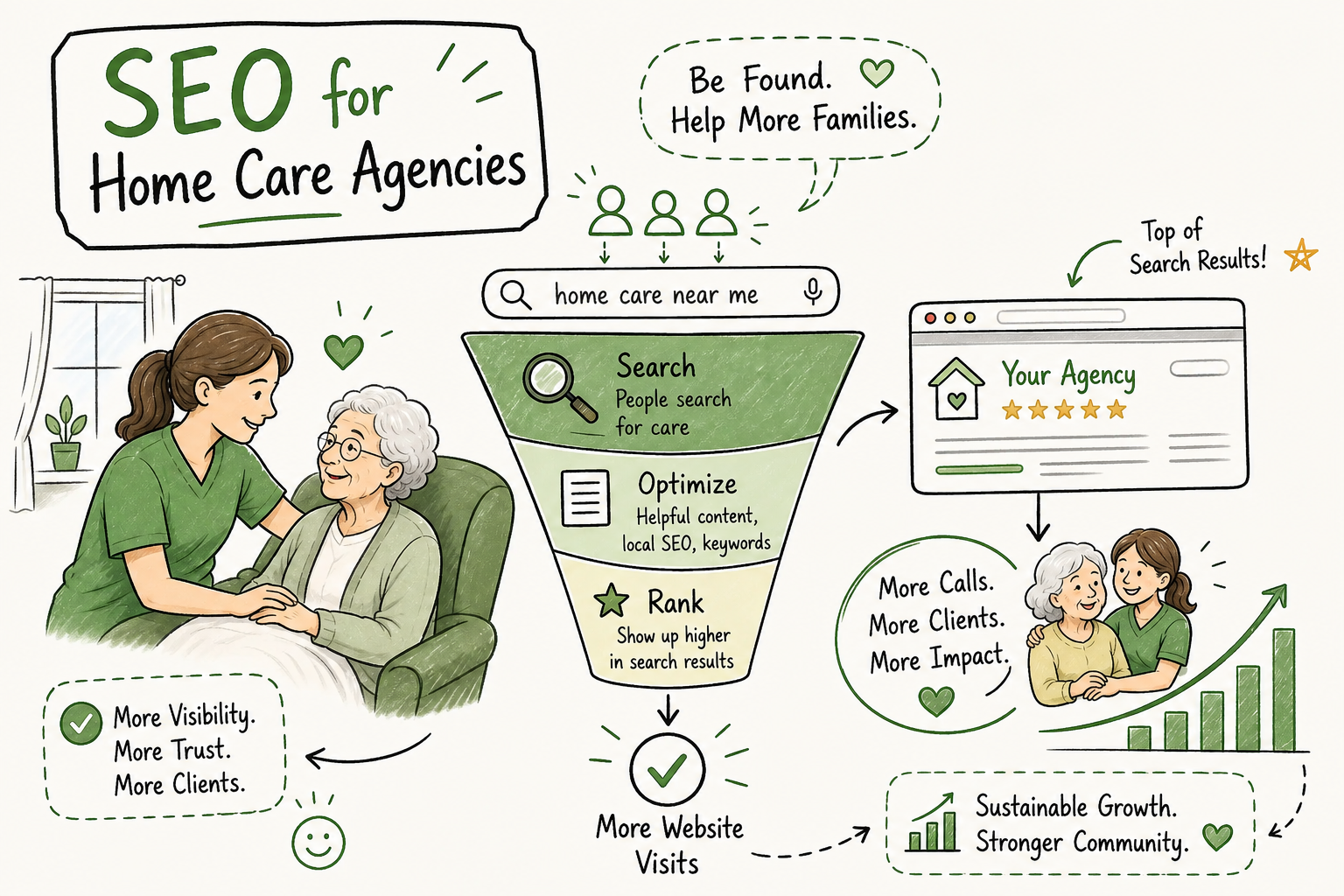
Families looking for home care do not all search the same way.
One person may search “home care near me.” Another may be looking specifically for dementia care, overnight support, help after a hospital discharge, or an agency serving a particular city.
Home care SEO is the process of making sure your agency can be found across those searches, then giving families a clear path from the search result to a qualified care inquiry.
That requires more than adding keywords to a website or setting up a Google Business Profile. A strong SEO strategy connects website structure, service pages, Local SEO, useful content, technical health, relevant authority, and conversion tracking into one system.
If your agency is already investing in search but you are not sure which part of that system is limiting performance, a Home Care Marketing Audit can help identify the biggest gaps before you start making changes.
What Home Care SEO Actually Means
SEO for home care agencies has a straightforward goal: help the right families discover your agency when they are researching care, comparing providers, or trying to arrange services.
The challenge is that those searches happen at different stages of the decision process.
Someone might search for:
- signs an elderly parent needs help at home
- dementia care options
- respite care near me
- 24-hour home care
- private-pay home care in [city]
- home care agency near me
- home care after hospital discharge
- cost of in-home care
- home care services in [city]
Some searches are educational. Others suggest the family may be much closer to contacting an agency.
A strong SEO strategy should account for both.
That means creating the right page for the searcher’s actual need rather than trying to make one homepage rank for every service, city, and question related to home care.
Match Search Intent to the Right Page
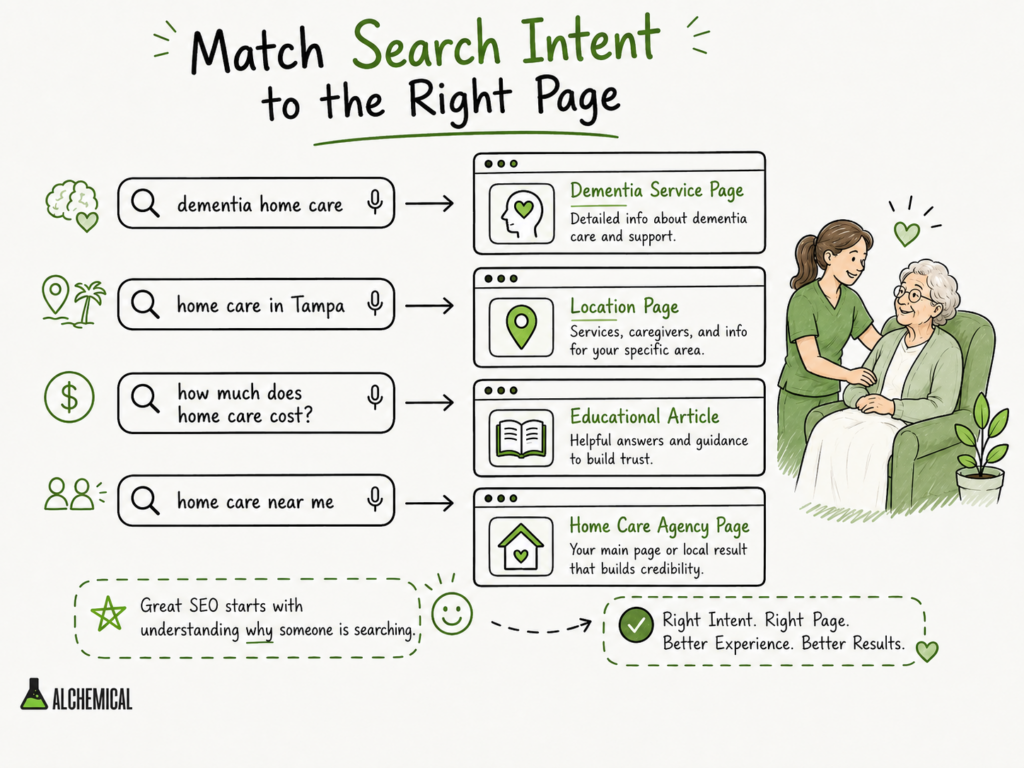
One of the most important SEO decisions is deciding which page should answer which search.
The goal is not to create a separate page for every keyword variation. Closely related searches should usually be grouped according to what the person is actually trying to accomplish.
For example:
- home care agency near me: Homepage or relevant local page
- dementia home care: Dementia care service page
- home care in [city]: Relevant location or service-area page
- overnight home care: Overnight care service page
- how much does home care cost: Educational resource
- signs my parent needs home care: Educational resource
- what happens during a care assessment: Educational resource
Several keywords may belong on the same page.
“Dementia home care,” “dementia care at home,” and “in-home dementia care” may all represent essentially the same underlying need. Creating three thin pages for those variations is usually less useful than building one strong resource that thoroughly answers the family’s questions.
Start with search intent, then decide whether a new URL is actually justified.
Build the Website Around Services Families Search For
Many home care websites rely on one broad services page to explain every type of care the agency provides.
That may be simple from an internal business perspective, but it can make it harder for families to find detailed information about the exact service they need.
A dedicated service page can make sense when:
- the agency genuinely offers the service
- families search for it independently
- the need is meaningfully different from other services
- the agency can provide enough useful information to justify a full page
Depending on the agency, that could include services such as:
- dementia care
- companion care
- personal care
- respite care
- overnight care
- post-hospital support
Each page should answer the questions that matter for that particular type of care.
For example:
- What does the service include?
- Who may benefit from it?
- Where is it available?
- How does the care process begin?
- What should families expect during an assessment?
- What trust information matters for this type of care?
- How can the family speak with someone?
Write the page around the service and the family researching it.
Do not create a new page simply because a keyword tool found another variation of the phrase. That is why SEO and building a home care website that converts should be planned together.
Create a Clear Site and Internal-Link Structure
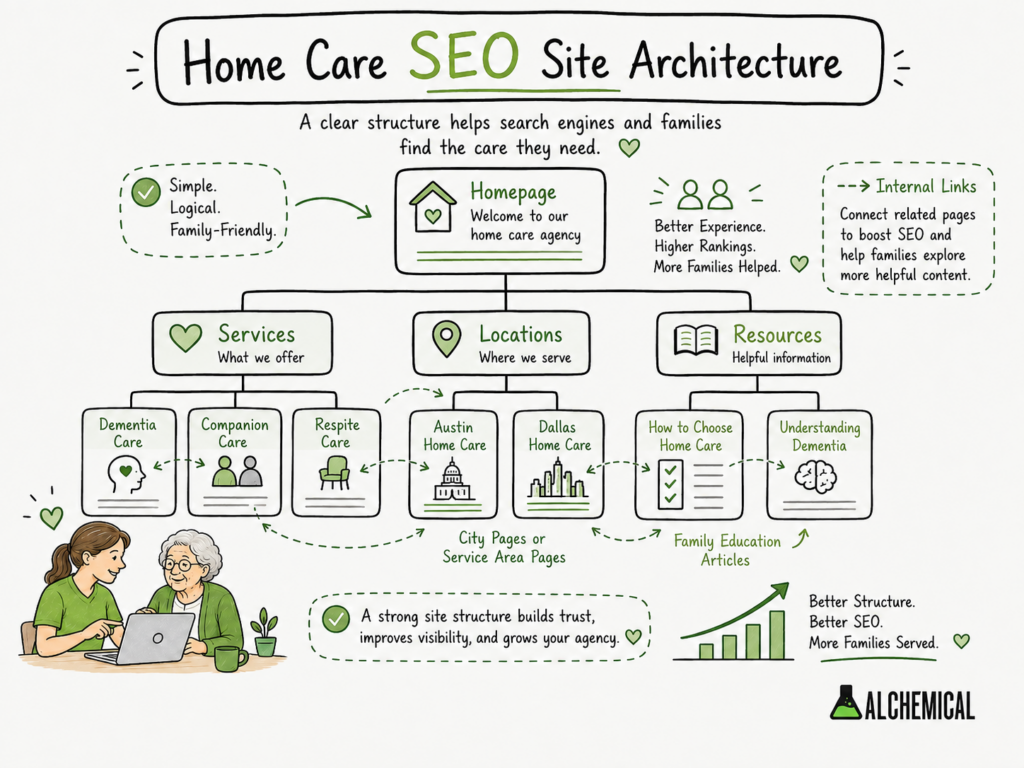
Important pages should be easy for both families and search engines to reach.
A home care website might organize its primary content like this:
Homepage → Services → Individual care-service pages
Homepage → Locations or service areas → Important local pages
Homepage → Resources → Educational content
Those branches should not operate in isolation.
A dementia-care page might link to related care options, relevant educational resources, the locations where dementia support is available, and the next step for requesting care.
Google explains that links help it discover pages and understand relationships between content. It also recommends crawlable links and descriptive anchor text that gives users and Google context about the destination. Google’s link guidance explains those principles in more detail.
The goal is not to link every page to every other page.
Internal links should reflect genuine relationships between topics.
Turn Organic Traffic Into Care Inquiries
Ranking is only the first half of the job.
A family can find the agency through Google and still leave because the website does not make it clear:
- whether the agency serves their location
- whether it provides the care they need
- why they should trust the agency
- how to contact someone
- what happens after they reach out
That is why SEO and building a home care website that converts should be planned together.
Important service and location pages should provide a clear next step.
Depending on the agency, that might be:
- calling the intake team
- requesting a care consultation
- completing a short inquiry form
- beginning the assessment process
Trust information should also appear where families need it rather than being buried several pages away.
That might include relevant reviews, licensing information, caregiver screening practices, professional affiliations, experience serving the community, or a clear explanation of how care begins.
More organic traffic is not automatically better if the website cannot turn that attention into qualified care opportunities.
Use Local SEO to Compete in the Markets You Actually Serve
Local SEO is one part of the broader home care SEO strategy, but it is especially important because most agencies serve defined geographic territories.
Google says local results are primarily determined by relevance, distance, and prominence. Complete and accurate business information can help Google understand the business, while reviews and links can contribute to prominence. You can read Google’s explanation in its local ranking guidance.
For home care agencies, the local foundation can include:
- an accurate Google Business Profile
- appropriate business categories
- accurate hours and contact information
- legitimate service areas
- useful local website content
- genuine customer reviews
- accurate core business information
- relevant local links and mentions
Our Home Care Local SEO guide covers Google Business Profile optimization, service areas, reviews, location pages, listings, local authority, and other local-search considerations in greater depth.
When Location Pages Make Sense
Dedicated location pages can help when an agency genuinely serves a market and has useful information for families in that community.
Serving five cities does not automatically mean the website needs five location pages.
A location page is more useful when it can provide meaningful information such as:
- care services available in the area
- communities or neighborhoods served
- consultation and care-start information
- relevant office or team details
- geographic considerations
- local resources
- common questions from families in that market
Avoid creating dozens of pages that are essentially identical except for the city name.
Google’s spam policies address doorway abuse, including substantially similar pages created for different cities or regions primarily to capture similar searches and funnel visitors elsewhere.
For smaller service territories, one strong service-area hub may be more useful than several weak city pages.
Build Content Around Real Family Questions
A strong home care SEO strategy should include more than commercial service pages.
Families often search for information before they know which provider they want to contact.
Useful educational topics may include:
- When is it time to consider home care?
- What is the difference between home care and home health?
- How much help does my parent need?
- What happens after a hospital discharge?
- What should families look for in a home care agency?
- What is respite care?
- How does dementia home care work?
- How quickly can home care begin?
- What should I ask during a care assessment?
- What does private-pay home care include?
Those articles should support the commercial structure of the website rather than becoming an unrelated collection of blog posts.
For example, an educational article about signs that a parent may need more support can naturally lead someone toward relevant care services.
An article about dementia care options can support the agency’s dementia-care service page.
The content library should help families move from question → understanding → relevant service → inquiry.
Separate Care-Seeker Traffic From Caregiver Traffic
This distinction is especially important in home care.
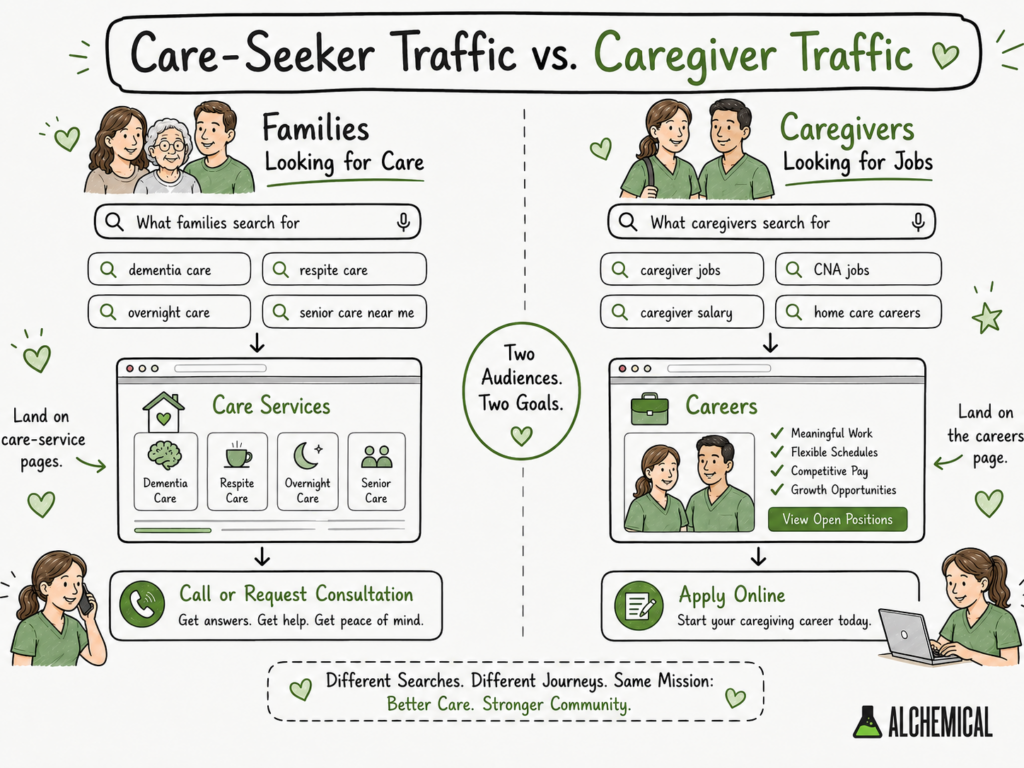
The same website can attract two completely different audiences: families looking for care and caregivers looking for employment.
Both may matter to the organization, but they represent completely different SEO goals.
Caregiver searches can include:
- jobs
- careers
- salaries
- certifications
- CNA training
- applications
- hiring
Care-seeker searches can include:
- dementia care
- companion care
- respite care
- overnight care
- private-pay care
- senior care near me
Those audiences should have separate paths through the website.
A home care agency should not judge SEO success by total organic traffic if a large portion of that traffic consists of job seekers rather than prospective clients.
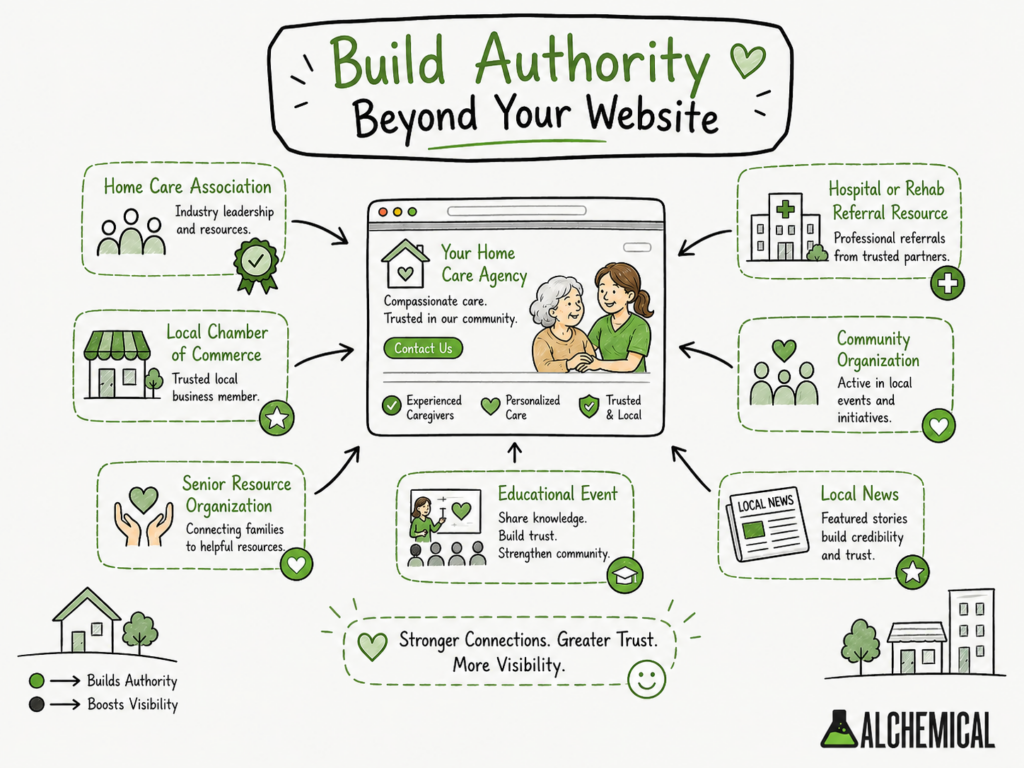
Build Authority Beyond Your Website
Good content and strong website structure matter, but the broader web also plays a role in search visibility.
For a home care agency, relevant links and mentions may come from legitimate relationships such as:
- home care and aging-services associations
- chambers of commerce
- senior-resource organizations
- community partnerships
- caregiver education programs
- local nonprofit relationships
- professional organizations
- useful community resources
- expert commentary
- original research
- local media coverage
The goal should not be collecting as many backlinks as possible.
A relevant link earned because the agency contributed something useful to its industry or community is fundamentally different from buying hundreds of generic links from unrelated websites.
Google’s spam policies prohibit link practices designed primarily to manipulate search rankings.
Build relationships and resources worth mentioning rather than treating backlinks as inventory.
Make Sure Google Can Crawl and Understand the Site
Strong content still needs a technically sound website.
Google’s Search Essentials outline technical requirements, spam policies, and key practices that help make content eligible to appear and perform in Google Search.
For most home care websites, start with the fundamentals:
- important pages can be crawled and indexed
- canonical URLs identify preferred versions of pages
- redirects send users and search engines to the correct destination
- broken internal links are corrected
- important pages are not buried too deeply
- the XML sitemap reflects important indexable content
- the site works well on mobile devices
- HTTPS is implemented correctly
- page titles and headings accurately describe the content
- duplicate or unnecessary URLs are controlled
- Google Search Console is configured
Technical SEO becomes especially important during a redesign or website migration.
Changing URL structures, deleting service pages, removing internal links, or failing to implement redirects can disrupt organic visibility even when the new website looks better.
Use Structured Data Accurately
Structured data can give Google additional machine-readable information about an organization and its pages.
Depending on the website, relevant markup may include Organization, LocalBusiness for genuine locations, Breadcrumb, and Article information. Google’s structured-data documentation explains the types and search features it currently supports.
Schema should represent the real business and visible page content.
A city that an agency serves is not automatically a separate business location, and structured data should not be used to manufacture locations that do not actually exist.
Think of structured data as a way to clarify information, not as a shortcut to rankings.
Measure Qualified Organic Leads, Not Just Rankings
Rankings are useful.
They are not the final business outcome.
A home care SEO program should eventually connect organic search performance to the agency’s intake process.
Useful SEO metrics may include:
- organic clicks
- organic impressions
- priority search queries
- visibility of important service pages
- visibility of important location pages
- calls attributed to organic traffic
- completed care inquiry forms
- qualified care inquiries
- assessments booked
- completed assessments
- client starts
- client acquisition cost
- revenue or weekly care hours associated with organic leads
Google Search Console’s Performance report can show metrics including clicks, impressions, CTR, average position, queries, and pages. Google’s Search Console Performance documentation explains how those metrics are reported.
That is valuable search data, but it should not be the end of the reporting process.
Combine it with tools and systems that can connect marketing activity to:
- calls
- forms
- CRM lead sources
- intake disposition
- assessments
- client starts
The important question is not simply:
How much organic traffic did we get?
It is:
Which searches and pages are producing qualified families who can actually become clients?
How Long Does Home Care SEO Take?
There is no reliable universal timeline.
An agency fixing a serious indexing problem may see changes differently from one trying to improve competitive rankings across several established markets.
Results can depend on factors such as:
- the agency’s current visibility
- website condition
- competition
- physical location
- existing content
- relevant links and mentions
- review profile
- implementation pace
- the difficulty of the searches being targeted
Some changes may be processed relatively quickly. Competitive organic visibility may require sustained work.
Avoid strategies built around a guaranteed ranking by a specific date.
A better approach is to establish a baseline, prioritize the biggest opportunities, implement improvements, and evaluate how search visibility and qualified leads respond.
What Should a Home Care Agency Prioritize First?
An agency starting with a weak SEO foundation should usually focus on the fundamentals before expanding aggressively.
A practical order is:
- Make sure important pages can be crawled and indexed.
- Confirm analytics and lead tracking are working.
- Correct major technical website problems.
- Identify the searches and services with the greatest business value.
- Improve the most important service pages.
- Verify and accurately complete the Google Business Profile.
- Correct meaningful business-information problems.
- Strengthen the most important local or service-area content.
- Build educational content around genuine family search intent.
- Establish a consistent review process.
- Earn relevant links and industry or community mentions.
- Measure which pages and searches produce qualified inquiries.
- Use those results to guide the next round of SEO work.
Do not begin by publishing dozens of pages simply because a keyword tool produced dozens of variations.
Build the foundation first. Expand when a new page serves a real search intent and a real business purpose.
Frequently Asked Questions About Home Care SEO
What Is Home Care SEO?
Home care SEO is the process of improving an agency’s website and search presence so that families can find it through relevant organic searches.
It can include technical SEO, service pages, site architecture, Local SEO, educational content, relevant links, structured data, and conversion tracking.
Is Home Care SEO the Same as Local SEO?
No.
Local SEO is one important part of home care SEO.
Local SEO focuses primarily on geographic searches, Google Business Profile, local visibility, location content, reviews, business information, and local prominence.
A broader home care SEO strategy also includes service-page optimization, informational content, technical SEO, site architecture, internal linking, and organic conversion tracking.
Does Every Home Care Agency Need Location Pages?
No.
A location page makes sense when the agency genuinely serves the market and can provide useful, differentiated information for families there.
A smaller service territory may be better served by one strong service-area page than several nearly identical city pages.
What Should Count as an SEO Conversion for a Home Care Agency?
Start with meaningful care-seeker actions such as:
- qualified phone calls
- completed care inquiry forms
- assessment requests
- booked assessments
Then connect those leads to completed assessments and client starts whenever the intake and CRM systems allow it.
A page view is not the same thing as a qualified care opportunity.
Build an SEO System, Not a Collection of Tactics
Home care SEO works best when website structure, Local SEO, content, technical health, authority, tracking, and intake support one another.
There is rarely one secret ranking tactic responsible for sustainable visibility.
The goal is to build a search presence that makes it easy for Google to understand the agency, easy for families to find the information they need, and easy for qualified prospects to take the next step.
SEO should also fit into the agency’s broader home care marketing strategy. Search visibility only creates value when the agency can turn that demand into qualified care opportunities.
Alchemical Marketing’s Home Care Growth Audit reviews the website, organic visibility, Google Business Profile, content, tracking, lead quality, and competitive search landscape to identify which opportunities deserve attention first.
Start with the foundation, then build from real search and lead data.