
TABLE OF CONTENTS
In years of working hands-on with assisted living owners, Executive Directors, Regional Directors, and Sales Directors, I’ve seen the same frustration repeat: teams drowning in spreadsheets, missed follow-ups, and no clear picture of where leads are stalling. One Owner I advised ran a 48-bed chain where inquiries came in steadily, but move-ins were erratic — sometimes 8 in a quarter, sometimes 3. The root? No centralized assisted living CRM system — everything lived in emails, notes, and calendars. We implemented a structured CRM setup with defined lead stages, automated follow-ups, and weekly visibility. Within five months, qualified leads rose 55%, tour bookings improved 40%, and they stabilized at 11–13 move-ins per quarter, pushing occupancy from 81% to 92%. The real win? They finally knew what was working — and what wasn’t.

As we close out December 2025, the senior living sector remains exceptionally strong. NIC MAP data for Q3 2025 shows assisted living occupancy at 87.2% (up 0.9 percentage points from Q2), overall senior housing at 88.7%, and occupied units nearing 630,000 — a new high driven by record Baby Boomer move-ins. With new supply growth still near historic lows (under 1% annually in many primary markets), operators who can convert inquiries efficiently into move-ins hold a clear advantage. A well-chosen senior living CRM is often the difference between inconsistent results and predictable census growth.
This guide helps operators evaluate and select the right assisted living CRM system — one that supports lead tracking AL, inquiry follow-up, sales automation, and admissions workflows — to drive sustainable occupancy gains.
If you’re still juggling multiple tools or manual processes, schedule a free CRM assessment call — we’ll review your current setup and highlight quick improvements.
Why the Right CRM Matters for Census Growth in 2025
Benchmarks show the stakes clearly. Typical lead-to-tour conversion sits 20–35%, tour-to-move-in at 25–40%, and overall inquiry-to-move-in 10–18%. Without strong pipeline visibility and automation, even solid inquiry volume produces unpredictable revenue.
Common pain points I’ve seen:
- Leads lost between inquiry and qualification
- Delayed or inconsistent follow-up
- No real-time sales tracking
- Disconnected tools (separate CRM, email, calendar)
- Poor reporting on stage drop-offs
In late 2025, with occupancy climbing (assisted living up nearly a full point in Q3) but labor shortages and costs pressuring margins, operators need tools that make every lead count. The right CRM for assisted living centralizes everything, automates routine tasks, and provides weekly insights to fix leaks fast.
Key Features to Look for in a Senior Living CRM
Not every CRM fits senior living operations. Focus on these essentials:
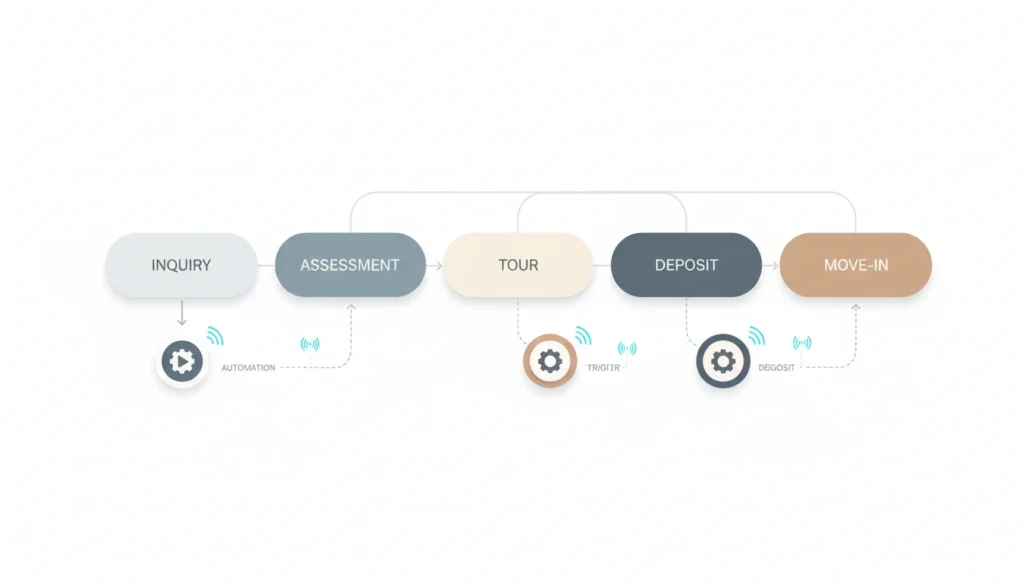
- Customizable Pipeline Stages — Tailored to your flow (Inquiry → Qualified → Engaged → Tour Scheduled → Tour Completed → Proposal → Move-In)
- Automated Inquiry Follow-Up — Multi-channel sequences (SMS, email, calls) triggered by stage changes
- Lead Tracking AL — Scoring/tagging based on engagement, urgency, or occupancy need
- Sales Automation — Task creation, reminders, and alerts to prevent drop-offs
- Admissions Software Integration — Seamless handoff from sales to clinical/resident records
- Simple, Actionable Reporting — Weekly dashboards showing velocity, drop-off points, and source performance
General CRMs (HubSpot, Salesforce) work well when customized; industry-specific ones (Continuum, Enquire/WelcomeHome, Yardi RentCafe Senior CRM) offer built-in senior living workflows.
Top CRM Options for Assisted Living Operators in 2025
Here’s a realistic comparison based on real operator usage and industry feedback:
| CRM / Platform | Best For | Key Strengths | Drawbacks / Cost Notes | Typical Move-In Impact (6–12 months) |
| HubSpot | Flexible, growth-focused operators | Free core CRM + powerful automation & reporting | Requires customization for senior living flows | +20–40% qualified leads |
| Salesforce | Larger chains with complex needs | Highly scalable, deep integrations | Steeper learning curve, higher cost | +30–50% pipeline velocity |
| Yardi RentCafe Senior CRM | Property mgmt integrated | Built-in senior living tools, mobile-friendly | Best with other Yardi suite | +15–35% tour bookings |
| Continuum CRM | Sales & marketing focused | Custom workflows, referral tracking | Stronger on sales than clinical handoff | +25–45% conversion rates |
| Enquire / WelcomeHome | Purpose-built for senior living | Intuitive interface, recommendation engine | May need add-ons for full clinical integration | +30–50% occupancy lift |
| PointClickCare (with CRM add-on) | Clinical + sales combo | Seamless admissions handoff from sales | More EHR-focused, CRM secondary | +20–40% move-in speed |
These reflect late-2025 realities — general platforms like HubSpot excel for customization and affordability, while specialized ones reduce setup time.
Implementation Tips from Real Operators
The best CRM fails without proper rollout. Lessons I’ve learned:
- Start with Stages & Automation — Define 6–8 pipeline stages first, then automate initial follow-up (huge early win)
- Train & Adopt — Weekly 15-min huddles + simple dashboards keep teams using it
- Integrate Gradually — Connect email/SMS first, then add reporting
- Review Weekly — Focus on drop-off points and velocity — adjust monthly
One Sales Director I supported implemented HubSpot with basic automation and saw lead-to-tour jump from 24% to 42% in 90 days — because follow-up became automatic and consistent.

How a Strong CRM Fits into Full Census Growth
A great assisted living CRM system is the central hub of a broader census growth system — connecting lead generation, automated follow-ups, tour optimization, sales process refinement, and reporting.
At Alchemical Marketing, we help operators select, configure, and integrate these tools into full frameworks tailored for assisted living and memory care. In one project, a 50-bed operator moved from fragmented tools to a streamlined CRM + automation setup, adding 14 residents in five months (~$840,000+ annualized revenue). The ED later said the visibility alone was transformative.
See how we approach this on the Alchemical Marketing homepage or explore our complete range of services.
Ready to evaluate your options? Book a free CRM strategy session — we’ll compare what fits your operations best.
Common CRM Mistakes Operators Should Avoid
From experience:
- Choosing based on price alone — cheap often means low adoption
- Skipping customization — generic flows lose senior living context
- No training plan — teams revert to old habits
- Ignoring integrations — disconnected data creates silos
Start small: Pick one pain point (e.g., slow inquiry follow-up) and automate it first.
Your Next Step Toward Better Census Control
With assisted living occupancy at 87.2% and still rising into late 2025 — and demand continuing to outpace limited new supply — operators with strong CRM systems will convert more inquiries into move-ins efficiently.
If your current tools aren’t delivering visibility or consistency, don’t wait. Schedule a complimentary consultation today — we’ll assess your needs and recommend the right path forward.
Here’s to predictable growth and higher occupancy in 2026.
Frequently Asked Questions
What is the best CRM for assisted living operators in late 2025?
It depends on size and needs. HubSpot shines for flexibility and affordability; specialized ones like Continuum or Enquire/WelcomeHome offer built-in senior living workflows. Most operators see strong results with customized general platforms or purpose-built tools.
Do I need a senior living-specific CRM, or can a general one work?
General CRMs (HubSpot, Salesforce) work very well when tailored to your pipeline stages and follow-up sequences. Industry-specific options reduce setup time but may cost more or limit flexibility.
How much can the right CRM increase move-ins?
Operators often see 20–50% improvement in lead-to-tour or tour-to-move-in rates within 4–8 months through better tracking, automation, and visibility — translating to 8–15 extra residents annually for mid-sized communities.
What features are must-haves for assisted living CRM?
Custom pipeline stages, automated multi-channel follow-up, lead scoring, sales task automation, simple reporting dashboards, and integration with email/SMS/calendar tools.
How long does CRM implementation take for senior living?
Basic setup (stages + initial automation) can deliver value in 30–60 days. Full optimization with training and integrations usually takes 3–6 months for steady, measurable census gains.