Web Design in Thousand Oaks: Websites Built to Generate Leads
Your website should do more than look professional. It should help the right people understand your business, trust it, and take the next step.
People searching for web design in Thousand Oaks are usually not looking for a design lesson. They are looking for a company that can make the website work better for the business.
That is the standard we use at Alchemical Marketing. A website should support the way customers actually discover, compare, and choose a business, then make the next step easy to take.
For a Thousand Oaks business, that means thinking beyond colors, fonts, and page layouts. The site has to fit the broader Thousand Oaks digital marketing strategy around search visibility, paid traffic, local discovery, conversion, and measurement.
Our broader web design and development services page covers the build itself; this guide focuses on what a Thousand Oaks website should accomplish for the business.
TABLE OF CONTENTS
Your Website Is Where Marketing Either Converts or Dies
A business can do a lot of things right before someone reaches the website.
Google Ads can put the company in front of a high-intent searcher. SEO can earn visibility for an important service. Google Maps can introduce the business to someone nearby. A referral can send over a warm prospect who already trusts the recommendation.
Then the visitor lands on the site.
If the offer is confusing, the proof is weak, the page is hard to use on a phone, or the next step is buried, the marketing that created the visit can still fail.
A useful way to think about the website is:
Traffic > Understanding > Trust > Action > Measurement
A website is not the finish line of your marketing. It is where your marketing gets tested.
What Should a Small Business Website Actually Accomplish?
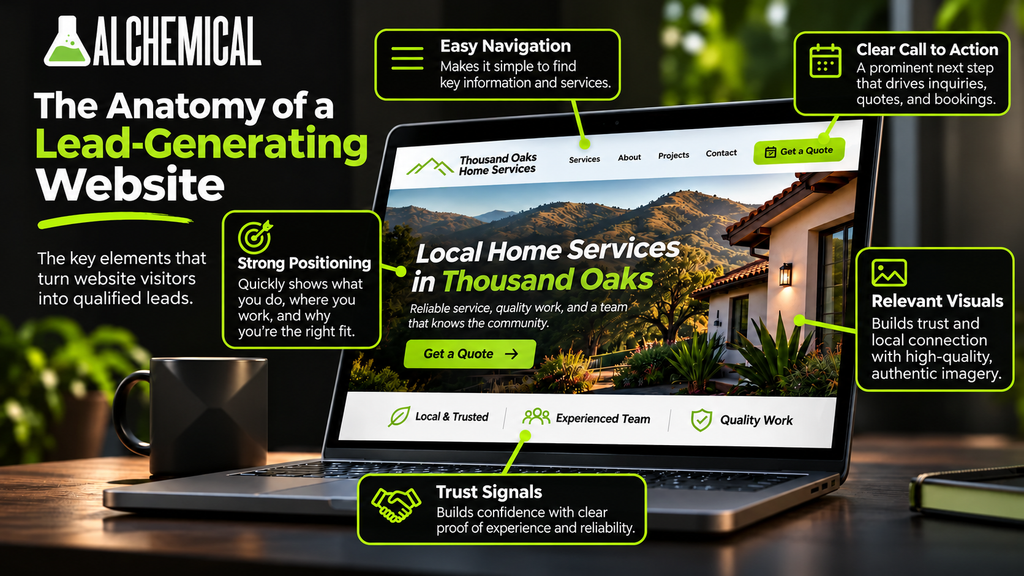
Our national Small Business Website guide goes deeper into the mechanics of building a site that works. At the local service level, the job can be reduced to four outcomes.
Make the Business Easy to Understand
A new visitor should be able to tell what the company does, who it serves, where it works, and what makes the offer relevant without digging through five pages.
That sounds basic, but it is one of the easiest things to lose when a website is designed around internal company language instead of customer questions.
Build Trust Quickly
Customers compare. A strong website gives them reasons to keep considering the business. Reviews, case studies, real project examples, credentials, useful explanations, team information, and specific proof can all help when they are relevant.
Make the Next Step Obvious
The action depends on the business. It might be a phone call, estimate request, consultation, appointment, reservation, store visit, or purchase. The page should make that action clear without turning every section into a giant button.
Make Performance Measurable
If the business cannot tell whether visitors call, submit forms, book appointments, request quotes, or become qualified leads, it becomes difficult to improve the site with confidence.
A beautiful website that does not help people act is still underperforming.
What Does Good Web Design Look Like in Thousand Oaks?
Thousand Oaks is not a market where businesses can assume customers have limited options.
U.S. Census QuickFacts currently reports roughly 122,230 residents, median household income of $135,603, broadband internet subscriptions in 94.1% of households, and a bachelor’s degree or higher among 51.4% of adults age 25 and older.
Those numbers do not prove that every Thousand Oaks customer behaves the same way. They do show a highly connected local market where people have easy access to information and can compare multiple businesses before making contact.
The City of Thousand Oaks describes the area as a robust mid-size business community with a skilled workforce and positions it as a place for both established and startup businesses.
That matters for web design because different local businesses win trust in different ways.
- Professional services often need expertise, specificity, strong proof, and a low-friction consultation path.
- Healthcare and wellness businesses need clear services, reputation signals, mobile usability, and an easy path to contact or book.
- Home-service companies often need urgency, service-area clarity, reviews, phone conversion, and pages built around high-intent services.
- Franchises and multi-location businesses need scalable architecture without turning every location page into a copy-and-paste clone.
A local site should reflect the real business and the real market, not just swap “Thousand Oaks” into a generic agency template.
For broader local-market context, see Business Is Changing in Thousand Oaks: Here’s What Small Businesses Should Be Watching.
What Makes a Website Generate More Leads?
There is no single layout that converts every audience. A dental practice, attorney, contractor, consultant, and restaurant have different customer journeys. The common principle is that the page should reduce uncertainty and make the next useful action easier.
Clear Positioning
The visitor should understand what the business does and why the offer is relevant before they are asked to decode slogans, internal terminology, or a vague brand statement.
Strong Calls to Action
Calls to action should match the stage of the buyer. Someone ready to book may need a direct scheduling path. Someone evaluating a complex service may need a consultation, estimate, case study, or deeper explanation first.
Trust at the Right Moment
Proof works best when it answers the doubt the visitor has at that point in the page. Reviews near a service claim, a case study near a performance promise, or credentials near a high-trust decision can be more useful than stacking every badge in one section.
Relevant Landing Pages
Not every visitor should land on the homepage. Paid campaigns, high-value services, distinct locations, and specialized audiences may deserve pages that match the exact reason the person clicked.
Fast, Friction-Low Experiences
Performance matters because waiting, layout shifts, broken forms, oversized images, and awkward navigation all add friction. Google recommends good Core Web Vitals and evaluates page experience across multiple signals, but the business reason is simpler: the site should not make interested people work unnecessarily hard.
Conversion-focused design is not a button color. It is the entire path between arrival and action.
SEO Should Be Built Into the Website, Not Bolted On Later
Web design and SEO are different disciplines, but the structure of the site can make future search growth easier or much harder.
The website should give search engines and customers a clear understanding of the services, pages, relationships, and locations that matter. That includes crawlable navigation, useful internal links, descriptive headings, sensible page architecture, mobile accessibility, clean redirects during a rebuild, and content that actually answers the searcher’s need.
Google’s Search Essentials emphasize technical eligibility, people-first content, and clear best practices that help pages appear and perform in Search.
A web designer does not need to turn every page into an SEO essay. But the site should make future SEO easier, not force the company to rebuild the architecture six months later.
For the local search side of that work, see our Thousand Oaks SEO strategy.
Your Website Has to Work on Mobile First
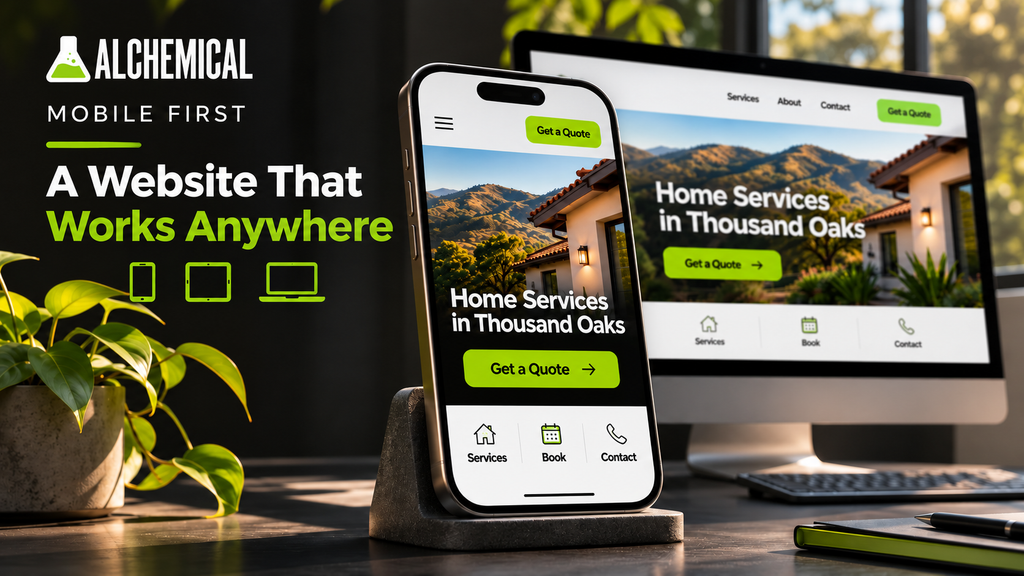
A desktop mockup can look fantastic and still hide the problems customers experience on a phone.
Google uses the mobile version of a site’s content for indexing and ranking and recommends responsive web design because it is the easiest mobile-friendly configuration to implement and maintain.
From a conversion standpoint, mobile design also forces useful discipline.
- Can someone understand the offer without pinching or zooming?
- Can they tap the phone number easily?
- Are forms short enough to finish?
- Does the important proof appear before the visitor gives up?
- Can they navigate the site with one hand?
- Do buttons, menus, and booking tools actually work at common phone sizes?
Responsive design is not a final QA box. It should shape the page from the beginning.
How Do You Know Whether Your Website Is Actually Working?
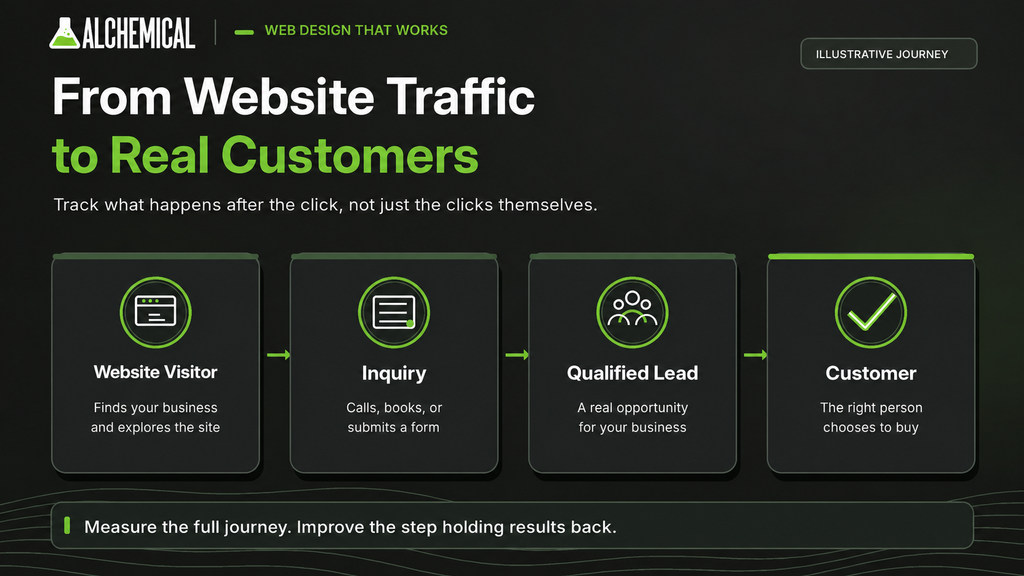
Pageviews are useful context, but they do not tell you whether the website is helping the business.
A better measurement chain looks like this:
- Visibility: Are the right people reaching the site?
- Engagement: Are they reaching the pages and information that matter?
- Conversion: Are they calling, submitting forms, booking, requesting estimates, or buying?
- Lead quality: Are those actions coming from customers the business actually wants?
- Business outcome: Are useful website actions becoming opportunities, customers, and revenue?
Traffic is useful. Revenue is more useful.
The goal is not to force perfect attribution onto every customer journey. It is to build enough measurement that decisions are based on evidence instead of opinions about which page “feels better.”
When Should a Thousand Oaks Business Redesign Its Website?
A redesign makes sense when the existing site is creating a real constraint. Common signs include:
- the business has changed but the website still describes the old offer
- the site is difficult to use on mobile
- pages are slow, unstable, or hard to maintain
- important services are buried or missing
- the company cannot build useful landing pages for campaigns
- forms, calls, or bookings are not tracked properly
- the site structure makes SEO expansion difficult
- the design no longer reflects the quality or positioning of the business
- qualified traffic reaches the site but very little of it takes action
A redesign should solve a business problem. “We are tired of looking at it” may be a reason to refresh the brand, but it is not automatically a reason to rebuild the entire site.
Custom Website vs. Template: Which Does a Small Business Need?
Templates are not automatically bad, and custom design is not automatically better.
A template can be perfectly reasonable when the business is simple, the site is small, functionality is limited, and the website does not carry much strategic complexity.
Custom design becomes more useful when the site has to support several services or markets, complex conversion paths, significant paid traffic, strong SEO requirements, CRM integrations, custom workflows, or a differentiated brand experience.
The right question is not whether a template sounds cheaper or custom sounds more premium. It is whether the approach gives the business enough control to do the job the website is supposed to do.
How Much Does Web Design Cost in Thousand Oaks?
There is no responsible single “Thousand Oaks web design price.” Two local businesses can need completely different projects.
Cost can change based on:
- number and type of pages
- custom design and brand work
- copywriting and content planning
- photography or video
- booking, ecommerce, or custom features
- CRM and third-party integrations
- SEO migration and redirects
- analytics and conversion tracking
- accessibility and performance work
- multiple locations or complex site architecture
- support after launch
When comparing proposals, compare scope, ownership, strategy, and what happens after launch, not just the final number.
Price matters. So does what the website is expected to do for the business.
How Long Does It Take to Build a Business Website?
Alchemical’s current guidance for a standard business website is typically about three to six weeks from kickoff to launch, depending on page count, custom copy or photography, functionality, and the speed of client feedback.
A more complex rebuild can take longer. A smaller project can move faster.
The useful question is not “How quickly can someone make the pages exist?” It is “How quickly can the team complete the strategy, content, design, development, testing, tracking, migration, and launch work without creating problems the business has to fix later?”
How to Choose a Web Design Company in Thousand Oaks
A strong web design company should be able to talk about the business before it talks about software.
Before hiring a partner, ask:
- What business goal will guide the site?
- How will you decide which pages we actually need?
- How do you plan the mobile experience?
- What SEO foundations are included in the build?
- How will calls, forms, bookings, or sales be tracked?
- Who owns the domain, hosting, content, accounts, and website?
- How will you protect existing rankings and links during a redesign?
- How do you test forms and critical customer paths before launch?
- What happens after the site goes live?
A web designer should be able to explain why something is on the page, not just why it looks good.
Web Design Red Flags We Would Take Seriously
Some web-design problems show up before the first mockup.
- No discussion of business goals or customer behavior.
- Design starts before anyone understands the offer.
- The conversation is almost entirely about colors, plugins, or page builders.
- Mobile is treated as a resized desktop version.
- There is no plan for analytics or conversion tracking.
- SEO is something another company can “add later.”
- Website ownership is unclear.
- Every client seems to get the same layout with different photos.
- The agency cannot explain how existing URLs will be handled during a rebuild.
- Launch is treated as the end of the project, with no testing or support plan.
The goal is not to make web development sound mysterious. It is to make sure the decisions behind the site survive scrutiny.
Our Approach to Web Design for Thousand Oaks Businesses
We treat the website as part of the marketing system, not a separate creative project.
1. Understand the Business
We start with the offer, customers, priorities, competition, economics, and what the website needs to accomplish.
2. Understand the Traffic
We look at how people are expected to arrive, including SEO, paid search, Maps, referrals, social, direct traffic, and existing campaigns.
3. Map the Conversion Path
Different visitors may need different next steps. We identify what each important audience should understand and what action makes sense.
4. Build the Website Architecture
Services, locations, landing pages, navigation, internal links, and content hierarchy should support the business now and leave room for growth.
5. Design for Trust and Action
Brand presentation matters, but it has to work alongside proof, usability, mobile design, messaging, and clear calls to action.
6. Measure What Happens
Calls, forms, bookings, purchases, and other valuable actions should be trackable where practical.
7. Improve What the Data Reveals
The website should be able to evolve as the company learns which pages, audiences, offers, and traffic sources produce the best opportunities.
Are You Sure the Website Is the Problem?
Sometimes a business needs a new website. Sometimes it absolutely does not.
A company can have a conversion problem caused by the site. It can also have a demand problem, an offer problem, a traffic-quality problem, weak reviews, slow sales follow-up, bad tracking, or a mismatch between the audience and the service.
Rebuilding the website will not fix a demand problem, a bad offer, or a broken follow-up process.
That is why diagnosis matters. If the current site is structurally sound and a few focused improvements can solve the problem, a full rebuild may not be the best first move.
A trustworthy web design company should be willing to tell you that before asking you to rebuild anything.
Build a Website That Does More Than Look Good
The best website for a Thousand Oaks business is not the one with the most animations, the newest framework, or the biggest design budget.
It is the one that helps the right people find the business, understand the offer, trust the company, take the next step, and gives the business enough data to know what happened.
If you are planning a new site or trying to figure out whether the current one is holding growth back, schedule a Thousand Oaks Website & Digital Visibility Review with Alchemical Marketing.
Frequently Asked Questions
How much does web design cost in Thousand Oaks?
There is no useful single local average because scope varies widely. A simple service-business site is a different project from a multi-location lead-generation site with custom content, integrations, tracking, SEO migration, and booking or ecommerce functionality. Compare the actual scope and ownership model, not just the quoted total.
How long does it take to build a small business website?
A standard Alchemical business website typically takes about three to six weeks from kickoff to launch. More complex sites can take longer, especially when content, integrations, migration, custom functionality, or several stakeholders are involved.
Should SEO be included in a website redesign?
The redesign should at minimum protect SEO fundamentals such as crawlability, page structure, headings, internal links, metadata, mobile usability, redirects, and existing valuable URLs. Ongoing SEO strategy is broader than web design, but the build should not create avoidable search problems.
Is custom web design better than a template?
Not automatically. Templates can work well for simple businesses with limited requirements. Custom design becomes more valuable when the site has complex services, multiple audiences, strong brand requirements, paid-traffic landing pages, integrations, SEO architecture, or conversion paths that a standard template cannot handle cleanly.
Do I own my website after it is built?
You should understand ownership before signing. Alchemical’s model is that clients retain ownership of their domain, hosting, code, content, and performance data.
What platform should a small business website use?
The platform should fit the website’s actual requirements, not the designer’s favorite tool. WordPress, Webflow, Squarespace, ecommerce platforms, and custom development each make sense in different situations. Ownership, maintainability, integrations, performance, and future growth all matter.
How often should a small business redesign its website?
There is no universal redesign schedule. Rebuild when the current site is creating a real business constraint, such as poor mobile usability, weak conversion, outdated positioning, difficult maintenance, limited SEO architecture, or functionality that no longer supports the business.
Can a new website help generate more leads?
Yes, when the website is a meaningful part of the constraint. Clearer positioning, stronger proof, better landing pages, improved mobile usability, faster experiences, and simpler conversion paths can all help. A new website cannot compensate for no demand, the wrong traffic, or an offer customers do not want.
Should I hire a local web design company?
Local familiarity can be useful, but geography alone is not a quality signal. Choose a partner that understands the business, can explain the strategy behind the site, plans for mobile, SEO and measurement, and gives you a clear ownership and support model.
What should I look for in a web design agency?
Look for business strategy before aesthetics, clear conversion thinking, mobile quality, SEO awareness, analytics and tracking, transparent ownership, a defined process, relevant proof, realistic expectations, and the ability to explain why each major design decision exists.
Primary Sources
- U.S. Census Bureau QuickFacts: Thousand Oaks city, California
- City of Thousand Oaks: Doing Business in Thousand Oaks
- Google Search Central: Google Search Essentials
- Google Search Central: Mobile-first Indexing Best Practices
- Google Search Central: Understanding Core Web Vitals and Google Search Results
- Google Search Central: Understanding Page Experience in Google Search Results
- Alchemical Marketing: Web Design FAQ