
TABLE OF CONTENTS
After more than 15 years consulting with assisted living owners, Executive Directors, Regional Directors, and Sales Directors, one truth stands out: most marketing efforts fail because they chase volume instead of velocity. I once worked with a 50-bed independent operator who was spending heavily on broad digital ads to “get more inquiries.” They got volume — 120+ leads monthly — but move-ins stayed flat at 6–8 per quarter. We shifted their entire assisted living marketing strategy to focus on census growth: better lead quality, automated nurturing, targeted B2B outreach, and pipeline discipline. Within seven months, qualified leads dropped to 70–80 per month, but move-ins rose to 12–14 consistently, pushing occupancy from 78% to 91% and adding roughly $900,000 in annualized revenue. The team worked smarter, not harder.

As of December 30, 2025, the senior living fundamentals are exceptionally strong. NIC MAP Vision data from Q3 2025 (the most recent full quarter) shows assisted living occupancy at 87.2% (up 0.9 percentage points from Q2), overall senior housing at 88.7%, and occupied units nearing 630,000 — a record high. Baby Boomer move-ins continue at a pace, while new inventory growth remains near historic lows (under 1% annually in most primary markets). For operators, this means opportunity — but only if your marketing directly serves census growth, not just lead volume.
This guide outlines a proven, B2B-focused assisted living marketing strategy that prioritizes occupancy and revenue results for Executive Directors, Owners/Operators, Regional Directors, and Sales Directors.
If your current marketing feels scattered or produces inconsistent move-ins, schedule a free strategy review call — we’ll audit your approach and highlight the highest-impact changes.
Why Most Assisted Living Marketing Plans Miss the Census Mark
Traditional AL marketing plans often focus on consumer-facing tactics: broad Google Ads, Facebook campaigns, or SEO for “assisted living near me.” These generate inquiries — but many are low-intent, early-stage, or family-driven, leading to high drop-off and wasted effort.

Real operator benchmarks show:
- Average lead-to-tour conversion: 20–35%
- Tour-to-move-in: 25–40%
- Overall inquiry-to-move-in: 10–18%
In late 2025, with occupancy already climbing 17 consecutive quarters, operators who treat marketing as a census engine — not a lead machine — capture the biggest gains. The shift is to operator marketing: targeting decision-makers who control move-ins, with precision B2B tactics that shorten the sales cycle and lift conversion rates.
Core Principles of a Census-Focused Assisted Living Growth Strategy
A strong assisted living growth strategy flips the script: prioritize quality over quantity, velocity over volume, and predictability over hope.
Key principles:
- Target B2B Decision-Makers — Owners, Executive Directors, Sales Directors — not end consumers
- Focus on High-Intent Sources — Professional referrals, targeted search, content for operators
- Automate the Pipeline — Fast, multi-channel nurturing to prevent drop-off
- Measure Census Impact — Track move-ins and occupancy lift, not just clicks or leads
- Iterate Weekly — Use data to refine sources, messaging, and follow-up
This census marketing mindset turns marketing from a cost center into a revenue driver.
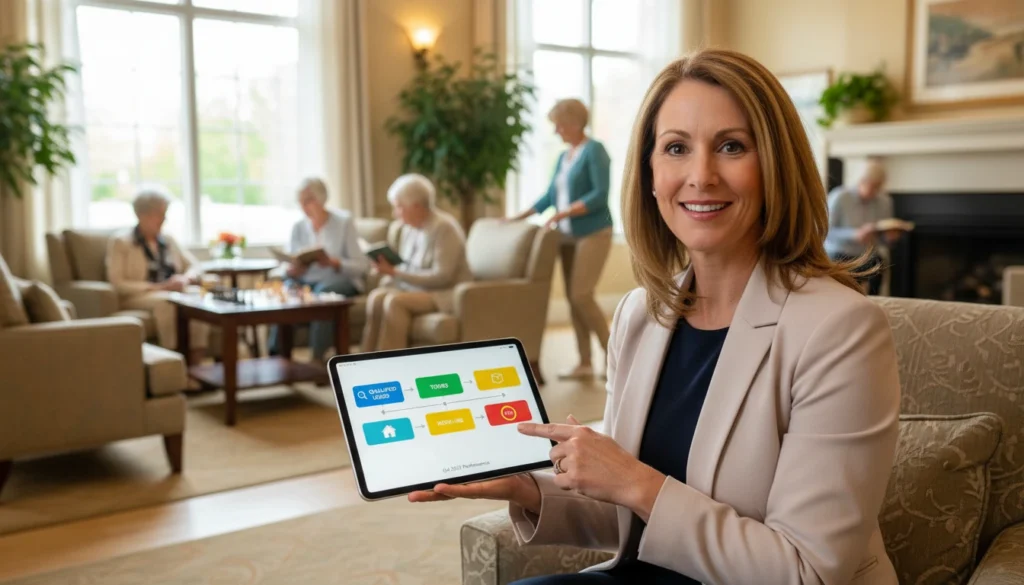
Building Your Operator Marketing Framework
Here’s a practical structure many top-performing operators use in 2025:
Lead Sources (Quality-First)
Professional referrals (hospitals, discharge planners) — highest conversion
Targeted Google Ads (B2B keywords: “assisted living occupancy solutions”)
Content marketing (guides, case studies for operators)
Fast Qualification & Nurturing
Instant response (<5–30 minutes)
Automated multi-channel sequences (SMS + email + video)
Lead scoring based on occupancy need, timeline, and decision-maker role
Pipeline & Conversion Optimization
Clear lead stages in CRM
Personalized tour experiences
Immediate post-tour proposals
Measurement & Refinement
Weekly KPIs: qualified leads, tour bookings, move-ins, occupancy lift
Monthly source audits
This framework consistently delivers 15–25% occupancy gains in 6–12 months.
If you’d like to see how this applies to your specific markets, book a no-obligation consultation.
Quick Comparison: Volume vs. Census-Focused Marketing
| Aspect | Volume-Focused (Traditional) | Census-Focused (Operator Marketing) | Typical Outcome Impact |
| Primary Target | Families/consumers | Owners, EDs, Sales Directors | Higher intent, faster decisions |
| Lead Volume | High (100–200+/month) | Moderate (60–100 qualified) | Lower cost per move-in |
| Lead-to-Tour Conversion | 15–25% | 35–50% | 2x more tours |
| Overall Move-Ins per Quarter | 6–10 (mid-size) | 12–16+ | +50–100% revenue lift |
| Cost Per Move-In | $3,500–$6,000 | $2,000–$3,500 | 30–50% better ROI |
These numbers reflect real operator campaigns and align with strong 2025 demand dynamics.
Execution Tips from Real Senior Living B2B Campaigns
Start small but deliberate:
- Audit Current Sources — Cut low-converting channels, double down on referrals, and targeted search
- Automate First Touches — Instant SMS/email + 7–10 nurture sequence
- Personalize Everything — Reference occupancy challenges for Owners, workflow for Sales Directors
- Review Weekly — Track move-ins and pipeline velocity, not vanity metrics
- Scale Gradually — Add content assets (e.g., “2025 Census Growth Playbook”) once basics are solid
One Regional Director I advised implemented this shift and went from erratic results to steady 14–16 move-ins per quarter — the predictability alone transformed their planning.
For a full census growth system that integrates assisted living marketing strategy with lead gen, automation, CRM, and process optimization, explore our complete range of services.
Ready to build a marketing plan that actually moves occupancy? Secure your strategy session.
Common Pitfalls and How to Avoid Them
From experience:
- Chasing cheap consumer leads — high volume, low conversion
- No B2B targeting — wastes budget on early-stage prospects
- Ignoring data keeps underperforming tactics alive
- Overcomplicating — start with response time and follow-up
Focus on one lever at a time: fix response time this week, add nurture next.
Your Next Step Toward Stronger Census Growth
With assisted living occupancy at 87.2% and still rising into late 2025 — and demand continuing to outpace limited new supply — operators with a deliberate assisted living marketing strategy focused on census growth will capture the largest share of move-ins.
If your marketing isn’t consistently filling beds, don’t wait another quarter. Schedule a complimentary review today — we’ll map your current approach and deliver clear, prioritized next steps.
Here’s to predictable occupancy and stronger revenue in 2026.
Frequently Asked Questions
What makes a good assisted living marketing strategy in late 2025?
One that targets B2B decision-makers, prioritizes lead quality over volume, automates follow-up, and measures success by move-ins and occupancy lift — not just inquiries.
Should operators focus on consumer ads or B2B marketing?
B2B-focused tactics (referrals, targeted search for operators, content for decision-makers) deliver higher conversion and faster census growth. Consumer volume often wastes budget on low-intent leads.
How much can a census-focused marketing plan increase occupancy?
Operators typically see 10–25% lifts in 6–12 months when shifting to quality leads, automation, and pipeline discipline — often adding 8–15 residents annually for mid-sized communities.
What’s the fastest way to improve marketing results?
Cut low-converting sources, automate lead response time (<30 minutes), and implement multi-channel nurturing. Many see 30–50% better tour bookings within 60–90 days.
How do I know if my Assisted Living marketing plan is working?
Track move-ins per quarter, cost per move-in, and occupancy trends not just leads or clicks. Consistent increases in move-ins and occupancy signal a healthy census-focused strategy.