
TABLE OF CONTENTS
I’ve lost count of how many assisted living owners. Executive directors have told me the same thing: “We get leads, but nothing feels predictable, and we need to building predictable assisted living sales pipeline for operators.” One conversation stands out — a Regional Director running three communities in the Midwest was averaging 90–110 inquiries a month. Yet, move-ins fluctuated wildly from 4 to 14 per quarter. After mapping their entire sales pipeline, we discovered that 68% of leads were stalling between the initial inquiry and tour booking due to inconsistent follow-up and unclear stages. We restructured the process with defined lead stages, automated inquiry follow-up, and weekly sales tracking. Within six months, move-ins stabilized at 12–15 per quarter, and occupancy climbed from 79% to 91%. The biggest relief wasn’t the numbers — it was knowing what to expect every month.

As of December 2025, the senior living market continues to favor operators who can create predictability. NIC MAP Vision Q3 2025 data shows assisted living occupancy at 87.2% (up 0.9 percentage points from Q2), overall senior housing at 88.7%, and occupied units approaching 630,000 — the highest since pre-pandemic levels. With Baby Boomer demand still accelerating and new inventory growth remaining under 1% annually in most primary markets, the opportunity is real. But without a structured assisted living sales pipeline, even strong demand turns into inconsistent revenue.
This guide walks Executive Directors, Owners/Operators, Regional Directors, and Sales Directors through building a sales pipeline that delivers repeatable move-ins — not random spikes.
If your pipeline feels more like guesswork than a system, schedule a quick pipeline review call — we’ll look at your current flow and identify the highest-leverage fixes.
Why Most Assisted Living Sales Pipelines Are Unpredictable
Industry benchmarks reveal the problem clearly. Typical lead-to-tour conversion sits between 20–35%, tour-to-move-in between 25–40%, and overall inquiry-to-move-in often lands at 10–18%. That means even decent lead volume produces erratic results.
Common reasons I see across communities:
- No defined lead stages — everything gets lumped as “lead” or “prospect.”
- Manual inquiry follow-up that depends on who has time
- Weak assisted living CRM discipline — notes scattered, tasks forgotten
- No weekly sales tracking — so issues compound unnoticed
- Lack of accountability for each stage owner
In late 2025, with occupancy climbing steadily but labor costs and turnover still pressuring margins, operators can no longer afford a leaky, unpredictable pipeline.
Mapping the Core Stages of a Strong AL Pipeline
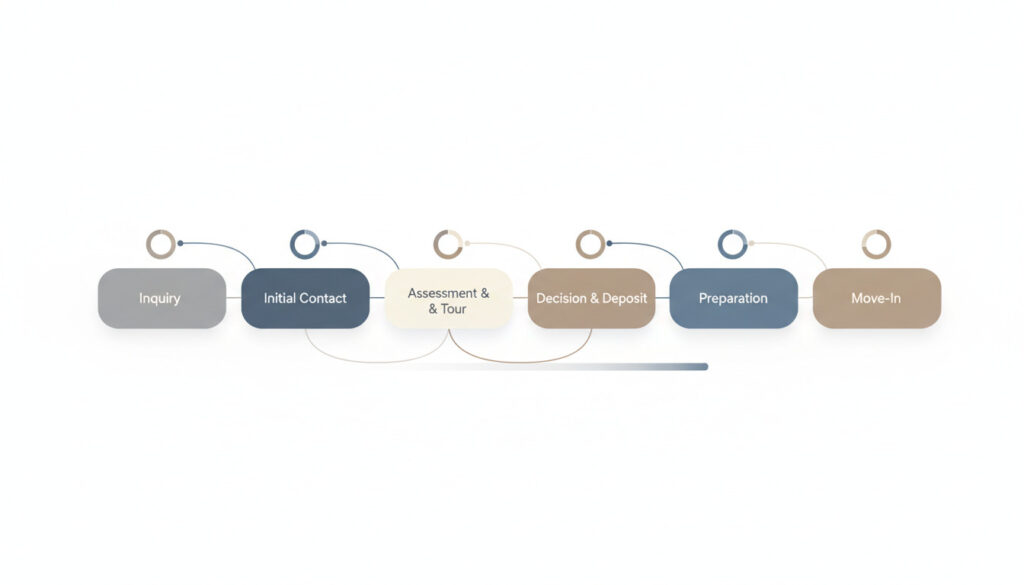
A predictable assisted living sales pipeline has clear, measurable stages. Here’s the structure top performers use:
- New Inquiry — First contact (form, call, referral)
- Qualified Lead — Basic qualification complete (occupancy need, decision-maker role, timeline)
- Engaged Prospect — At least one meaningful interaction (call, video, personalized email)
- Tour Scheduled — Confirmed tour date
- Tour Completed — Post-tour follow-up sent
- Proposal Sent — Customized offer delivered
- Decision / Move-In — Contract signed or move-in date set
Each stage should have:
- Clear exit criteria
- Assigned owner
- Automated triggers (e.g., if no response in 48 hours → re-engagement sequence)
This structure alone reduces lost leads by 30–50% in most communities I’ve worked with.
Choosing and Using Assisted Living CRM the Right Way
A good assisted living CRM is the backbone of pipeline management. The operators I’ve seen get the best results use platforms like HubSpot, Salesforce, or Yardi with these essentials:
- Custom pipeline stages matching the flow above
- Automated task creation (e.g., “Call back in 3 days”)
- Lead scoring or tagging (hot vs. warm based on engagement)
- Integration with SMS/email tools for fast inquiry follow-up
- Simple weekly reporting dashboard
You don’t need the most expensive option — you need one that’s actually used. One Owner I advised switched from spreadsheets to HubSpot with basic automation and saw qualified lead volume double in 90 days because nothing fell through the cracks.
If you’re struggling to get visibility into your pipeline, book a no-obligation consultation — we’ll help you choose and configure the right tools.
Inquiry Follow-Up: The Make-or-Break Moment
Speed and consistency in inquiry follow-up are non-negotiable. Data consistently shows that responding within 5 minutes can lift tour bookings by 40%+ compared to waiting an hour or more.
Effective follow-up sequence:
- Minute 0–5: Instant SMS + email confirmation
- Hour 1: Value-first message (“Here’s a quick guide to boosting occupancy”)
- Day 1: Personalized call or video
- Day 3: Educational email with case study
- Day 7: SMS nudge + calendar link
Automating this multi-channel flow is one of the fastest ways to improve pipeline velocity. One Sales Director I worked with implemented this and moved from 22% to 41% lead-to-tour conversion in three months.

Sales Tracking & Weekly Pipeline Reviews That Actually Drive Results
Sales tracking isn’t about complex dashboards — it’s about answering four questions every week:
- How many leads entered the pipeline?
- How many moved to the next stage?
- Where are the biggest drop-offs?
- Which sources or tactics are outperforming?
Use a simple table like this (real operator example from Q4 2025):
| Stage | This Week | Last Week | Change | Action Needed |
| New Inquiry | 28 | 24 | +17% | — |
| Qualified Lead | 19 | 16 | +19% | — |
| Tour Scheduled | 11 | 7 | +57% | Celebrate & replicate |
| Tour Completed | 9 | 6 | +50% | Improve post-tour follow-up speed |
| Proposal Sent | 6 | 4 | +50% | — |
| Move-In | 3 | 2 | +50% | — |
Weekly 15-minute reviews prevent small leaks from becoming big problems.
For a complete census growth system that ties lead generation, assisted living CRM, automation, inquiry follow-up, tour optimization, and pipeline management together, explore our full range of services.
If you want predictable move-ins instead of monthly surprises, secure your spot for a strategy call.
Integrating the Pipeline Into Daily Operations
The strongest pipelines become part of the rhythm of the community. Daily huddles review yesterday’s inquiries, weekly meetings focus on stage movement, and monthly reviews look at source performance and revenue impact.
At Alchemical Marketing, we help operators build exactly this kind of system — combining precise lead generation, automation, CRM discipline, and sales process refinement to create predictable occupancy growth for assisted living and memory care communities.
In one recent project, a 45-bed chain went from erratic 6–12 move-ins per quarter to steady 14–16, adding roughly $1.1M in annualized revenue. The Executive Director later said the biggest win was “finally knowing what next month would look like.”
You can see more about how we approach this on the Alchemical Marketing homepage.
Ready to build a pipeline you can actually count on? Schedule a free pipeline audit today.
Common Pipeline Mistakes Operators Should Avoid
From experience, here are the traps that keep pipelines unpredictable:
- Treating every inquiry the same — no qualification
- Relying on manual follow-up — too inconsistent
- Skipping weekly reviews — problems grow silently
- Using spreadsheets instead of a real CRM
Start small: Define three clear stages this week, automate initial follow-up, and hold one 15-minute review next Monday. Measure, adjust, repeat.
Final Thoughts: Predictability Is the New Growth
With assisted living occupancy at 87.2% and climbing into late 2025, and demand continuing to outpace new supply, operators who build predictable sales pipelines will capture the largest share of move-ins.
If inconsistent results are holding your community back, don’t wait another quarter. Schedule a complimentary strategy session now — we’ll map your current pipeline and give you clear, prioritized next steps.
Here’s to steady move-ins and stronger occupancy in 2026.
Frequently Asked Questions
What’s a realistic assisted living sales pipeline conversion rate in late 2025?
Overall inquiry-to-move-in typically falls between 10–18%, with top performers reaching 22–30%. The key is consistent movement through defined stages rather than chasing higher volume.
How many stages should an assisted living sales pipeline have?
Most effective pipelines use 6–8 clear stages (Inquiry → Qualified → Engaged → Tour Scheduled → Tour Completed → Proposal → Move-In). Fewer stages lose visibility; more create unnecessary complexity.
Do I need an expensive CRM to manage the pipeline effectively?
Not at all. HubSpot, Salesforce, or even Yardi with basic automation can work well. The real difference comes from consistent usage, defined stages, and automated follow-up — not the price tag.
How often should we review the sales pipeline?
Weekly 15–20 minute meetings are ideal. Daily quick checks on new inquiries prevent early drop-off; monthly reviews look at source performance and revenue impact.
How much revenue can a more predictable pipeline add?
For a 50-bed community at $6,000/month average rate, moving from erratic 8–12 move-ins per quarter to steady 14–16 can add $400,000–$800,000+ in annualized revenue. Predictability also reduces stress and turnover.