
TABLE OF CONTENTS
Google Ads can work very well for home care agencies. It can also burn through a budget fast when the account is paying for the wrong searches, targeting the wrong people, or optimizing toward weak conversion signals.
You can achieve this by fixing five areas:
- Search intent
- Negative keywords
- Geographic targeting
- Conversion tracking
- Landing page fit.
If you are not sure which of those areas is actually causing the problem, a Home Care Marketing Audit can help identify where performance is breaking down.
Spending more will not fix your problems. A bigger budget poured into a messy campaign usually creates a bigger mess.
Where Home Care Google Ads Waste Usually Starts
Most waste does not come from one giant mistake. It comes from small leaks happening at the same time.
A campaign may be paying for caregiver job searches, reaching people outside the service area, or counting weak actions as conversions. Then the traffic lands on a generic homepage that was never built to convert paid search visitors.
Find those leaks before increasing spend.
If the account needs more than a cleanup, our Google Ads for Home Care Agencies setup guide covers the full campaign structure, including targeting, keywords, landing pages, bidding, and conversion tracking.
Match Types: Start With Control
Broad match is not automatically bad. Google recommends pairing broad match with conversion-based Smart Bidding because it can use more signals to match searches.
But that does not mean every home care account should launch wide open.
A local account with weak tracking, little conversion history, and no negative keyword strategy often benefits from tighter control first. Phrase and exact match make search-term reviews easier while the account builds clean data.
Once lead tracking is reliable, broad match becomes something to test, not something to fear.
Also review Search Partner traffic separately. Keep it when it produces qualified inquiries at an acceptable cost. Reconsider it when it consistently does not.
Negative Keywords: Stop Paying for Searches You Never Wanted

Home care has a built-in search-intent problem. The same words can attract families looking for care and people looking for work.
Queries such as caregiver jobs, CNA training, caregiver salary, home health aide certification, and caregiver resume are usually obvious exclusions.
Google’s search terms report shows the actual searches that triggered your ads and helps identify terms that should be added as negatives.
Be more careful with adjacent care terms. Someone searching “assisted living vs home care” may still be comparing options for a parent. A family searching “hospice and home care” may need supplemental private-pay support.
Before blocking a term, ask: could a legitimate prospective family reasonably search this?
Review search terms frequently during launch. Weekly is a practical starting point. The goal is not to build the world’s longest negative list. It is to stop paying for the same bad intent over and over.
Geographic Targeting Has a Home Care Catch

Targeting should reflect the places your caregivers can actually serve. But the person searching may not live near the person who needs care.
An adult daughter in Chicago may be looking for home care for her father in Tampa. A son in California may be comparing agencies for his mother in New Jersey.
Google’s default location targeting can include people who are in a location or who have shown interest in it. A more restrictive Presence setting focuses on people in or regularly in the targeted area.
For home care, switching to Presence blindly can exclude legitimate decision-makers. This remote-family dynamic is also reflected in Alchemical’s current home care PPC guidance.
Use qualified lead data to decide. Combine location settings with city-specific keywords, service-area exclusions, and clear geographic language in your ads.
Ad scheduling should follow the same logic. Families do not only search during office hours. Run ads when your intake process can respond quickly, then use your own lead data to tighten the schedule.
Conversion Tracking: Teach Google What a Good Lead Looks Like
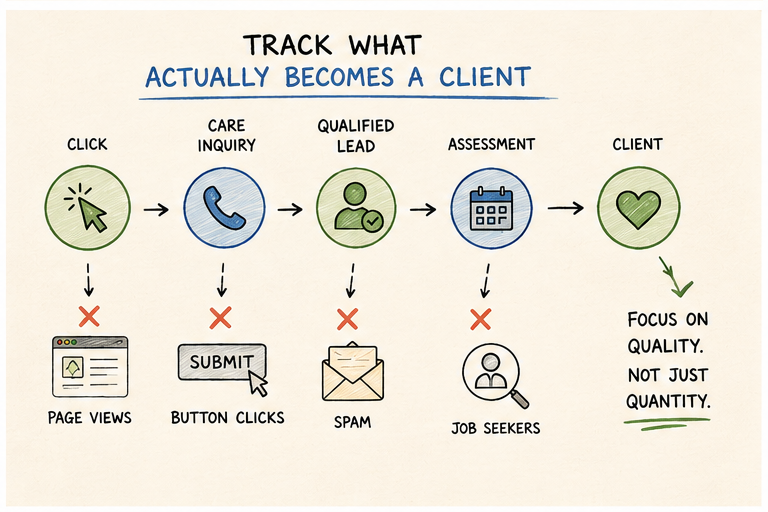
A click on a phone number is not necessarily a qualified inquiry. A form-button click is not the same as a completed form. A page view is definitely not a new client.
Google Ads lets advertisers separate primary conversion actions used for bidding from secondary actions used mainly for observation.
For home care, useful signals usually include completed inquiry forms, meaningful phone calls, scheduled assessments, and eventually qualified leads or new clients.
For calls, Google allows you to set a minimum duration before the call counts as a conversion. There is no universal number that works for every agency. Compare call duration with actual call quality and choose a threshold that reflects real conversations.
The bigger opportunity is sending lead quality back into Google. Enhanced conversions for leads can help connect the original ad interaction with later CRM outcomes.
That matters because two form fills are not equal. One may be a caregiver looking for a job. Another may be a private-pay family inside your service area that books an assessment.
The closer your tracking gets to qualified inquiries and real clients, the better your optimization decisions become.
Your Landing Page Can Make Good Traffic Look Bad
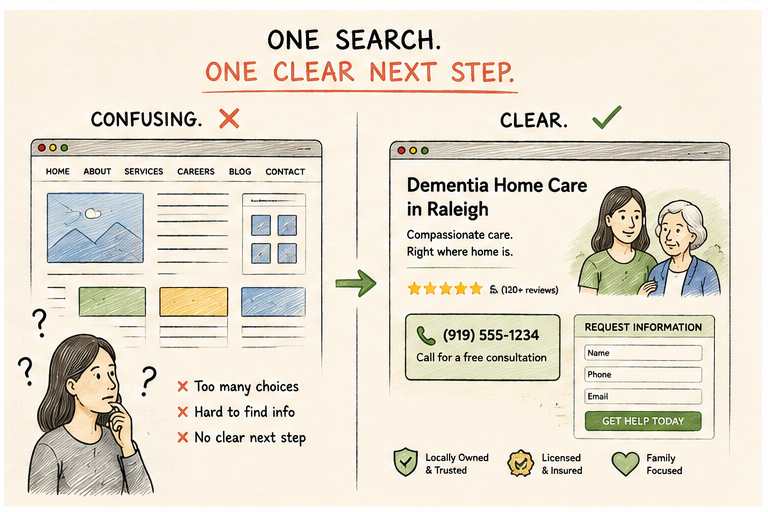
Sometimes the campaign sends the right person to the website and the website loses them.
Imagine someone searching “dementia home care in Raleigh.” If the ad sends that person to a generic homepage covering every service, recruiting, and company history, they have to work to figure out whether the agency can help.
A focused landing page should continue the conversation that started with the search.
If the search is for dementia care, make dementia care obvious. If it is for 24-hour care, quickly explain the service, where it is available, why the agency can be trusted, and how to speak with someone.
Keep the next step simple. A clear phone number, short inquiry form, relevant reviews, service-area information, and mobile-friendly layout matter more than adding more copy.
For a deeper look at what happens after the click, our guide to building a home care website that converts covers trust signals, mobile experience, calls to action, forms, and the path from website visitor to qualified care inquiry.
Measure Waste With Business Metrics
Clicks and conversion rates can help diagnose a campaign, but they do not tell the whole story.
For home care, pay close attention to:
• Cost per qualified care inquiry
• Qualified inquiry to assessment rate
• Client acquisition cost
• Search-term quality
• Conversion quality
A $20 click that becomes a profitable private-pay client can be a great investment. A $4 click from someone looking for a caregiver job is still wasted money.
The Right Order for Cleaning Up the Account
If the account is underperforming, fix it in this order:
- Fix conversion tracking.
- Review search terms and negative keywords.
- Review geography, networks, and scheduling.
- Align ads with landing pages.
- Test broader reach after the foundation is clean.
A strong home care marketing audit should look beyond surface metrics. It should connect Google Ads, landing pages, local visibility, lead quality, and the path from inquiry to client.
Stop Paying Google to Teach You the Same Lesson Twice
Some wasted spend is unavoidable. Paid search is a live marketplace, and every campaign needs room to learn.
The expensive mistake is continuing to pay for problems you already know how to fix.
If job searches keep appearing, block them. If the wrong locations keep producing clicks, tighten the targeting. If your conversions are mostly weak actions, fix the tracking. If good traffic reaches the wrong page, fix the page.
The goal is not a perfect Google Ads account. It is a cleaner system that gives qualified families a clear path to your agency.
That is the same approach we use across our home care marketing work. If you want to see where your current account is leaking budget, schedule a free Home Care Growth Audit and we will review the biggest opportunities first.
Frequently Asked Questions
Should home care agencies use broad match keywords?
Broad match can work well when conversion tracking is accurate and Google has useful conversion data. Newer accounts may benefit from tighter phrase and exact match targeting first, then testing broad match as the account develops.
How often should a home care agency review search terms?
Weekly is a practical starting point for a new or actively changing campaign. More established accounts can adjust the frequency based on search volume and how often new irrelevant queries appear.
Should home care agencies turn off Google Search Partners?
Not automatically. Review Search Partner traffic separately and judge it by qualified lead quality and cost. Keep it when it works. Reconsider it when it consistently does not.
What should count as a Google Ads conversion for a home care agency?
Prioritize completed care inquiry forms, meaningful phone calls, scheduled assessments, qualified leads, and eventually new clients. Avoid treating page views, button clicks, and other weak actions as equal to genuine care inquiries.