TABLE OF CONTENTS
Small businesses have no shortage of ways to spend money on marketing.
Google Ads, SEO, Local SEO, social media, email, websites, content, AI tools, and dozens of other channels all compete for the same budget. The hard part is not finding another thing you could be doing.
It is figuring out which problem actually needs solving first.
Most small businesses do not need every digital marketing service at the same time. A company struggling to get found has a different problem from one getting plenty of traffic but very few leads. A local service business may need a different mix than a company selling nationally.
If you are working with a digital marketing agency for a small business, that is one of the first things the agency should help you figure out.
This guide breaks down Google Ads, SEO and AEO, Local SEO, Local Services Ads, website development, landing pages, conversion optimization, and AI chatbots based on the problem each service is actually supposed to solve.
Because the goal is not to do more marketing.
It is to figure out what deserves your attention next.
What Digital Marketing Services Does a Small Business Actually Need?
Most small businesses need a combination of services that helps them get discovered, capture demand, turn traffic into leads, and understand what is producing results.
The right combination depends on where the current bottleneck is.
These services overlap, but they are not interchangeable.
SEO cannot fix a sales team that never calls leads back.
Google Ads cannot fix an offer nobody wants.
A beautiful new website will not matter much if nobody ever visits it.
The better starting question is:
What is currently preventing the business from getting more of the right customers?
Once you can answer that, the marketing conversation gets much easier.
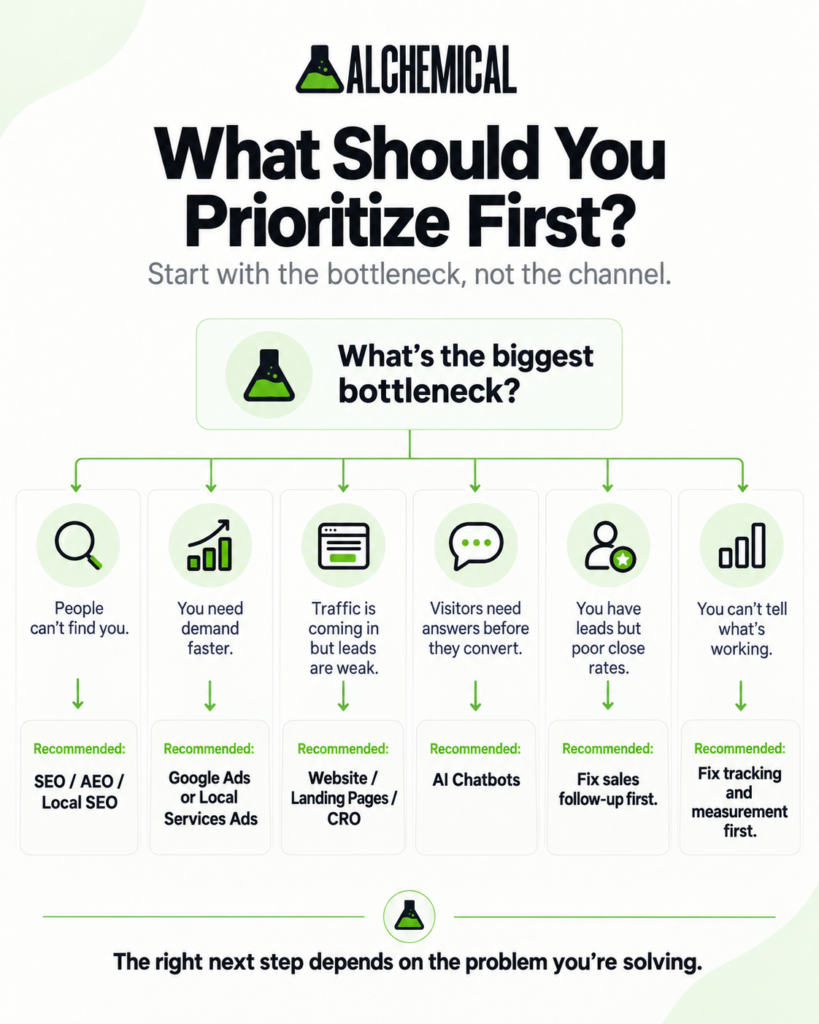
Start With the Bottleneck, Not the Marketing Channel
Marketing channels are tools.
The business problem should determine which tool gets used.
That sounds obvious, but it is surprisingly easy to do the reverse. A company hears that SEO is important, competitors start running ads, somebody recommends TikTok, or a salesperson pitches an AI product. Before long, the marketing plan becomes a collection of disconnected activities.
A better approach is to identify where the customer journey is breaking down.
People cannot find you
If potential customers are actively looking for what you sell but your business is barely visible, you have a discovery problem.
Depending on the business, the first places to investigate may include:
- SEO and AEO
- Local SEO
- Google Ads
- Local Services Ads
The right choice depends on search behavior, geography, competition, economics, and how quickly the business needs results.
People can find you, but you need more opportunities now
Organic visibility can be extremely valuable, but not every business wants to wait for more of it to develop.
If meaningful search demand already exists, paid search can give a business another way to compete for those customers.
That does not automatically make paid advertising profitable.
The cost of reaching a prospect still has to make sense relative to lead quality, conversion rates, customer value, margins, and the sales process.
People visit, but they do not convert
This is where businesses often make an expensive mistake.
Traffic is weak, so they buy more traffic.
But sometimes traffic is not the real problem.
If people are already reaching the website and very few take the next step, the website, landing page, messaging, offer, or conversion path may deserve attention before the acquisition budget increases.
Sending twice as many people into a weak conversion experience does not fix the experience. It can simply make the weakness more expensive.
Leads arrive, but too many disappear
Sometimes marketing is doing its job.
The leads are there.
The problem starts afterward.
Prospects may wait too long for an answer, leave without finding basic information, submit an inquiry after hours, or fall into a follow-up process that nobody owns.
Technology such as AI chatbots can help in some of these situations.
However, if leads are being generated and your team consistently fails to contact or close them, another marketing channel may not be the highest priority.
That is a sales or operational problem first.
Google Ads: Capture Existing Demand Now
Google Ads can be a strong fit when people are already searching for a product or service and a business wants to compete for that demand immediately.
Unlike a channel that primarily tries to create awareness, search advertising can place a business in front of people whose searches already suggest interest in a relevant solution. Google Ads uses keywords and other signals to connect Search campaigns with relevant queries.
That makes PPC especially interesting for businesses with clear commercial search demand.
When Google Ads makes sense
Paid search may deserve priority when:
- people already search for the service or product
- the business wants to generate opportunities faster
- customer value can support paid acquisition
- the website or landing page can convert traffic
- conversions can be tracked
- the business can follow up with leads effectively
The existence of search volume alone is not enough.
A $100 lead could be excellent for one company and completely unworkable for another.
The economics depend on what happens after the click.
What actually determines whether PPC works?
Clicks are the beginning of the process, not the goal.
A healthy Google Ads program also depends on:
- which searches trigger the ads
- what those searchers actually intend to do
- how well the ad matches that intent
- how competitive the auction is
- where the visitor lands
- whether the offer makes sense
- whether conversion tracking works
- whether leads are qualified
- whether the business follows up effectively
That is why optimizing paid search around clicks alone is dangerous.
If an agency can tell you click-through rate improved but cannot tell you whether the campaign is producing meaningful opportunities, you still do not have enough information to make a good budget decision.
When Google Ads may not be the answer
Paid search may deserve less priority when:
- very few people search for the product or category
- the business has not validated the offer
- margins cannot realistically support acquisition costs
- the website is a major conversion problem
- tracking is unreliable
- the company cannot handle additional demand
Sometimes the best PPC recommendation is to fix something else before increasing PPC spend.
Is Google Ads worth it for a small business?
It can be.
Google Ads is most attractive when high-intent demand already exists and the economics of acquiring those customers make sense.
It is not automatically worthwhile simply because Google can generate traffic.
The question is whether the business can turn that traffic into enough qualified opportunities and customers to justify the investment.
SEO and AEO: Build Visibility in Search and AI
SEO and AEO help businesses become easier to discover, understand, and trust across traditional search and increasingly AI-powered search experiences.
The important part is not treating those as two completely disconnected disciplines.
SEO helps search engines crawl, understand, evaluate, and surface useful pages.
AEO focuses more heavily on making information clear enough for answer-driven and generative systems to understand, retrieve, summarize, and potentially cite.
There is substantial overlap.
In fact, Google now explicitly says its established SEO best practices remain foundational for visibility in generative AI features such as AI Overviews and AI Mode. Google also recommends useful, unique, non-commodity content rather than supposed AEO or GEO tricks.
So if somebody tells you traditional SEO is dead and offers a collection of secret AEO hacks instead, skepticism is reasonable.
What SEO actually includes
SEO can involve:
- technical website health
- crawlability and indexation
- keyword and search-intent research
- service and product pages
- useful informational content
- internal linking
- website architecture
- on-page optimization
- local relevance
- authority and backlinks
- page experience
- measurement through tools such as Google Search Console
The exact mix depends on what is preventing the site from earning more useful organic visibility.
What AEO changes
AI search puts even more emphasis on something good SEO should already care about:
Can a system quickly understand what this page knows and why it is useful?
That tends to reward content with:
- direct answers
- clear definitions
- logical headings
- useful comparison tables
- specific examples
- original expertise
- credible supporting evidence
- clear business and entity information
- information that adds something beyond a generic summary
Google’s current guidance specifically encourages valuable, unique content and warns against chasing artificial AEO and GEO shortcuts.
That is good advice for humans too.
When SEO and AEO deserve priority
Search visibility may deserve attention when:
- potential customers already search for what you sell
- competitors consistently outrank you
- important service or product pages have little visibility
- customers research heavily before buying
- informational searches influence the buying journey
- organic acquisition could create meaningful long-term value
SEO is particularly useful when people are already asking questions or searching for solutions that your business is qualified to answer.
For a deeper look at how organic search works specifically for smaller companies, our guide to small business SEO explains how to prioritize search demand, technical SEO, content, authority, Local SEO, and AI search.
When SEO may not be first
SEO does not automatically deserve the first dollar in every marketing budget.
Another priority may come first when:
- the business needs demand immediately
- almost nobody searches for the category
- the offer itself is not working
- the website cannot support the business
- leads are already plentiful but sales follow-up is broken
Good marketing strategy is partly knowing what to do.
It is also knowing what does not need to happen yet.
Local SEO: Win Visibility Where Your Customers Actually Are
Local SEO helps a business compete when the location of the customer or provider matters to the search.
Think about searches such as:
- plumber near me
- home care agency in Dallas
- divorce attorney Chicago
- dentist nearby
- commercial cleaning company Atlanta
In these situations, ranking for the service is only part of the problem.
The business also needs to establish relevance to the market being searched.
Google says its local results are mainly influenced by relevance, distance, and prominence. It also uses information from Business Profiles, websites, reviews, links, and other sources to understand and surface local businesses.
What Local SEO includes
Depending on the company, Local SEO may involve:
- Google Business Profile optimization
- accurate business information
- review generation and management
- service pages
- legitimate location pages
- localized website content
- local citations
- locally relevant backlinks and mentions
- technical SEO
- structured data where appropriate
- local search tracking
The important word there is legitimate.
Creating dozens of nearly identical city pages with a different location pasted into each one is not the same thing as building useful local content.
Who should prioritize Local SEO?
Local SEO matters most when customers make decisions partly based on geography.
That can include:
- home services
- healthcare practices
- senior care providers
- professional services
- local retailers
- restaurants
- cleaning companies
- multi-location businesses
- other service-area businesses
An ecommerce company selling nationally may have very different priorities.
Local SEO vs. regular SEO
The two disciplines overlap heavily.
A useful distinction is:
SEO asks: Can people find us when they search for this service, product, or topic?
Local SEO also asks: Can the right people find us in the markets where we actually operate?
A strong local strategy usually needs both a healthy website and an accurate local presence. Optimizing a Google Business Profile while ignoring the website is rarely a complete strategy.
Local Services Ads: Reach High-Intent Local Customers
Local Services Ads are another way eligible local businesses can compete for people searching for specific services.
Unlike a standard Search campaign where the click often sends someone to a website, Google’s Local Services experience has historically been designed around generating direct inquiries such as calls and messages.
Eligibility and screening vary by business type and location. Google may require verification steps such as license, insurance, or background checks depending on the category and market.
There is also an important current wrinkle.
Google is transitioning parts of its Local Services advertising experience into Performance Max campaigns with pay-per-lead goals. Eligibility and migration timing vary by category and geography, so businesses should verify Google’s current setup rather than assuming an older LSA playbook still applies exactly as written.
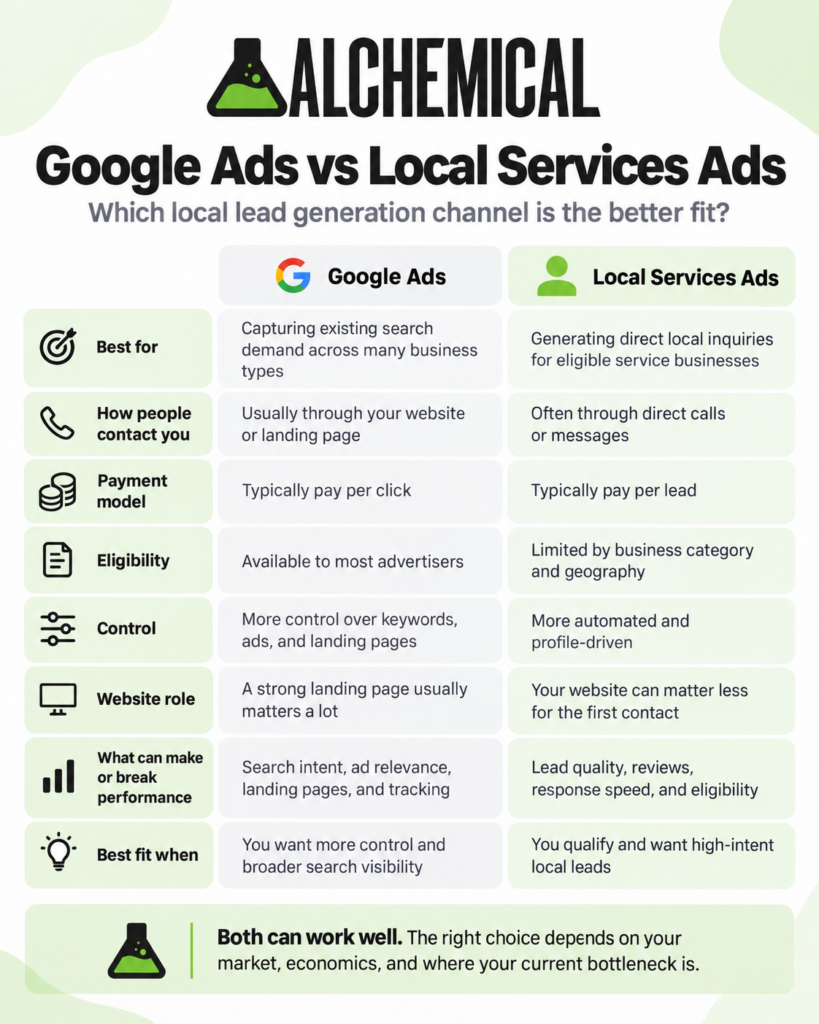
Google Ads vs. Local Services Ads
They may compete for some of the same customer demand, but they are not identical.
When Local Services Ads deserve attention
They may be worth investigating when:
- your business operates in an eligible category
- customers search locally for your service
- individual leads can be valuable
- your reputation and reviews are competitive
- someone can respond quickly to new inquiries
- customer economics support paid lead generation
Why paying for a lead does not guarantee a good lead
This distinction matters.
A lead is not automatically a qualified prospect.
And a qualified prospect is not automatically a customer.
A campaign can generate plenty of inquiries and still perform poorly if:
- leads are outside the service area
- prospects want the wrong service
- price expectations do not match
- response times are slow
- the sales process is weak
- the cost per acquired customer does not make sense
Local Services Ads should be judged based on business outcomes, not simply because the billing model uses the word “lead.”
Website Development, Landing Pages, and Conversion Optimization
Web design and development solve a different problem from traffic acquisition.
They determine what happens after somebody arrives.
A website can look polished and still perform poorly.
Likewise, an older or less flashy website can sometimes perform well because the message is clear, the visitor trusts the company, and the next step is obvious.
The real question is not:
Does the website look modern?
It is:
Does the website help the right visitor confidently take the next step?
When you may need a new website
A full rebuild can make sense when the existing site has fundamental problems such as:
- poor mobile usability
- slow or unreliable performance
- confusing architecture
- outdated positioning
- weak technical foundations
- an editing system nobody can reasonably manage
- pages that cannot support SEO
- a conversion path that cannot be improved without major structural changes
A new website is a significant project.
It should solve significant problems.
Redesigning a site because somebody is tired of looking at it is not always a sufficient business case.
When you need landing pages
A landing page gives a specific audience or campaign a more focused experience.
That can be especially useful for:
- Google Ads campaigns
- individual services
- specific offers
- distinct customer segments
- geographic campaigns
- lead-generation initiatives
Imagine someone searches for emergency water damage restoration.
They click an ad and land on a homepage talking equally about fire damage, mold, remodeling, company history, community involvement, and six other services.
The information may all be useful somewhere on the site.
It is probably not all equally useful to that visitor in that moment.
A strong landing page reduces that mismatch.
When conversion rate optimization deserves priority
Conversion rate optimization, or CRO, becomes particularly important when traffic already exists but too few visitors become leads or customers.
Potential problems include:
- unclear messaging
- weak calls to action
- complicated forms
- poor mobile experiences
- confusing page structure
- weak offers
- missing trust signals
- slow pages
- poor message match between an ad and the page
- unclear next steps
The answer is not always a complete redesign.
Sometimes the highest-value improvements are much smaller.
Do I need a new website before doing SEO or Google Ads?
Not necessarily.
If the existing website has a strong foundation, SEO improvements may be possible without rebuilding it.
Paid campaigns may also use dedicated landing pages instead of waiting for an entire site redesign.
On the other hand, if the site creates serious technical or conversion problems, dealing with those issues early may make every traffic channel more effective.
The decision depends on the severity of the bottleneck.
AI Chatbots: Turn More Website Visits Into Real Conversations
AI chatbots can help a small business answer common questions, capture information, qualify visitors, route inquiries, or create a next step when a human is not immediately available.
That can be useful because website visitors do not always arrive during business hours or follow the exact path you hoped they would.
Someone may want to know:
- whether you serve their area
- whether you provide a specific service
- what happens during an appointment
- whether they qualify
- how quickly someone can help
- who they should contact
- how to schedule the next step
A well-designed chatbot can help bridge that gap.
Where AI chatbots can be useful
Potential use cases include:
- after-hours lead capture
- answering common pre-sale questions
- initial qualification
- appointment or consultation requests
- routing visitors to the right service
- collecting intake information
- handing conversations to a human
The goal should be to reduce friction.
Not automate conversations simply because AI is fashionable.
Where AI chatbots go wrong
A chatbot can hurt the experience when it:
- gives inaccurate answers
- pretends to know something it does not
- traps users in repetitive conversations
- makes it difficult to reach a human
- collects information without creating a useful next step
- adds unnecessary complexity to a simple website
The technology is not automatically the strategy.
A chatbot should make it easier for an interested visitor to move forward.
If it creates another obstacle between the visitor and the company, it is doing the opposite.
Are AI chatbots worth it for small businesses?
Sometimes.
They are more compelling when a business has meaningful website traffic, high-value leads, common pre-sale questions, after-hours interest, or a real need for faster qualification and routing.
A business receiving a handful of simple inquiries each month may have much less to gain.
And a chatbot will not fix a website nobody visits.
Start with the actual bottleneck.
How These Digital Marketing Services Work Together
The strongest marketing systems do not treat every service as an isolated department.
Each service should have a job in the customer journey.
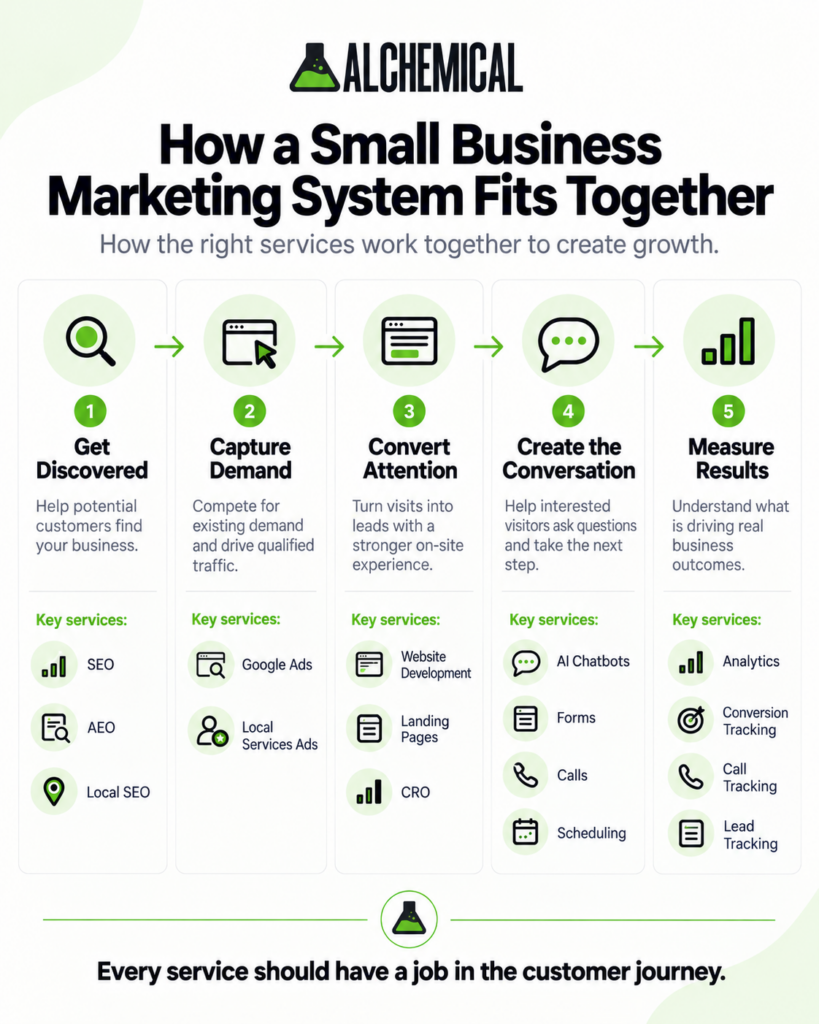
1. Get discovered
SEO, AEO, and Local SEO help potential customers discover the business through organic search and search-driven research.
2. Capture demand
Google Ads and Local Services advertising can help the business compete for existing demand through paid acquisition.
3. Convert attention
The website, landing pages, messaging, offers, and CRO determine how much of that attention turns into action.
4. Create the conversation
Forms, calls, scheduling tools, and AI chatbots help interested visitors become actual inquiries.
5. Measure what happens
Analytics, conversion tracking, call tracking, CRM data, and lead-source tracking help connect those activities to business outcomes.
That final layer matters across everything.
Otherwise, it becomes easy to optimize each channel for its own preferred metric.
SEO celebrates traffic.
PPC celebrates clicks.
The website team celebrates engagement.
The chatbot celebrates conversations.
Meanwhile, the owner is asking a much more useful question:
Are we getting more good customers?
No marketing channel should be evaluated entirely in isolation when another part of the customer journey can determine whether it succeeds.
Which Digital Marketing Service Should Your Small Business Prioritize First?
Start with the problem you can actually observe.
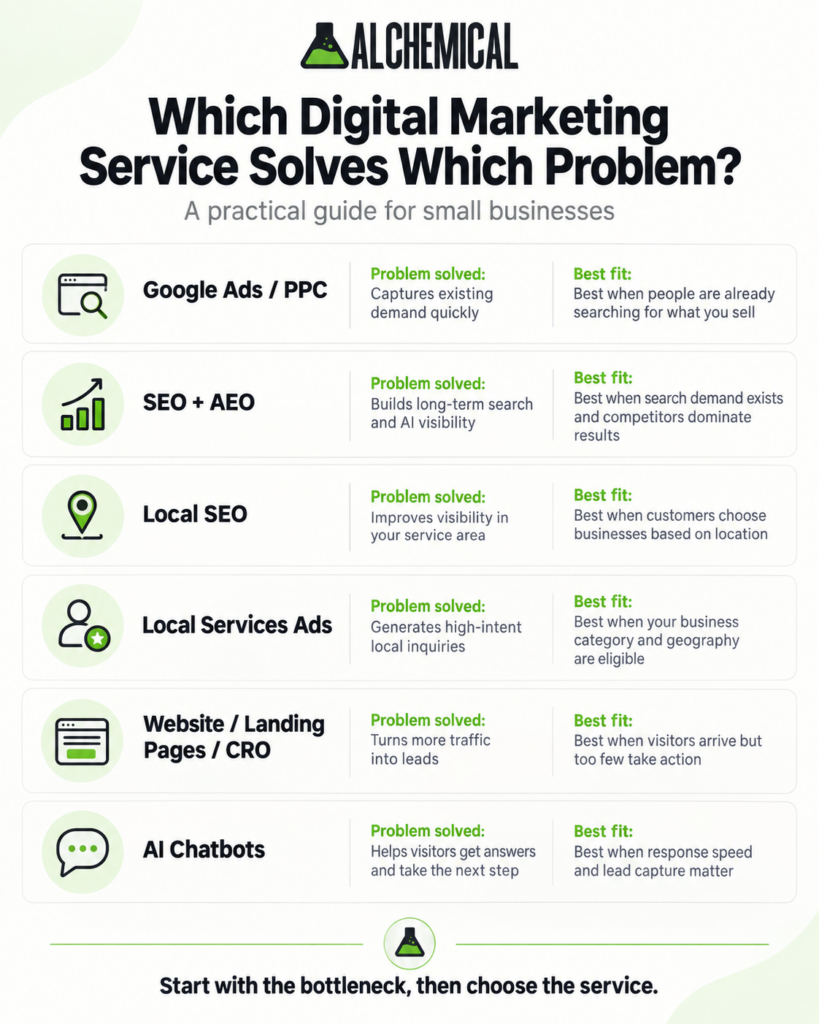
This table is not a universal prescription.
Real businesses are messier than that.
You may have two bottlenecks at once.
For example, a company may need better search visibility and a better website. Improving one without the other could limit the upside.
The framework is useful because it changes the question from:
What marketing should we be doing?
to:
What problem needs to be solved next?
That usually leads to a much better conversation.
Do Small Businesses Need All of These Digital Marketing Services?
No.
Trying to do everything at once can spread budget, attention, and measurement too thin.
The stronger approach is usually to sequence investments around the biggest opportunities and constraints.
For example, a local service company may start with Local SEO and paid search because customers already look for the service by location.
A company with strong organic traffic but weak lead generation may get more value from improving landing pages and conversion paths than producing another year of traffic growth.
A company generating plenty of website inquiries may not need another acquisition channel at all. It may need better lead response.
And a business with no reliable tracking may need to fix measurement before increasing the budget anywhere.
These are examples, not formulas.
The right sequence depends on:
- customer behavior
- market demand
- competition
- customer value
- margins
- geography
- existing performance
- internal capacity
- sales follow-up
- business goals
The goal is not to build the biggest marketing stack.
It is to build the one that solves the problems your business actually has.
How Should a Small Business Measure Digital Marketing Success?
Marketing measurement should move progressively closer to business outcomes.
Visibility
These metrics help explain whether people can find you.
Examples:
- search visibility
- rankings
- impressions
- local visibility
Traffic and engagement
These tell you whether people are interacting with your marketing.
Examples:
- clicks
- website sessions
- calls
- page engagement
Leads
These show whether that attention is turning into opportunities.
Examples:
- contact forms
- phone inquiries
- booked consultations
- appointments
- demos
Lead quality
This is where reporting becomes far more useful.
How many leads are actually:
- relevant
- qualified
- inside the service area
- looking for the right solution
- realistic potential customers
Business outcomes
Where possible, the business should ultimately look at:
- customers
- sales
- revenue
- customer acquisition cost
- advertising return
- customer value
Not every business can perfectly trace every sale back to one marketing interaction.
That is normal.
The goal is to get as close to meaningful business outcomes as reasonably possible.
The closer a metric gets to an actual customer or revenue result, the more useful it becomes when deciding where the next marketing dollar should go.
How Do You Build the Right Digital Marketing Mix?
The best digital marketing strategy for a small business is rarely the one with the most channels.
It is the one where each service has a clear job.
Google Ads should have a reason to exist.
SEO should have a reason to exist.
The website should have a job beyond looking professional.
Local SEO should connect to how customers actually search.
An AI chatbot should solve a real communication problem.
And the business should be able to understand what happens after all of those things start working together.
At Alchemical Marketing, that is how we think about digital marketing.
We start by looking at where the biggest opportunity or bottleneck actually is. Depending on the business, that may be search visibility, paid acquisition, local discovery, the website, conversion, measurement, or what happens after a prospect arrives.
Sometimes the answer is more marketing.
Sometimes it is fixing the marketing you already have.
If you want another set of eyes on where your biggest opportunities are, you can schedule a free consultation with Alchemical Marketing.
Frequently Asked Questions
What are the most important digital marketing services for a small business?
The most important services depend on the problem the business needs to solve. Google Ads can capture existing search demand, SEO and AEO can improve organic visibility, Local SEO can strengthen geographic visibility, Local Services Ads can generate local inquiries for eligible businesses, website and conversion work can improve lead generation, and AI chatbots can help with questions, qualification, and lead capture.
Most businesses should prioritize the services that address their biggest current constraint rather than trying to use every channel at once.
Is SEO or Google Ads better for a small business?
Neither is universally better.
Google Ads can provide faster access to existing search demand because a business can pay to compete for relevant searches. SEO generally focuses on earning organic visibility over time.
Some businesses benefit from using both. Others may have a clear reason to prioritize one first.
The right choice depends on demand, competition, budget, timing, customer economics, and the strength of the website.
Is Local SEO different from SEO?
Yes, although they overlap.
SEO broadly focuses on improving organic search visibility. Local SEO places additional emphasis on searches where geography matters, including Google Business Profile visibility, local relevance, reviews, location or service-area information, and other signals that help customers find a business in a particular market.
Are Local Services Ads better than Google Ads?
Not automatically.
Local Services advertising can be attractive for eligible local businesses because the format is designed around direct lead generation. Google Ads can offer broader campaign options and more control over how paid search traffic is targeted and routed.
Lead quality, customer acquisition cost, competition, eligibility, and sales performance ultimately matter more than which advertising product sounds better.
Do small businesses need AI chatbots?
Not every small business needs an AI chatbot.
They can be useful when website visitors frequently have questions, arrive after hours, need qualification, or benefit from an immediate next step. Businesses with little website traffic or very simple customer journeys may have other priorities first.
A chatbot should solve a real communication or conversion problem rather than being added simply because AI is popular.