
TABLE OF CONTENTS
Small businesses rarely struggle because there are not enough ways to market themselves. Usually, the problem is the opposite.
SEO, Google Ads, social media, email, websites, content, automation, analytics, and now AI search all compete for the same budget and attention. Knowing which channels actually deserve your time can be much harder than simply knowing they exist.
A digital marketing agency for a small business should help solve that problem. The agency’s job is not to sell you every marketing service available. It should help you understand where your best opportunities are, execute the work that matters, and measure whether that work is creating real business results.
The right agency can bring specialized expertise and structure to your marketing. The wrong one can add another monthly expense while leaving you just as confused about what is working.
This guide explains what a digital marketing agency should actually do for a small business, when hiring one makes sense, which services matter, what to look for before signing a contract, and how to tell whether an agency is the right fit.
What Does a Digital Marketing Agency Do for a Small Business?
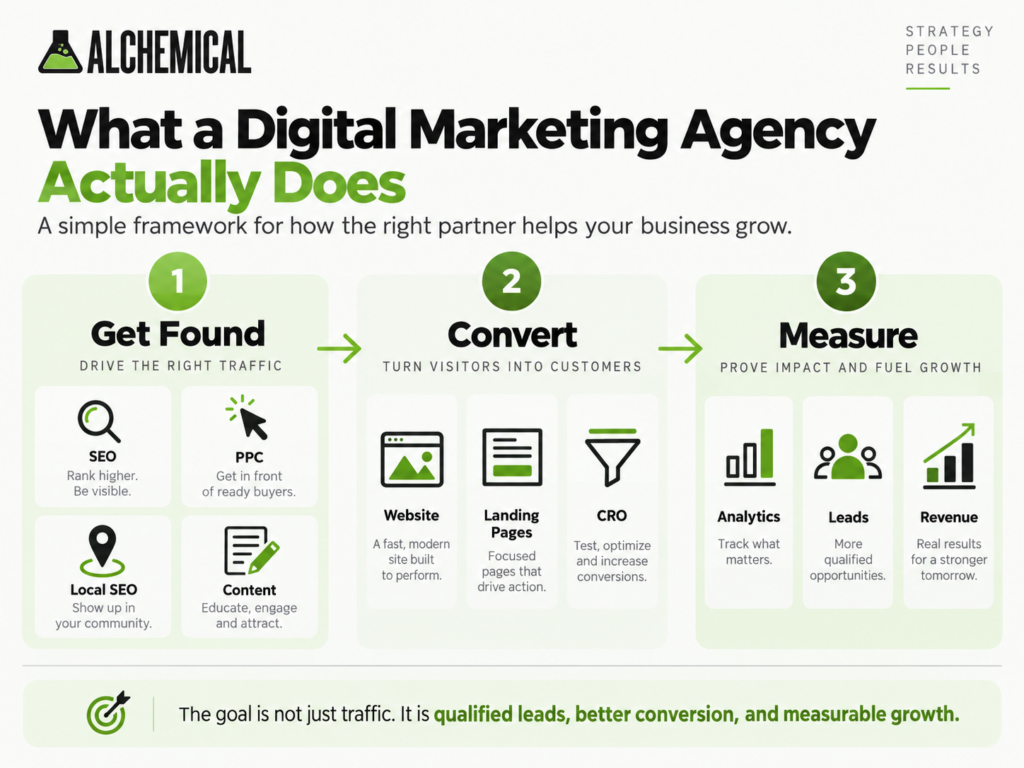
A digital marketing agency helps a business reach the right people online, turn that attention into leads or sales, and understand which marketing efforts are actually working.
Most of that work falls into three areas:
1. Helping people find your business
Depending on the company, this may include:
- Search engine optimization
- Local SEO
- Google Ads
- Paid social advertising
- Content marketing
- Email marketing
- Social media
- Video
- AI search visibility
- Other forms of digital advertising
The right mix depends heavily on how people discover and buy what you sell.
For example, if customers are already searching Google for your service every day, SEO and paid search may deserve more attention than an awareness campaign.
On the other hand, a business selling something people do not know to search for may need a different strategy.
That distinction matters.
Marketing should start with how customers actually make decisions, not with whichever channel an agency happens to specialize in.
2. Turning attention into leads or sales
Generating traffic is only part of digital marketing.
Once someone reaches your website or landing page, the experience needs to give them a reason to keep going.
That can involve:
- Website strategy
- Landing page development
- Calls to action
- Lead forms
- Mobile usability
- Page speed
- Conversion rate optimization
- Trust signals
- Messaging
- Offer development
A business can have great SEO and still struggle if the website does not build trust.
Likewise, an excellent Google Ads campaign can waste money when it sends visitors to a page that does not clearly explain what happens next.
That is why traffic generation and website conversion should usually be planned together.
3. Measuring what happens
Marketing becomes much easier to manage when the business can see where leads are coming from and what happens after they arrive.
That may require:
- Google Analytics
- Conversion tracking
- Call tracking
- CRM integrations
- Lead-source tracking
- Campaign reporting
- Revenue attribution where possible
Clicks and traffic are useful signals, but they are not the final goal for most businesses.
Ultimately, you want to understand whether marketing is helping produce qualified leads, customers, revenue, or whatever outcome actually matters to the company.
What Digital Marketing Services Does a Small Business Actually Need?
Most small businesses do not need every digital marketing service at the same time.
That is one of the easiest ways to overspend.
The better question is:
What is currently preventing the business from getting more of the right customers?
Once that is clear, choosing marketing channels becomes much easier.
For a deeper breakdown of the major channels and when each one makes sense, our guide to digital marketing services for small business explains how to prioritize SEO, paid search, Local SEO, website optimization, and other services based on the problem you are actually trying to solve.
If customers are already searching for what you sell
Search marketing may deserve priority.
That could include:
- SEO
- Local SEO
- Google Ads
- Microsoft Ads
- Strong service or product pages
For a local service business, this could mean appearing when someone searches for exactly what the company provides in a specific city.
For another company, it might mean competing nationally for high-value commercial searches.
For a deeper look at organic search, our guide to small business SEO explains how businesses can build visibility across Google, local search, and AI-powered search.
If people are not familiar with the product or solution
Demand generation may matter more.
Potential channels include:
- Social advertising
- Video
- Educational content
- Influencer partnerships
- Display advertising
- Other awareness campaigns
In this situation, the business may need to create interest before it can capture demand.
If traffic is strong but leads are weak
More traffic may not solve the problem.
The website could be the bottleneck.
An agency should look at things like:
- Messaging
- Page structure
- Offers
- Calls to action
- Forms
- Trust
- Mobile experience
- Landing pages
- Conversion tracking
Buying more clicks before fixing a weak conversion path can simply make an existing problem more expensive.
If leads are coming in but nobody knows why
Measurement becomes the priority.
A business should be able to answer basic questions such as:
- Which channels are generating leads?
- Which campaigns are generating qualified leads?
- What is the cost to acquire those opportunities?
- Which leads actually become customers?
- Where is the company wasting money?
Without that information, increasing the marketing budget becomes much harder to justify.
If the business depends heavily on local customers
Local search deserves special attention.
That may include:
- Google Business Profile
- Local SEO
- Reviews
- Location and service pages
- Local advertising
- Accurate business information
- Local search tracking
A small business serving one metro area has very different marketing needs from an ecommerce company selling nationwide.
A good agency should recognize that before recommending a strategy.
When Does Hiring a Digital Marketing Agency Make Sense?
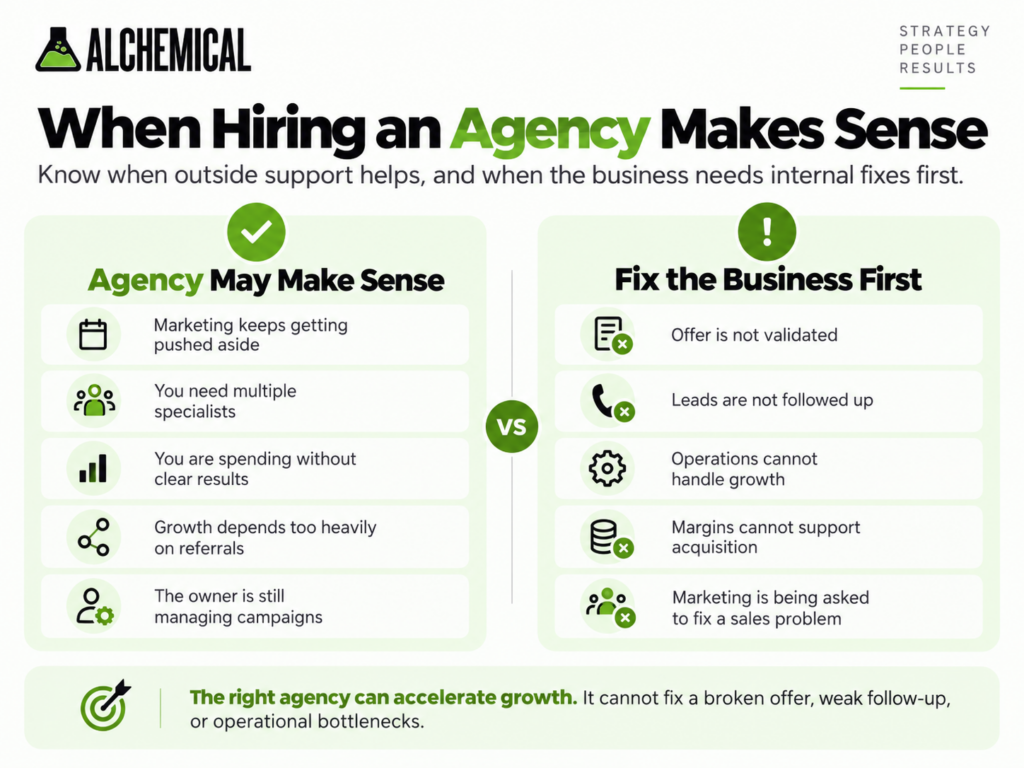
Hiring an agency usually makes the most sense when a business has a real marketing opportunity but does not have the time, resources, or specialized expertise to handle it internally.
There are several common signs that outside help may be useful.
Marketing keeps getting pushed aside
Many small businesses do not have a full marketing department.
Instead, marketing ends up being handled by:
- the owner
- a salesperson
- an office manager
- a junior marketing employee
- several freelancers
Everyone may be doing their best, but marketing often becomes the thing that gets worked on when there is time.
An agency can add consistency and ownership.
Nobody has deep expertise in the channels you are using
Digital marketing has become highly specialized.
A person who is excellent at SEO may not be an expert in paid search.
Strong web development skills do not automatically translate into conversion expertise.
Likewise, a social media manager may not know how to build analytics infrastructure.
Hiring every specialist internally is not realistic for many small businesses.
An agency can give the company access to several disciplines without requiring a full internal department.
You are spending money but cannot explain the results
This is one of the clearest warning signs.
If you are spending thousands of dollars every month but cannot confidently explain:
- where leads come from
- which campaigns are working
- what is being tested
- what is being improved
- what your next priority is
then the business does not have enough visibility into its marketing.
The solution is not always another agency. However, something in the current system needs to change.
Growth relies too heavily on referrals
Referrals can be an excellent source of business.
The problem comes when they are the only reliable source.
Digital marketing can help a company create additional ways for customers to discover it without replacing the relationships already driving referrals.
The owner is still personally managing marketing
There is a point where an owner’s time becomes more valuable elsewhere.
That does not mean the owner should stop understanding marketing.
It means they should not necessarily be the person adjusting bids, researching keywords, updating website pages, reviewing tracking, and troubleshooting campaigns every week.
When an Agency Might Not Be the Right Move Yet
An agency is not automatically the right solution.
Sometimes the underlying business needs attention first.
For example, hiring a marketing agency may not make sense yet if:
- the business has not validated its product or service
- the company cannot handle additional demand
- leads are not being followed up with consistently
- margins cannot support the cost of acquiring customers
- the sales process is fundamentally broken
- leadership expects marketing to fix a poor customer experience
- the business cannot clearly explain what it sells or who it serves
Marketing can amplify a strong business.
It can also amplify problems.
A responsible agency should be willing to tell you when the bottleneck is somewhere else.
Digital Marketing Agency vs. In-House Marketing
There is no universal answer to whether a business should hire an agency or build an internal team.
Both models have advantages.
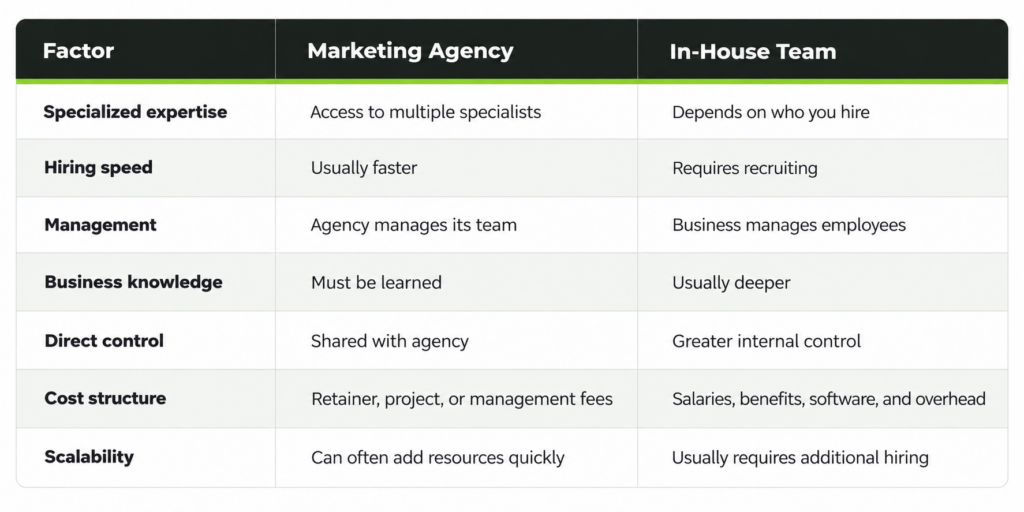
The right answer depends on what capabilities the business needs and how often it needs them.
For example, a company that needs SEO, paid search, web development, analytics, and design may find it difficult to justify five specialized full-time employees.
Meanwhile, a larger organization that needs constant daily marketing coordination may benefit from building more of those capabilities internally.
There is also a hybrid model.
Many businesses keep strategy or general marketing leadership in-house while using agencies for specialized execution.
How Much Does a Digital Marketing Agency Cost?
There is no single standard price for digital marketing services.
Agency pricing depends on the work being performed, the level of expertise involved, the market, the size of the account, and how much responsibility the agency is taking on.
Common pricing models include:
Monthly retainers
The business pays a recurring monthly fee for an agreed scope of work.
This is common for:
- SEO
- paid advertising management
- ongoing content
- marketing strategy
- multi-channel engagements
Fixed project pricing
A defined price is attached to a specific project.
Examples include:
- website development
- tracking setup
- audits
- landing page projects
- strategy engagements
Percentage of advertising spend
Some paid media agencies charge a percentage of the amount being spent on advertising.
In other cases, agencies use a flat management fee or a hybrid of the two.
Hourly consulting
This can work well when a business needs strategy, troubleshooting, training, or occasional specialized help rather than full execution.
Hybrid pricing
Some agencies combine retainers, project fees, media management fees, or performance incentives.
Whatever the model, the more useful question is often not:
“What does the agency cost?”
It is:
“What am I actually getting for that cost, and how will we know whether it is creating value?”
A $2,000 engagement that does very little can be more expensive than a $5,000 engagement that solves a meaningful business problem.
Price matters.
So does what the investment is expected to accomplish.
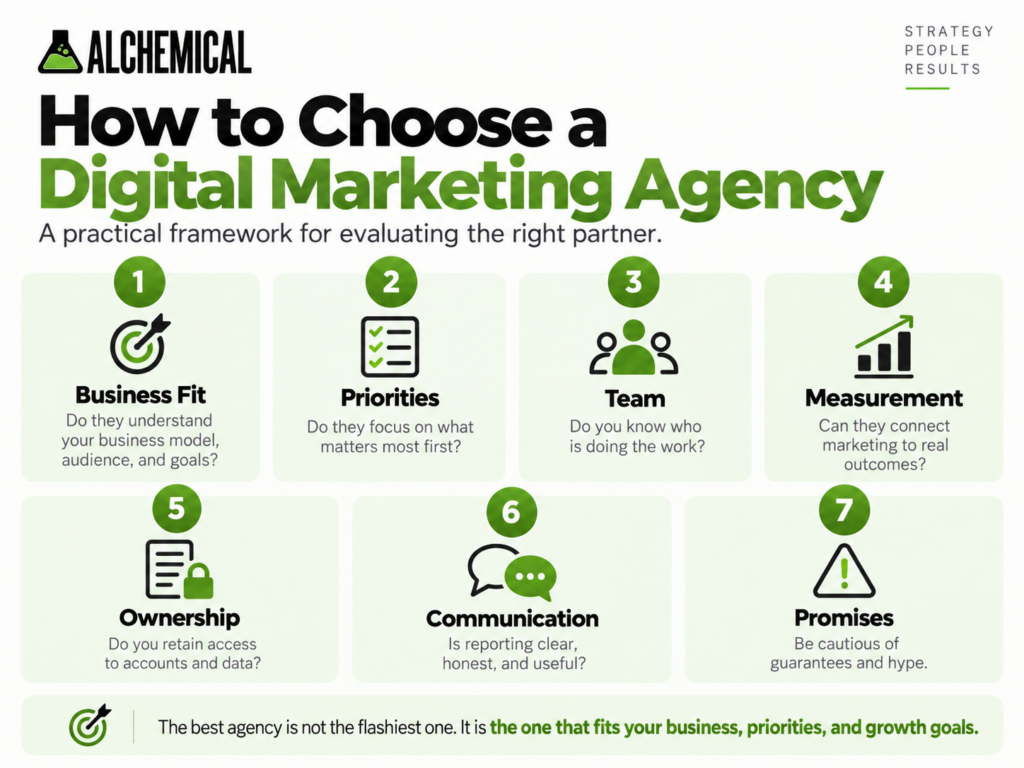
How to Choose the Right Digital Marketing Agency
Finding an agency is easy.
Finding one that fits your business takes more work.
Here are some of the things worth evaluating.
1. Do they understand the business problem?
An agency should want to understand more than your industry.
They should ask about:
- customers
- margins
- geography
- sales process
- average customer value
- competition
- capacity
- current marketing
- business goals
If the strategy is being recommended before the agency understands the problem, be careful.
2. Can they explain what they would prioritize?
Good agencies should have opinions.
That includes telling you what not to spend money on.
If every service the agency sells somehow becomes a priority for every client, that is worth questioning.
Ask:
“If we could only improve one or two things first, what would you choose and why?”
The answer can tell you a lot.
3. Who will actually work on your account?
The person selling the engagement may not be the person managing the work.
Ask who will handle:
- strategy
- communication
- paid advertising
- SEO
- content
- development
- analytics
Then ask how much experience those people have.
You are not just hiring a logo on a proposal.
You are hiring the people behind it.
4. How will success be measured?
Marketing reports can contain dozens of metrics.
That does not mean all of them matter equally.
Ask how the agency plans to connect its work to business outcomes.
Depending on the company, that may include:
- qualified leads
- calls
- appointments
- ecommerce purchases
- sales opportunities
- customers
- revenue
- customer acquisition cost
Traffic, rankings, impressions, and clicks can help explain what is happening.
They should not automatically be treated as the final definition of success.
5. Who owns the accounts and assets?
This is one of the least exciting questions you can ask before hiring an agency.
It is also one of the most important.
Make sure you understand who owns:
- your domain
- website
- Google Ads account
- analytics property
- Google Business Profile
- advertising data
- creative assets
- written content
- tracking infrastructure
Ideally, the relationship should not depend on holding important business assets hostage.
6. How does communication work?
Ask:
- How often will we meet?
- Who is our main contact?
- How quickly do you respond?
- What will be included in reporting?
- How are recommendations explained?
- What happens when performance declines?
A strong agency should make your marketing easier to understand, not more mysterious.
7. What are they promising?
Be cautious around guarantees that sound too clean.
Marketing results depend on variables such as:
- competition
- budget
- market demand
- website quality
- pricing
- reputation
- sales follow-up
- customer experience
An agency can control its strategy, execution, testing, communication, and accountability.
It cannot control every outcome surrounding the business.
What Questions Should You Ask Before Hiring a Digital Marketing Agency?
Before signing an agreement, ask questions that force the agency to explain how it actually works.
A useful starting list:
- What would you prioritize during the first 90 days?
- Which services do you think we actually need?
- Which services do you think we do not need right now?
- Who will work on our account?
- How will you measure success?
- How do you define a qualified lead?
- What accounts and assets will we own?
- What is included in your fee?
- What costs are separate?
- How often will we communicate?
- What will reporting look like?
- How do you respond when a campaign underperforms?
- How long is the agreement?
- What happens if we decide to leave?
You do not need a perfect answer to every question.
You should, however, feel like the answers are clear.
Confusion before the contract rarely becomes greater transparency afterward.
What Should a Good Agency Relationship Look Like?
A strong agency relationship should create a repeatable cycle:
Strategy → Execution → Measurement → Learning → Adjustment
The agency develops a plan.
The plan gets executed.
Results are measured.
The team learns from those results.
Then the strategy changes when the evidence says it should.
That last part matters.
Marketing strategies should not become permanent simply because they were written into the original proposal.
Markets change.
Competitors change.
Search behavior changes.
Platforms change.
Businesses change.
The agency should be willing to adapt with them.
A healthy relationship also includes clear responsibilities.
For example, the agency may be responsible for generating qualified leads, but the client may be responsible for responding quickly and following up.
If nobody defines those responsibilities, it becomes very easy for both sides to blame each other when performance falls short.
Does a Small Business Need a Full-Service Digital Marketing Agency?
Not necessarily.
A full-service agency makes the most sense when several parts of marketing need to work together.
For example:
A company may need SEO to improve organic visibility, Google Ads to capture immediate demand, website improvements to increase conversion rates, and analytics to understand which channels produce revenue.
Coordinating those efforts through one team can be valuable.
However, specialization also matters.
A business with a very specific need may be better served by an excellent specialist than by a mediocre agency that claims to do everything.
- If your biggest problem is Google Ads, you may need a great paid-search team.
- If your website is the bottleneck, web strategy may deserve priority.
- If local visibility is the issue, Local SEO may matter more.
The best structure is the one that fits the actual problem.
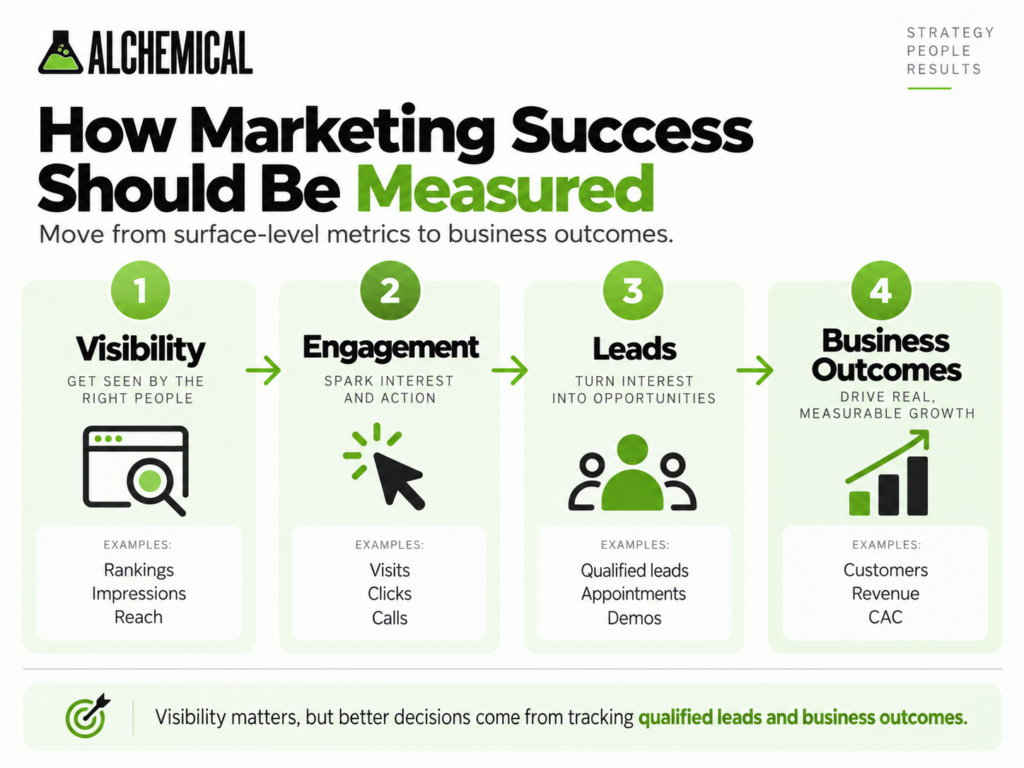
How Should a Small Business Measure Digital Marketing Success?
One of the easiest ways to improve marketing decisions is to separate metrics into levels.
Visibility metrics
These tell you whether people are seeing the business.
Examples:
- search rankings
- impressions
- reach
- search visibility
Engagement metrics
These show whether people are interacting.
Examples:
- website sessions
- clicks
- calls
- page engagement
- form activity
Lead metrics
These move closer to a business result.
Examples:
- inquiries
- qualified leads
- booked consultations
- demos
- appointments
Business metrics
These are usually the most useful for deciding where money should go.
Examples:
- customers
- sales
- revenue
- customer acquisition cost
- return on advertising spend
- customer lifetime value
Not every company can connect every marketing interaction directly to revenue.
That is fine.
The goal is to get as close as reasonably possible.
The closer a metric gets to an actual business outcome, the more useful it becomes when deciding what to keep, change, or stop.
So, Should You Hire a Digital Marketing Agency?
A digital marketing agency can make sense when your business has a clear opportunity to grow but needs more strategy, specialization, or execution than your current team can provide.
The right agency should make your marketing easier to understand.
You should know:
- what is being worked on
- why it matters
- how success is being measured
- what the results are telling you
- what should happen next
Most importantly, get clear on the problem you need marketing to solve before choosing a partner.
That makes it much easier to distinguish between an agency that is simply selling services and one that can help you build a useful marketing system.
At Alchemical Marketing, we approach digital marketing by connecting search visibility, paid media, website performance, conversion, and measurement around the business outcome that matters most.
Because better marketing is not about doing more things.
It is about doing the right things for the right reasons.
If you want help figuring out where your biggest opportunities are, you can schedule a free consultation with Alchemical Marketing.
Frequently Asked Questions
What does a digital marketing agency do for a small business?
A digital marketing agency helps a small business attract potential customers online, convert that attention into leads or sales, and measure which marketing efforts are producing results. Services may include SEO, paid advertising, website strategy, content, analytics, Local SEO, conversion optimization, and other digital channels.
Is a digital marketing agency worth it for a small business?
It can be. An agency is most useful when the business has a real marketing opportunity but lacks the time, expertise, or internal resources to execute the strategy effectively. The value depends on the quality of the agency, the economics of the business, and whether marketing results can be measured against meaningful business outcomes.
How much should a small business spend on digital marketing?
There is no responsible universal budget for every small business. The right investment depends on factors such as revenue, margins, competition, growth goals, geography, customer value, existing demand, and which channels are being used. A marketing budget should be based on the opportunity and expected economics rather than an arbitrary percentage alone.
What digital marketing services should a small business outsource first?
Start with the area that requires specialized expertise and is creating the biggest bottleneck. For one business that may be SEO. For another it could be paid search, website conversion, analytics, or Local SEO. The first outsourced service should solve a real problem rather than simply add another marketing channel.
Is it better to hire a marketing agency or a freelancer?
It depends on the scope of work. A freelancer can be a strong choice for a specialized or clearly defined project. An agency may make more sense when the business needs multiple disciplines, ongoing strategy, coordination between channels, or additional capacity. Neither structure is automatically better. The right choice depends on what the business actually needs.