
TABLE OF CONTENTS
Small businesses hear that they “need SEO” all the time.
The harder question is what that actually means for the business.
SEO can involve fixing technical problems, improving service pages, publishing useful content, earning authority, competing in local search, and making information easier for AI-powered search systems to understand.
You probably do not need to attack all of those things at once.
Small business SEO is the process of making your business easier to discover when potential customers search for the products, services, or answers you provide. The goal is not simply to rank for more keywords. It is to earn visibility for searches that can realistically contribute to the business.
That distinction changes how SEO should be approached.
A keyword with thousands of searches is not automatically valuable. A ranking is not automatically a win. And more organic traffic does not automatically mean better marketing.
The question is whether the right people are finding the business at the right moment and whether that visibility can turn into something meaningful.
SEO is one piece of a broader digital marketing services for small business strategy. This guide explains how SEO works, where small businesses should focus first, when it is worth the investment, what you can reasonably do yourself, and how Local SEO and AI search fit into the larger system.
What Is Small Business SEO?
Small business SEO is the process of improving a company’s website, content, online presence, and authority so potential customers can find it through organic search.
That can happen when someone:
- searches for a product or service
- researches a problem
- compares possible solutions
- looks for a provider nearby
- researches a company before contacting it
- asks an AI-powered search system a related question
Google describes SEO as helping search engines crawl, index, and understand website content.
But getting understood by Google is only half the job.
The person who reaches the page also needs to quickly understand:
- what the business offers
- whether it is relevant to them
- why they should trust it
- what they should do next
A page can be perfectly optimized for a keyword and still be a bad business asset.
How is small business SEO different from enterprise SEO?
The fundamentals are largely the same. The priorities usually are not.
Large organizations may have:
- thousands of pages
- established brand authority
- large marketing teams
- dedicated developers
- significant content resources
- enough scale to pursue very broad search opportunities
Small businesses typically have fewer resources and far less room to waste them.
That makes prioritization especially important.
A small business usually does not win SEO by doing everything.
It wins by being selective about which searches are actually worth competing for and what needs to happen to earn those searches.
The Small Business SEO Opportunity Filter
Before deciding that a keyword, topic, or SEO project deserves resources, I would run it through five questions.
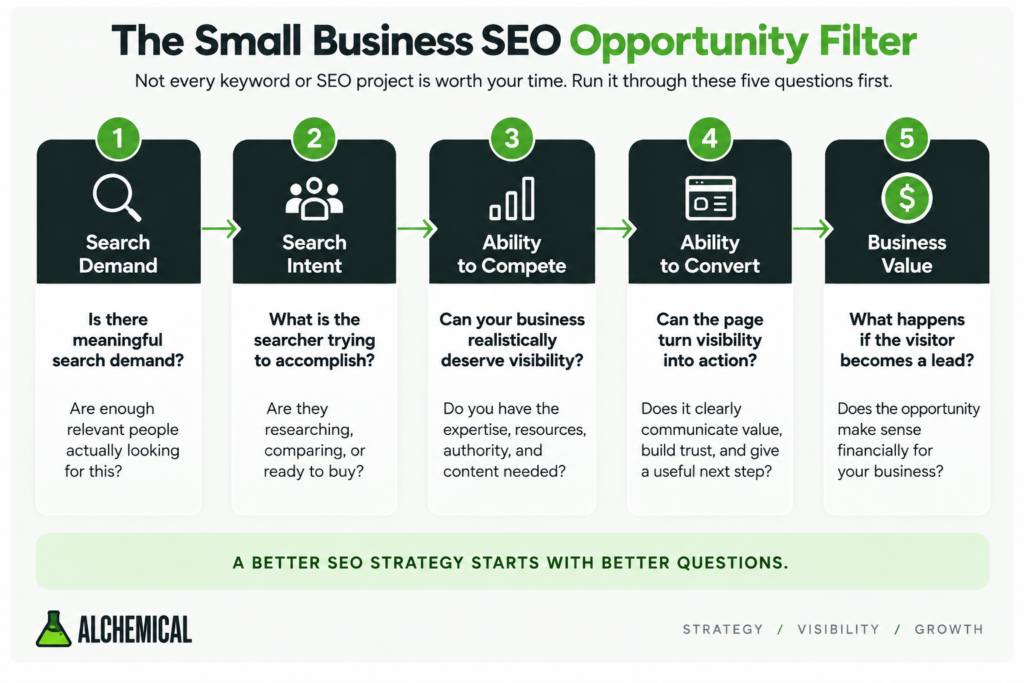
1. Is there meaningful search demand?
Are enough relevant people actually looking for the subject?
Search volume is useful here, but it is only the starting point.
2. What is the searcher trying to accomplish?
Someone researching a basic definition has different business value from someone actively comparing providers.
Intent matters.
3. Can your business realistically deserve visibility?
Look at who already ranks.
Do you have the expertise, resources, authority, content, and website needed to compete?
Not every keyword is equally realistic.
4. Can the page turn visibility into action?
Ranking a weak page solves only part of the problem.
The page still needs to communicate value, build trust, and give the visitor a useful next step.
5. What happens if the visitor becomes a lead?
Customer value, margins, sales follow-up, geography, capacity, and lead quality determine whether the opportunity matters financially.
That creates a much better SEO question than:
How much search volume does this keyword have?
A 10,000-volume keyword with weak intent and almost no connection to your business may be far less valuable than a 200-volume service search from people actively looking to hire someone.
This filter should sit underneath the rest of your SEO strategy.
How Does SEO Work for a Small Business?
SEO works by helping search engines find your website, understand your pages, evaluate their relevance and usefulness, and decide when they deserve to appear.
For most small businesses, that comes down to four things.
Search engines need to find and understand your website
Before a page can rank, search engines need to be able to access and process it.
Technical SEO deals with things like:
- crawling
- indexing
- site architecture
- redirects
- canonical URLs
- mobile usability
- performance
- duplicate content
- broken pages
- rendering issues
A technical audit can easily produce hundreds of warnings.
That is not the same thing as having hundreds of priorities.
The useful question is:
Which technical issues are actually preventing important pages from being discovered, understood, indexed, or used effectively?
Fix those first.
Your page needs to match the searcher’s intent
Ranking is not simply about using the right keyword.
Imagine two searches:
emergency plumber near me
and
why does my water heater keep leaking
Both could matter to a plumbing company.
But the person making each search wants something completely different.
One likely needs a provider.
The other needs an explanation.
Those searches should not necessarily land on the same page.
Good SEO starts by identifying what someone is actually trying to accomplish and creating the right type of page for that need.
The content needs to be worth finding
Search engines have become much better at understanding meaning instead of relying heavily on exact keyword repetition.
That makes thin keyword-variation content increasingly hard to justify.
If five keywords represent the same underlying question, you usually do not need five articles.
You need one strong answer.
Useful SEO content can include:
- service pages
- product pages
- comparisons
- pricing explanations
- guides
- FAQs
- case studies
- original research
- tools
- first-party observations
- answers to questions customers repeatedly ask
The best content also adds something.
If the first page of Google contains ten nearly identical explanations and your article becomes the eleventh, you have created content but very little information gain.
Search engines need reasons to trust the business
Search engines do not evaluate every page in isolation.
Authority can also be influenced by signals such as:
- relevant backlinks
- legitimate industry mentions
- professional associations
- press
- local organizations
- customer reviews
- partnerships
- citations
- recognized expertise
- brand signals
A relevant link from a source respected in your industry can be more meaningful than dozens of links created only because somebody was willing to sell them.
SEO authority should look at least somewhat like reputation in the real world.
Why Is SEO Important for Small Businesses?
SEO matters when potential customers already use search as part of how they discover, research, or choose businesses.
SEO can capture demand that already exists
This is the most important reason to care about SEO.
If people already search for exactly what you sell, that demand exists whether your company participates or not.
The businesses appearing in those results have an opportunity to capture it.
If your competitors consistently show up and you do not, SEO may deserve attention.
But do not confuse demand with volume.
A 200-volume query from someone actively looking for a provider can have far more business value than a 10,000-volume informational term.
SEO can influence more than the final purchase search
People rarely move through search in a perfectly straight line.
Someone may first search:
What does this service cost?
Later:
How does this process work?
Then:
Best provider near me
And finally:
Company name reviews
Strong SEO can help a business appear throughout that decision process instead of only competing for the final commercial search.
Useful pages can continue producing visibility
Paid advertising generally requires ongoing media spend to maintain paid placement.
Organic visibility works differently.
A useful page can continue attracting relevant searches after the initial work has been completed.
That does not mean SEO is free.
Creating, improving, maintaining, and promoting strong pages requires time and resources. Rankings can also change as competitors improve, search systems evolve, or the market changes.
The advantage is that organic visibility is not necessarily tied to paying for every individual click.
Search now extends beyond traditional blue links
Search behavior is expanding.
Potential customers may encounter businesses through:
- traditional Google results
- Google Maps
- AI Overviews
- Google AI Mode
- ChatGPT
- other AI assistants
The interfaces are changing.
The underlying challenge is not:
How do we hack each new platform?
It is:
How do we become a useful, trustworthy source of information wherever people search?
Is SEO Worth It for a Small Business?
SEO can be worth it when customers search for what the business offers, those customers have enough value to support the investment, and the company has a realistic opportunity to compete.
It is not automatically worthwhile for every small business.
SEO tends to make sense when:
- meaningful search demand exists
- customers research before buying
- competitors already capture important searches
- customer value supports the investment
- the company wants acquisition beyond referrals or paid media
- the website can turn traffic into inquiries or sales
- the business can handle additional demand
SEO may not be the first priority when:
- very few people search for the category
- the offer has not been validated
- the website cannot convert
- margins cannot support the investment
- the company already has plenty of leads
- sales follow-up is the real problem
- another business constraint is more urgent
This is one reason standardized SEO packages can be problematic.
Two companies in the same industry may have completely different bottlenecks.
One might need technical cleanup.
Another may need new commercial pages.
Another may already have excellent rankings and need conversion work instead.
The strategy should follow the evidence.
What Are the Main Parts of Small Business SEO?
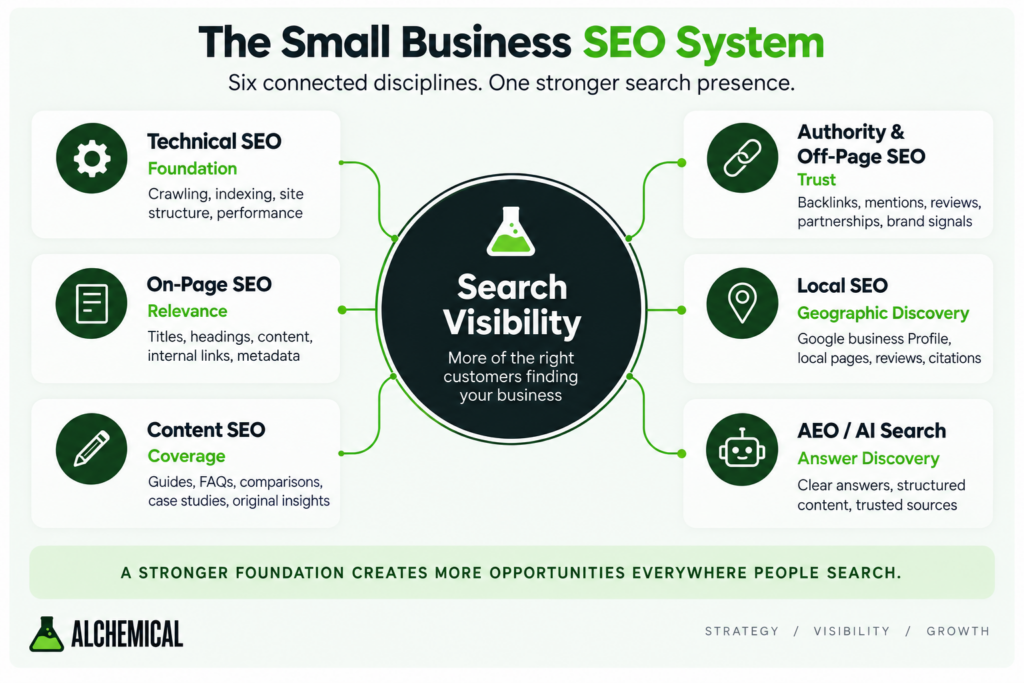
Most small-business SEO work fits into a handful of connected disciplines.
Technical SEO
Technical SEO focuses on whether search engines can properly access and understand the website.
Common areas include:
- crawlability
- indexing
- redirects
- page speed
- mobile usability
- canonicalization
- structured data where appropriate
- duplicate URLs
- site architecture
- migrations
The goal is not a technically perfect website.
The goal is a technically sound website that does not prevent strong pages from competing.
On-Page SEO
On-page SEO focuses on how well individual pages communicate what they are about and how well they satisfy search intent.
That can include:
- titles
- headings
- service or product copy
- internal links
- supporting information
- image context
- metadata
- page structure
- calls to action
Keywords belong here.
Keyword density does not need to run the meeting.
If a sentence sounds awkward because an exact-match phrase had to be inserted into it, the optimization probably went too far.
Content SEO
Content helps a business address questions and searches beyond its core commercial pages.
Useful content often comes directly from conversations with customers.
What do prospects ask before hiring you?
What confuses them?
What objections come up?
What alternatives do they compare?
What mistakes do they make?
Those questions often produce much better SEO content than asking a tool for 50 random blog ideas.
Authority and Off-Page SEO
Off-page SEO helps establish credibility beyond your own website.
Depending on the business, that might involve:
- relevant backlinks
- press
- partnerships
- professional associations
- local organizations
- directories
- citations
- reviews
- original resources people want to reference
Strong authority-building usually comes from creating a legitimate reason for someone else to mention the business.
Local SEO
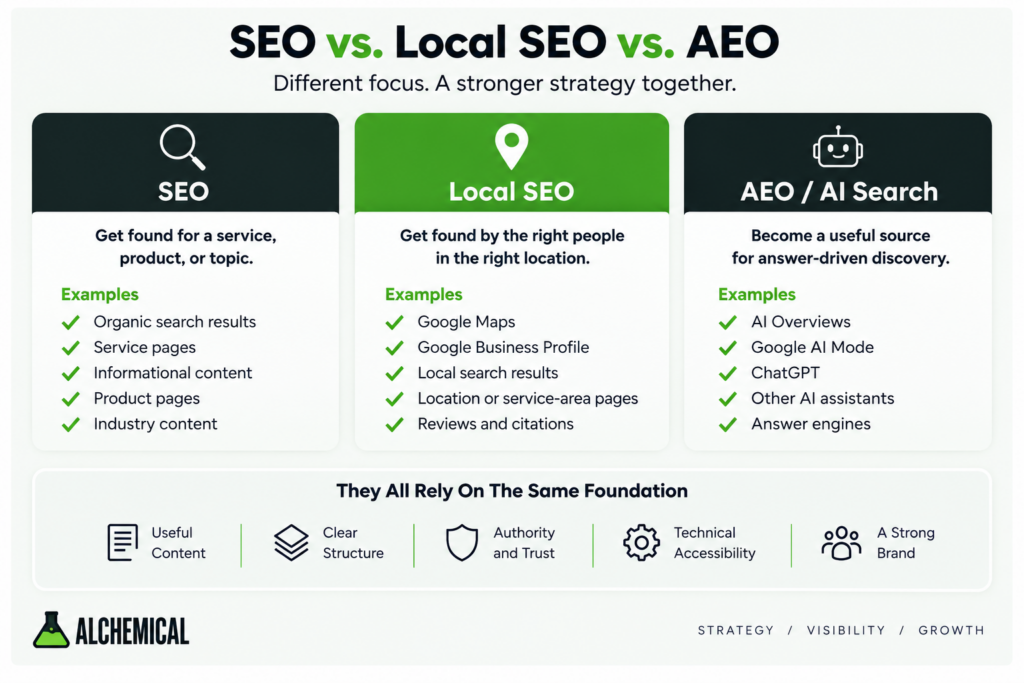
Local SEO focuses on searches where geography affects the customer’s decision.
It matters especially for:
- home services
- healthcare
- senior care
- professional services
- cleaning companies
- restaurants
- retail
- other location or service-area businesses
Local SEO can include:
- Google Business Profile
- reviews
- local service pages
- location pages
- accurate business information
- local links and mentions
- traditional website SEO
Google says its local results are primarily influenced by relevance, distance, and prominence.
Local SEO deserves its own strategy when a business depends heavily on customers in a defined geographic market.
AEO and AI Search
AEO, or Answer Engine Optimization, focuses on making information easier for AI-powered and answer-driven systems to understand, retrieve, and use.
This does not mean throwing out SEO and starting over.
Much of the foundation overlaps:
- useful content
- clear answers
- original expertise
- accessible pages
- logical structure
- trustworthy sources
- clear brand and entity information
Google’s current guidance specifically says traditional SEO fundamentals continue to matter for its generative AI search experiences.
AEO is better thought of as an extension of search optimization than a replacement for it.
How to Improve SEO for a Small Business
If I were prioritizing SEO for a small business, I would work through the following sequence.
1. Start with searches that can actually create business
Begin with the customer.
Ask:
- What do people search when they need what we sell?
- Which searches suggest buying intent?
- What questions come up before a sale?
- Which searches are location-dependent?
- Where are competitors visible?
- Which topics could realistically contribute to leads or revenue?
Then run those opportunities through the SEO Opportunity Filter.
Search volume alone should never make the decision.
2. Get the core commercial pages right
Before publishing 50 blog posts, make sure the pages explaining what the business actually sells are strong.
A useful service page should clearly explain:
- what is offered
- who it is for
- what problem it solves
- what the process looks like
- why the company is credible
- what the visitor should do next
One of the easiest ways to make an SEO dashboard look impressive is to grow informational traffic while the pages closest to revenue barely move.
That may technically be traffic growth.
It may not be the growth the business needs.
3. Fix technical issues based on impact
Technical SEO tools can surface a huge number of problems.
Prioritize issues affecting:
- indexation
- important pages
- site architecture
- internal linking
- mobile usability
- performance
- migrations
- duplicate URLs
- crawlability
A 200-item audit is not a strategy.
Knowing which five issues matter most is.
4. Create content around real customer decisions
Content should help people make progress.
Useful topics often include:
- how something works
- what it costs
- which option is better
- common mistakes
- what to expect
- how to choose
- who something is right for
- what happens next
Those topics naturally align with both traditional SEO and answer-driven search.
The content becomes much stronger when you add:
- firsthand knowledge
- real examples
- original data
- expert judgment
- frameworks
- specific observations
If the article could have been written without understanding the business or industry, it probably needs more depth.
5. Build internal links around the reader’s next question
Internal links help search engines understand relationships between pages.
More importantly, they help people continue learning.
A useful SEO architecture might eventually look like:
Small Business SEO
→ Local SEO
→ AEO and AI Search
→ supporting articles
→ commercial SEO services
Links should appear because the next page helps the reader.
Not because somebody decided every article must contain twelve internal links.
6. Build authority for reasons that make sense
Instead of asking:
Where can we buy links?
ask:
Why would a legitimate website want to reference us?
Possible answers include:
- original research
- useful tools
- industry data
- strong resources
- expert commentary
- community work
- partnerships
- case studies
- PR
- genuinely useful content
Authority is much easier to defend when it was earned for a real reason.
7. Connect SEO reporting to the business
If organic traffic rises 40% but qualified leads stay flat, the business should know that.
If rankings fall for a huge informational keyword but service-page leads rise, that matters too.
A good SEO report should help explain:
- what changed
- why it changed
- whether it matters
- what should happen next
That is much more useful than celebrating every green arrow on a dashboard.
Can You Do Small Business SEO Yourself?
Yes. Many small-business SEO tasks can be handled internally.
The question is whether someone has the time and expertise to do the work consistently.
Tasks many small businesses can handle internally
Depending on the website and team, you may be able to:
- improve service-page copy
- answer customer questions
- publish useful content
- maintain Google Business Profile
- request legitimate reviews
- improve internal linking
- monitor Search Console
- fix basic on-page issues
For a relatively simple website, that can go a long way.
When specialist help becomes more useful
Outside expertise may make sense when you are dealing with:
- complex technical problems
- competitive markets
- large website migrations
- multi-location SEO
- advanced keyword architecture
- large content programs
- authority building
- analytics problems
- difficult indexation issues
- AI-search visibility strategy
There is also a capacity issue.
The owner may be perfectly capable of learning SEO.
That does not necessarily mean spending four hours a week doing SEO is the best use of their time.
When Does Local SEO Matter for a Small Business?
Local SEO matters when where the customer is located affects which business they choose.
If someone searches for a dentist, home care provider, plumber, attorney, cleaning company, restaurant, or other local service, Google needs to understand both:
what the business does
and
where the business is relevant
Google’s local search systems primarily consider relevance, distance, and prominence.
That means Local SEO can involve:
- Google Business Profile optimization
- reviews
- accurate business details
- local service pages
- useful location pages
- local authority
- website SEO
- local mentions and links
A simple distinction is:
Traditional SEO asks:
Can people find us for this service or topic?
Local SEO also asks:
Can the right people find us in the places where we actually provide it?
Businesses serving specific cities, metro areas, or service territories should usually treat Local SEO as a meaningful part of their search strategy.
We will go much deeper into that system in our dedicated guide to Local SEO for Small Business.
How Is AI Search Changing Small Business SEO?
AI search is changing how some people consume search results.
It is not eliminating the need for SEO.
Users increasingly encounter search information through:
- Google AI Overviews
- Google AI Mode
- ChatGPT
- AI assistants
- answer engines
Instead of choosing only from a traditional list of links, someone may receive an answer synthesized from multiple sources.
That creates another visibility opportunity.
What is AEO?
Answer Engine Optimization, or AEO, is the practice of making information easier for AI-powered and answer-driven search systems to understand, retrieve, and use when answering questions.
That might include creating content with:
- clear definitions
- direct answers
- descriptive headings
- original expertise
- useful comparisons
- trustworthy evidence
- clear business information
- strong technical accessibility
Notice how little of that sounds radically different from good SEO.
That is the point.
SEO and AEO should reinforce each other
Google has specifically stated that its traditional SEO guidance continues to apply to generative AI features.
There is no special piece of AEO schema that suddenly unlocks AI visibility.
There is no reason to abandon useful SEO content and produce hundreds of tiny AI-targeted pages.
And there is no guarantee that adding a question heading will make ChatGPT cite you.
The best foundation remains remarkably familiar:
Be useful. Be clear. Be credible. Make the information easy to access and understand.
AEO adds new interfaces and new ways information can be surfaced.
It does not remove the fundamentals.
We will build this out much further in our dedicated guide to AEO and AI Search for Small Businesses.
SEO vs. Google Ads: Which Should a Small Business Prioritize?
Neither is universally better.
They solve different timing and acquisition problems.
Google Ads
Google Ads allows a business to pay to compete for relevant search demand.
That can make sense when:
- demand already exists
- results are needed sooner
- customer economics support paid acquisition
- tracking is strong
- the business can convert the traffic
SEO
SEO focuses on earning organic visibility.
It may deserve more attention when:
- search demand has long-term value
- competitors dominate organic results
- research plays an important role in buying decisions
- the business wants to diversify acquisition
- useful content could capture demand across multiple stages
Many businesses benefit from using both.
The useful question is:
Which channel fits the current opportunity, economics, timing, and bottleneck?
How Long Does Small Business SEO Take?
There is no responsible universal SEO timeline.
Results depend on factors such as:
- existing authority
- competition
- technical health
- website quality
- current rankings
- content quality
- backlinks
- market conditions
- implementation speed
- keyword difficulty
It is also important to define what “results” means.
Early signs can include:
- pages being indexed
- impressions increasing
- more queries appearing in Search Console
- ranking movement
- new pages receiving traffic
Those are useful indicators.
They are not the same thing as qualified leads or customers.
If rankings improve for three months and nothing meaningful happens downstream, the next question should not automatically be:
How do we get even more rankings?
It should be:
Are we targeting the right searches and sending those visitors to the right experience?
How Much Does SEO Cost for a Small Business?
There is no universal small-business SEO price.
Cost depends on the market, website, competition, amount of work, and level of expertise required.
One business may need:
- technical cleanup
- several service pages
- basic Local SEO
Another may need:
- ongoing content
- authority building
- technical support
- analytics
- multi-location SEO
- conversion work
- multiple specialists
Those are very different engagements.
Common models include:
Monthly retainers
Useful when SEO requires ongoing strategy and execution.
Projects
Useful for defined work such as:
- audits
- migrations
- keyword research
- content architecture
- technical remediation
Consulting
Useful when an internal team can execute but needs expert guidance.
Instead of looking only at price, ask:
What problem is this engagement supposed to solve?
What work is actually included?
How will we know whether it is creating value?
An inexpensive SEO engagement that accomplishes almost nothing can be far more expensive than a larger engagement that solves an important problem.
How Should a Small Business Measure SEO Success?
SEO measurement should move from visibility toward business outcomes.
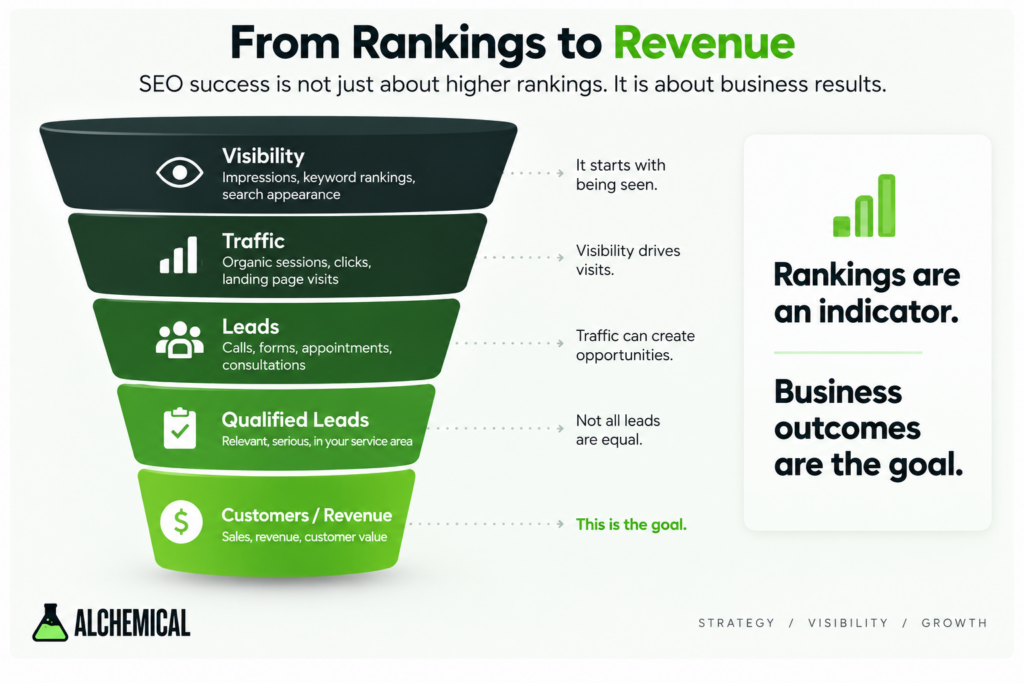
Visibility
Examples:
- search impressions
- important keyword rankings
- organic visibility
- local visibility
- AI-search visibility where measurable
These help explain whether the business is becoming easier to find.
Traffic
Examples:
- organic sessions
- clicks
- important landing-page visits
Traffic tells you whether visibility is producing visits.
Leads
Examples:
- calls
- forms
- appointments
- consultations
- demo requests
- purchases
Now we are closer to the business.
Lead quality
This is where reporting becomes much more useful.
Are the leads:
- relevant?
- qualified?
- inside the service area?
- interested in the right service?
- realistically capable of becoming customers?
A report showing 100 leads means very little if 80 are useless.
Business outcomes
Where measurement allows it, connect SEO to:
- customers
- sales
- revenue
- customer acquisition cost
- customer value
Perfect attribution is not always realistic.
The goal is to get close enough that the business can make better decisions.
Rankings help explain what happened.
They are not the final definition of success.
Should You Hire an SEO Agency?
An SEO agency can make sense when the opportunity is meaningful but the business lacks the expertise, capacity, or time to execute it internally.
Outside help may be useful when:
- nobody consistently owns SEO
- technical problems are difficult to diagnose
- competition is strong
- content production needs more capacity
- keyword strategy is unclear
- Local SEO requires coordination
- analytics are weak
- AI-search visibility is becoming important
An agency may be a poor fit when:
- search opportunity is limited
- the company has larger problems elsewhere
- nobody can implement recommendations
- the business expects guaranteed rankings
- leadership only wants traffic rather than business outcomes
If you hire someone, they should be able to explain why one opportunity deserves priority over another.
A generic audit followed by a generic checklist is not much of a strategy.
For a broader look at evaluating a digital marketing agency for a small business, see our guide to choosing the right marketing partner.
Alchemical’s SEO and AEO services are built around understanding the opportunity first, finding the constraints that actually matter, and connecting search visibility to measurable business outcomes.
Building an SEO Strategy That Fits the Business
The best small-business SEO strategy is not the one with the longest checklist.
It is the one that identifies:
where valuable search demand exists
→ which pages should capture it
→ what is preventing those pages from competing
→ whether the website can convert that visibility
→ whether the resulting customers justify the investment
That is the Small Business SEO Opportunity Filter in practice.
For one company, the answer may be better service pages.
For another, Local SEO may be the biggest opportunity.
Another business may already rank well but need conversion improvements.
And increasingly, strong SEO strategies also need to consider how useful company information gets discovered through AI-powered search.
At Alchemical Marketing, we look at SEO as part of the larger acquisition system.
Search visibility matters.
So does what happens after someone finds you.
If you want help identifying where your strongest SEO opportunities and constraints are, you can schedule a free consultation with Alchemical Marketing.
Frequently Asked Questions
What is SEO for a small business?
Small-business SEO is the process of improving a company’s website, content, authority, and online presence so potential customers can find it through organic search. It can include technical SEO, content, Local SEO, backlinks, commercial-page optimization, and increasingly optimization for AI-powered search experiences.
Is SEO worth it for a small business?
SEO can be worth it when customers actively search for what the business sells, customer value supports the investment, and the company has a realistic opportunity to compete. It may deserve less priority when search demand is limited or another business bottleneck is more urgent.
Can I do SEO myself?
Yes. Many small businesses can handle basic SEO tasks internally, including improving pages, publishing useful content, maintaining Google Business Profile, adding internal links, and monitoring Search Console. More technical or competitive situations may benefit from specialist support.
How much does SEO cost for a small business?
There is no universal small-business SEO price. Cost depends on competition, website condition, technical complexity, content needs, Local SEO requirements, authority building, and whether the engagement involves consulting, project work, or ongoing management.
How long does SEO take for a small business?
SEO timelines vary based on competition, current authority, website quality, technical health, content, backlinks, market conditions, and implementation speed. Early visibility improvements may happen before meaningful lead or customer growth.
Does SEO still matter with AI search?
Yes. AI-powered search changes how some answers are presented, but search systems still need useful, trustworthy, accessible information. Google’s current guidance says established SEO fundamentals continue to support visibility in its generative AI search experiences.
Is Local SEO the same as SEO?
Local SEO is a specialized part of SEO focused on searches where geography affects the customer’s decision. It adds elements such as Google Business Profile, reviews, local relevance, location or service-area pages, and local authority to the broader SEO foundation.