
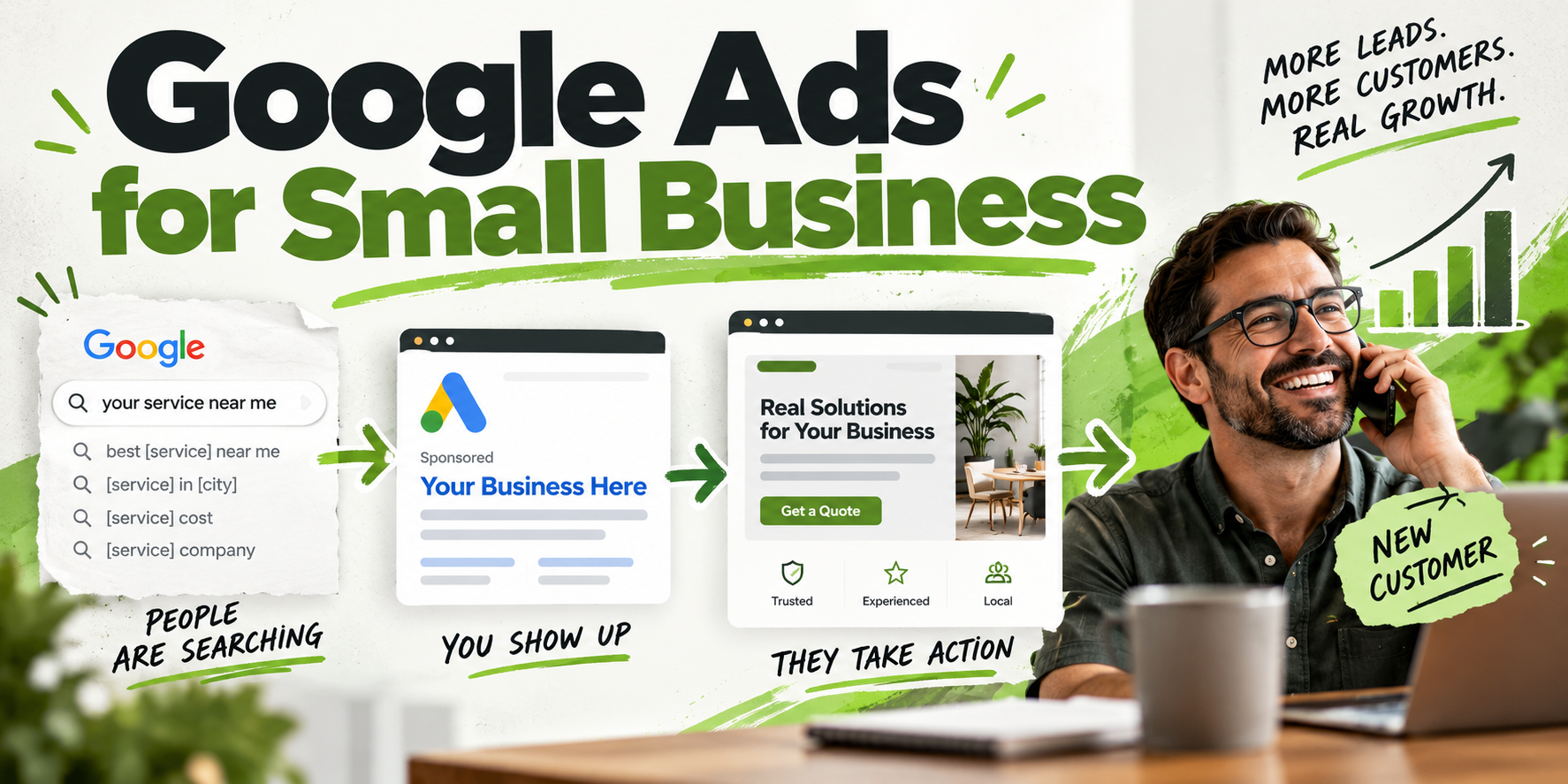
Google Ads for Small Business: How They Work, What They Cost, and When They’re Worth It
Google Ads can put a small business in front of someone at a valuable moment: when they are actively searching for what that business sells.
That is what makes paid search attractive. It is also what makes wasting money surprisingly easy.
A click does not tell you whether someone became a qualified lead. A lead does not tell you whether they became a customer. A campaign can look healthy inside Google Ads and still be a bad investment once you follow the numbers back to the business.
The better question is not simply whether Google Ads works. It is whether your business has enough valuable search demand, healthy customer economics, a strong conversion path, reliable tracking, and the ability to turn opportunities into customers.
At Alchemical Marketing, we approach Google Ads as one part of a broader customer-acquisition system, where paid search, SEO, website conversion, and follow-up need to work together.
If you are still deciding where paid search fits alongside SEO, Local SEO, website optimization, and other channels, our guide to digital marketing services for small business explains which marketing services tend to solve different growth problems.
This guide focuses specifically on Google Ads: how it works, what it costs, when it is worth the investment, how to structure and measure campaigns, and where small businesses most often waste money.
Clicks are not the goal. Customers are.
TABLE OF CONTENTS
Do Google Ads Work for Small Businesses?
Yes. Google Ads can work very well for small businesses when there is valuable search demand and the business can turn that demand into profitable customers.
The size of the company is not the main issue. What matters more is whether people are actively searching for what you sell and whether you can compete for those searches at economics that make sense.
Google Ads is especially useful because it can capture intent that already exists.
“AC repair company near me” signals something very different from “Why is my air conditioner making noise?”
Both searches are relevant to HVAC. One is much closer to hiring someone.
A small business does not need the biggest possible audience. It needs enough valuable demand to justify the cost of acquiring it.
Search intent matters more than traffic volume
A campaign can generate plenty of impressions, clicks, and even leads without producing much business.
Suppose one campaign produces 100 leads and two customers while another produces 40 leads and eight customers.
The first campaign has the cheaper lead. The second may have the much better business outcome.
A cheap lead can be expensive.
That is why cost per lead should not be treated as the finish line. The real question is what happens after the lead enters the business.
Google Ads can expose problems the campaign did not create
Paid search often makes weaknesses elsewhere in the customer journey easier to see.
Relevant traffic that reaches a confusing website is a conversion problem.
Qualified calls that go unanswered are a follow-up problem.
Tracked conversions with little relationship to revenue are a measurement problem.
Google Ads puts a price tag on the traffic, so these weaknesses become harder to ignore.
When Google Ads has a strong foundation
Google Ads tends to make more sense when:
- people already search for what the business sells
- those searches carry meaningful commercial intent
- customer value can support paid acquisition
- the website or landing page can convert demand
- meaningful conversions can be tracked
- the business can respond to and close opportunities
It may struggle when search demand is weak, margins cannot support acquisition, the offer is unclear, the website leaks qualified traffic, tracking is unreliable, or follow-up is poor.
Those are the conditions that determine whether the advertising has a real chance to work.
The Google Ads Readiness Filter
Before worrying about keywords, bidding strategies, campaign types, or ad copy, run the business through five questions.
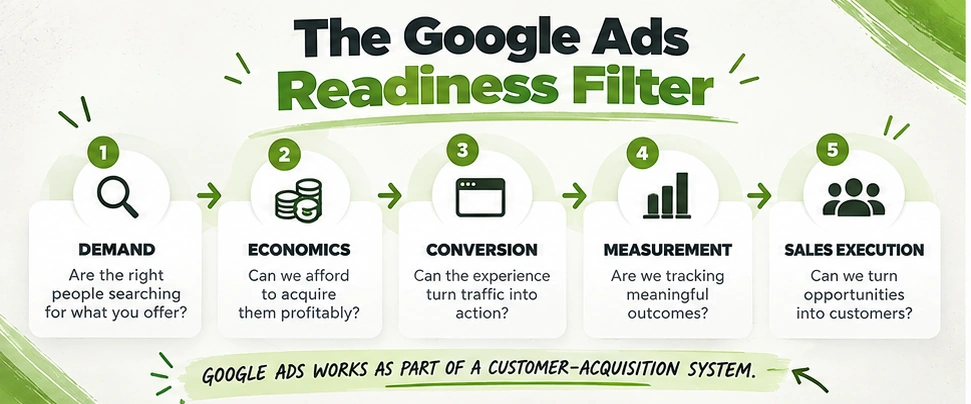
1. Demand: Are the right people actually searching?
Start with demand.
The useful question is not “Can we run Google Ads?”
You can.
The better question is whether enough potential customers are searching with intent that could realistically turn into business.
Look at:
- what people search
- how often they search
- how commercially valuable those searches appear
- where those searches happen
- how closely the search relates to the service
- how much competition exists for that demand
A smaller pool of high-intent searches can be more valuable than a much larger pool of general traffic.
2. Economics: Can we afford to acquire the customer?
Work backward from the business.
What is a customer worth? What gross profit does the average customer create? How often do leads become customers? How much can the business reasonably spend to acquire one?
The useful chain is:
Cost per Click → Cost per Lead → Cost per Qualified Lead → Cost per Customer → Customer Value
If the economics work at the bottom, an expensive-looking CPC may still be reasonable.
If the economics fail at the bottom, slightly cheaper clicks may not save the strategy.
3. Conversion: Can the business turn paid traffic into action?
The searcher needs to land somewhere that matches what they were looking for.
The page should quickly answer:
- Am I in the right place?
- Does this company solve my problem?
- Can I trust them?
- What should I do next?
If those answers are buried, paid traffic gets expensive quickly.
4. Measurement: Do we know which outcomes actually matter?
Modern Google Ads relies heavily on conversion data and automated bidding.
That makes measurement more important, not less.
If the system believes every lead is equally valuable when the business knows otherwise, there is a disconnect between the optimization goal and the actual business goal.
Better automation starts with better business signals.
5. Sales Execution: Can we turn the opportunity into revenue?
Follow the lead outside Google Ads.
Ask:
- Was the phone answered?
- Was the lead contacted?
- Was the inquiry qualified?
- How quickly did someone respond?
- Was there meaningful follow-up?
- Did the prospect book?
- Did they buy?
If the sales process is the bottleneck, increasing ad spend can magnify the problem.
The full filter
Demand → Economics → Conversion → Measurement → Sales Execution
If one area is weak, identify it.
If several are weak, fixing them may create more value than increasing the advertising budget.
Google Ads is one part of a customer acquisition system, not an isolated channel.
How Does Google Ads Work for a Small Business?
Google Ads helps a small business compete for visibility when someone searches for something related to its products or services.
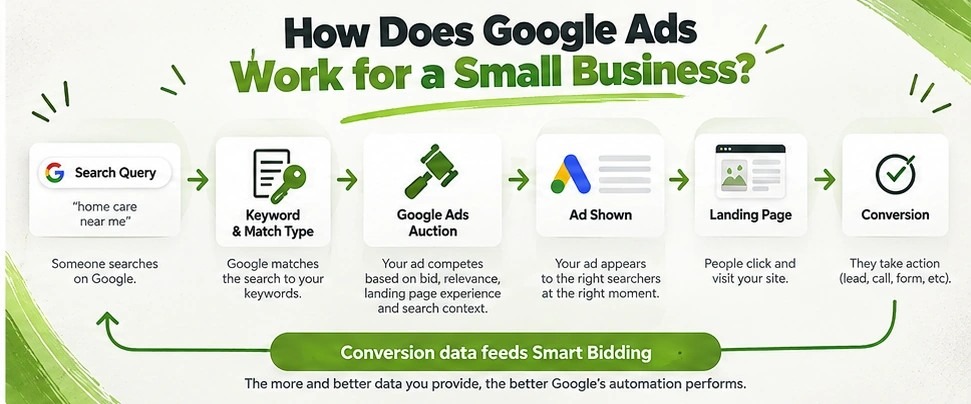
The basic path is:
Search → Match → Auction → Ad → Landing Page → Conversion → Customer
Each step affects both cost and lead quality.
The ad auction happens every time someone searches
When a person searches Google, eligible advertisers can enter an automated auction.
The highest bidder does not simply win.
Google uses Ad Rank to determine whether an ad can show and where it may appear. Ad Rank considers the bid, ad and landing-page quality, auction competition, search context, thresholds, and the expected impact of assets.
That gives smaller advertisers an opportunity to compete through relevance and focus, not budget alone.
Keywords and search terms are different
A keyword is something you add to Google Ads to help define the searches you want to compete for.
A search term is what the person actually searched.
Those are not always the same.
The search terms report shows the queries that triggered your ads. Reviewing it is essential because it reveals where the budget is actually going and where negative keywords may be needed.
Keywords tell Google where to look. Search terms show you where the money went.
Broad, phrase, and exact match are more semantic than they used to be
Google currently offers three main keyword match types:
- Broad match can show ads on searches Google considers related to the keyword.
- Phrase match can show on searches that include the meaning of the keyword.
- Exact match can show on searches Google considers to have the same meaning or intent.
Exact match no longer means the search must reproduce the keyword word for word.
Google also recommends combining broader matching with conversion-based Smart Bidding in appropriate campaigns because the system can evaluate more auction-time signals.
That does not make broad match universally better.
The right choice depends on tracking quality, budget, bidding strategy, account maturity, and how costly irrelevant traffic would be.
The auction is about more than the bid
Google also provides Quality Score as a diagnostic across expected click-through rate, ad relevance, and landing-page experience.
It can help identify weak points, but it should not become the business goal.
A beautiful Quality Score does not pay the bills. Customers do.
Bidding tells Google what to optimize
Some bidding strategies focus on clicks. Others focus on conversions or conversion value.
Smart Bidding uses auction-time signals to adjust bids based on the likelihood or expected value of a conversion.
That makes measurement especially important.
If a qualified consultation, a ten-second call, and a job application are all treated as equally valuable primary conversions, the system receives a poor definition of success.
The smarter the automation becomes, the more important clean business signals become.
Ads, assets, and landing pages have to continue the same conversation
Responsive search ads let advertisers provide multiple headlines and descriptions that Google can combine and test.
Assets can add links, phone numbers, locations, images, and other useful information.
The goal is not to fill every available field. It is to make the ad more useful and relevant.
Then the landing page has to deliver on the promise.
If someone searches for a specific service, the page should quickly confirm what is offered, who it is for, where it is available, why the business is credible, and what to do next.
Where AI Max fits
AI Max is an optimization layer for Search campaigns that can expand matching, customize ad text, and use final URL expansion.
The opportunity is greater automation.
The responsibility is stronger inputs.
Conversion tracking, landing pages, location settings, search-term quality, and business outcomes still need human oversight.
The right question is not whether to use AI. It is whether the campaign gives AI enough good information to make useful decisions.
Are Google Ads Worth It for a Small Business?
Google Ads is worth it when the customers created by the campaign are worth more to the business than the cost required to acquire them at an acceptable margin.
That is a better standard than asking whether the clicks feel expensive.
Follow the economics all the way down the funnel
The useful chain is:
Cost per Click → Cost per Lead → Cost per Qualified Lead → Cost per Customer → Customer Value
A keyword can have expensive clicks and still be profitable.
Another can produce cheap leads that almost never become customers.
The further you can measure down the funnel, the better you can judge whether the campaign is actually creating value.
The main benefits of Google Ads
Google Ads can help a small business:
- reach people while they are actively searching for a solution
- control which services, products, locations, and offers receive budget
- get visibility without waiting for organic rankings to develop
- measure which searches and ads lead to action
- test offers and messaging quickly
- scale spend when the economics work
The speed of the feedback loop is a major advantage. It does not guarantee profitability, but it helps the business learn faster.
When it may not be worth it yet
If the offer is unclear, search demand is limited, the website consistently loses qualified visitors, tracking is unreliable, or the economics cannot support the market’s click costs, fix the bottleneck before increasing spend.
How Much Does Google Ads Cost for a Small Business?
There is no universal Google Ads budget for small businesses because cost depends on the market, the searches you want to compete for, and how effectively the business turns traffic into customers.
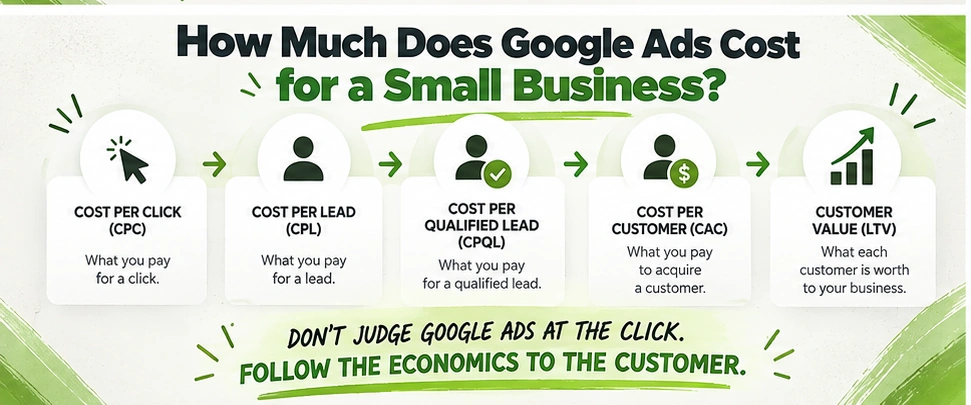
Google Ads is an auction, so click costs can change with competition, search context, geography, ad quality, landing-page experience, and bidding.
Broad industry averages are useful context, not a pricing sheet for your business.
What determines Google Ads cost?
The biggest factors include:
- search competition
- commercial intent
- industry and customer economics
- geography
- match strategy
- ad and landing-page quality
- bidding strategy
- conversion performance
A better question than “Is this CPC expensive?” is:
What can we afford to pay to acquire a customer, and what does the market require to reach one?
Ad spend and management cost are different
Ad spend is the money paid to Google.
Management cost is the time or money required to plan, build, measure, and improve the campaign.
Managing the account yourself can reduce outside fees, but it still consumes time and expertise.
What is a good starting budget?
There is no responsible universal number.
A useful starting budget should be large enough to participate in the searches that matter and collect enough meaningful data to evaluate performance.
A practical process is to:
- identify the searches and services that deserve priority
- estimate the likely click-cost range in the market
- define meaningful conversion actions
- work backward from customer economics
- start with a scope the business can learn from
- scale only after the data supports scaling
If the budget can buy only a handful of clicks in a competitive market, learning may be slow.
If the budget is far larger than the business can responsibly absorb while tracking and conversion are unproven, the lessons can get expensive quickly.
When should you increase the budget?
Increase spend when you understand which searches are valuable, which conversions are meaningful, what it costs to acquire customers, and whether the business has capacity for more.
More budget should amplify something that works, not substitute for understanding why it does not.
How to Use Google Ads for a Small Business
A strong small-business campaign starts with the business outcome and works backward into Google Ads.
1. Define the outcome and tracking first
Do not begin with “We need clicks.”
Begin with the business action you actually want:
- qualified calls
- consultation requests
- booked appointments
- purchases
- quote requests
- revenue from a specific service
Set up conversion tracking before the campaign becomes dependent on automated optimization.
For lead-generation businesses, measurement may eventually include qualified leads and closed customers, not only form submissions.
Google distinguishes between primary conversions used for bidding and secondary conversions used mainly for observation. Use that distinction carefully.
2. Structure campaigns around meaningful business differences
A small account does not need dozens of campaigns simply because Google allows it.
Separate campaigns when you need to manage something differently, such as budget, geography, service line, conversion goal, profitability, or bidding objective.
Within campaigns, group closely related searches and offers so the ad and landing page remain relevant.
The goal is enough structure to make good decisions, not maximum complexity.
3. Start with the highest-value search intent
A limited budget should usually focus first on searches closest to the action the business wants.
“How much does tree removal cost?” and “tree removal company near me” may both matter, but they do not carry the same intent.
Start where search intent and business value overlap most clearly.
4. Build keyword themes around how customers actually search
Use keyword research to understand service terms, location modifiers, urgent searches, problem-based searches, branded searches, and obvious irrelevant meanings.
Organize related terms into logical ad groups.
Modern matching is semantic enough that you do not need dozens of nearly identical ad groups for tiny wording differences.
5. Write clear ads and use useful assets
Strong search ads are usually clearer than they are clever.
The searcher should quickly understand what you offer, whether it matches the search, why they should consider you, and what to do next.
Use sitelinks, call assets, location assets, image assets, and other extensions when they genuinely make the ad more useful.
6. Send traffic to the page that best answers the search
The homepage is not automatically the best destination.
A focused service or landing page may be better when the search is specific.
The page should make the query, ad promise, offer, location, and next action feel connected.
7. Use location and scheduling intentionally
Local businesses should target the areas they can actually serve and review Google’s location targeting options rather than assuming the map alone controls who sees the ad.
Ad scheduling should match the conversion path.
A phone-heavy business may care about staffed hours. A business that accepts forms or online bookings may not need the same restriction.
8. Review search terms and negative keywords
Keyword selection is only the starting point.
Review what people actually searched and ask whether each pattern is relevant, commercially useful, and worth paying for.
Use negative keywords to reduce repeated irrelevant traffic, especially when broader match types are involved.
9. Use remarketing when the buying cycle is longer
Not every visitor is ready to convert on the first visit.
Remarketing can help keep the business visible to people who have already interacted with the site, especially when customers need time to compare options or involve other decision-makers.
The goal is to support the decision, not follow people around indefinitely with the same generic message.
10. Use Smart Bidding and AI with good inputs
Automation is most useful when conversion tracking is accurate, the objective is clear, budgets are intentional, landing pages are strong, and the business understands which leads are valuable.
Automate the mechanics. Keep human judgment on the business.
11. Connect campaign data to lead quality and test deliberately
For many service businesses, a form fill is only the beginning.
When possible, connect Google Ads with CRM and offline conversion data so you can see which leads were qualified, which opportunities were created, and which customers closed.
Google’s enhanced conversions for leads can help connect downstream lead outcomes with advertising.
Then test one meaningful hypothesis at a time so you can actually learn from the result.
What Keywords Should a Small Business Target in Google Ads?
Prioritize keywords that connect meaningful search intent with a product or service the business can profitably deliver.
The best keyword is not necessarily the one with the most searches. It is the one that creates the best business opportunity.
Start with commercial intent
Look for searches that suggest the person is moving toward action, such as service names, provider searches, location terms, urgent problem searches, or modifiers such as quote, price, hire, buy, book, and near me when they fit the industry.
Informational searches can still be useful, but they usually sit farther from a transaction and deserve closer scrutiny when budget is tight.
Long-tail does not automatically mean cheaper or better
More specific searches can be easier to interpret, but they may still be expensive or low volume.
Judge keywords by intent, relevance, competition, conversion quality, and business value.
Negative keywords are part of keyword strategy
Think about what you do not want as well as what you do.
Depending on the business, that can include jobs, training, free resources, DIY intent, unrelated services, or locations outside the service area.
Match type should then reflect tracking quality, bidding strategy, budget, account maturity, and tolerance for irrelevant traffic.
How Should Local Small Businesses Use Google Ads?
Local businesses should concentrate spend around the services, searches, and geographic areas where they can actually serve customers profitably.
Target the real service area
Do not target an entire state because the setting makes it easy if the business can realistically serve only a handful of cities.
If profitability varies by market, evaluate location performance separately.
Review the location option, not just the map
Google location targeting can include people physically in an area and, depending on the setting, people who have shown interest in it.
A business that only serves customers physically within a defined area should review whether a Presence setting is more appropriate.
Then monitor actual geographic performance.
Keep the local experience consistent
When geography matters, the ad and landing page should quickly confirm that the business serves the area, offers the relevant service, is credible, and provides a clear next step.
For multi-location businesses, separate campaigns only when budgets, offers, goals, service areas, or economics genuinely need separate management.
The Biggest Google Ads Mistakes Small Businesses Make
Most Google Ads waste comes from a handful of recurring mistakes.
Optimizing for clicks instead of customers
Cheaper traffic is not an improvement if it creates worse business.
Treating every conversion as equally valuable
A qualified consultation and an accidental ten-second call should not teach the bidding system the same lesson.
Launching before tracking works
You can spend money without reliable tracking. You just cannot learn very intelligently from it.
Targeting too broadly before understanding what converts
Broad reach can be useful, but expanding before you understand lead quality often expands uncertainty.
Ignoring search terms
The keyword list is not enough. Review the real searches behind the spend and use negatives when patterns are irrelevant.
Sending every click to the homepage
Paid-search visitors often have specific needs. Use the page that best continues the intent behind the search.
Spreading a small budget across too many priorities
A limited budget divided across too many services, markets, and campaign types may not give any area enough room to learn.
Prioritize first. Expand after something works.
Letting automation run on weak inputs
Smart Bidding and AI can make decisions at enormous scale.
Weak conversion definitions, landing pages, or lead-quality feedback can simply help the system make the wrong decisions faster.
Ignoring lead handling
A good lead that goes unanswered is still a lost opportunity.
Marketing and sales cannot be measured as separate universes when the goal is revenue.
How Should a Small Business Measure Google Ads Success?
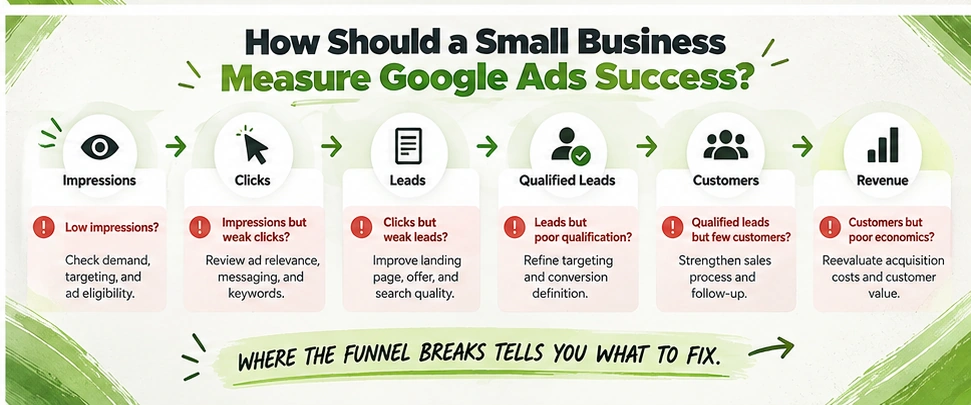
Measure Google Ads from the top of the funnel down to the business outcome, and do not stop at the first metric that looks good.
Visibility and traffic
Impressions, impression share, clicks, click-through rate, and cost per click help diagnose reach and engagement.
They are useful, but they are not proof of profitability.
Conversions and qualified conversions
Calls, forms, purchases, bookings, and quote requests show whether traffic takes action.
For lead generation, go one step further:
- Was the person in the service area?
- Did they want a service you offer?
- Were they a real prospect?
- Did they meet the business’s qualification criteria?
Customers and economics
When possible, measure:
- customers acquired
- revenue
- cost per customer
- customer acquisition cost
- conversion value or return on ad spend where appropriate
- gross profit or contribution margin when available
The diagnostic chain is:
Impression → Click → Lead → Qualified Lead → Customer → Revenue
Where that chain breaks tells you what to investigate.
Weak clicks point toward relevance or messaging. Strong clicks but weak leads point toward search quality, offer, or landing page. Strong leads but weak customer results point toward qualification or sales execution.
When CRM or offline conversion data is available, feed better downstream outcomes back into measurement and bidding.
A cheap lead is not better if it is less likely to become a customer.
Can a Small Business Compete With Bigger Advertisers?
Yes. A small business can compete without trying to outspend larger advertisers across every search.
The advantage usually comes from focus: specific services, geographies, valuable searches, strong landing pages, clean measurement, and fast follow-up.
Ad Rank also means budget is not the only factor in the auction.
The goal is not to beat the largest advertiser everywhere.
It is to win enough of the right opportunities at economics that work for your business.
Google Ads vs. SEO: Which Should a Small Business Prioritize?
Google Ads and SEO solve different versions of the same visibility problem. The better priority depends on demand, economics, timing, competition, and the current bottleneck.
Google Ads lets you pay to compete for search visibility now.
SEO builds organic visibility over time.
Paid search is often attractive when high-intent demand already exists and the business wants immediate visibility or faster market feedback.
SEO is often attractive when the business wants durable organic discovery and can invest over time.
Many businesses eventually use both.
Our guide to small business SEO goes deeper into the organic side.
The useful question is not “Which channel is better?”
It is “Which channel fits the current opportunity and problem?”
Should You Manage Google Ads Yourself or Hire an Agency?
A small business can manage Google Ads internally when the account is simple, someone has time to learn it, and the cost of mistakes is manageable. Professional management becomes more valuable as spend, tracking, and complexity increase.
DIY may make sense when
- the business has a small number of services
- the geography is straightforward
- tracking is relatively simple
- someone can review search terms and performance consistently
- the owner or team genuinely wants to learn paid search
The learning curve is strategic as well as technical. Someone still has to judge search quality, conversion value, bidding, landing pages, and economics.
Professional management may make sense when
- spend is large enough that optimization has meaningful financial impact
- multiple services or locations need different strategies
- tracking or CRM integration is complex
- lead quality varies significantly
- nobody internally can manage the account consistently
A good PPC manager does more than press buttons. The real value is diagnosing where the acquisition system is breaking.
Our Google Ads management page explains how Alchemical approaches campaign strategy, tracking, optimization, and lead quality.
If you are comparing a broader relationship across multiple marketing channels, our guide to choosing a digital marketing agency for a small business explains what to evaluate before hiring a partner.
Building a Google Ads Strategy That Fits the Business
The strongest Google Ads strategy is not the one with the most keywords, campaigns, or automation.
It is the one that connects:
Valuable Search Demand → Relevant Ad → Useful Landing Page → Meaningful Conversion → Qualified Opportunity → Customer → Healthy Economics
Start with the business.
Understand what a customer is worth, what people search, which actions matter, and where the funnel is leaking.
Then use Google Ads to capture and optimize that demand.
If the campaign works, scale deliberately.
If it does not, find the bottleneck before buying more traffic.
If you want another set of eyes on the strategy, schedule a meeting with Alchemical Marketing.
Frequently Asked Questions About Google Ads for Small Business
Do Google Ads work for small businesses?
Yes, when there is meaningful search demand and the business can turn paid traffic into profitable customers.
Are Google Ads worth it for a small business?
They can be when customer value and profit support the cost required to acquire one.
Judge the channel on customers and economics, not CPC alone.
How much does Google Ads cost for a small business?
There is no standard cost. Competition, geography, industry, search intent, bidding, ad quality, landing pages, and conversion performance all affect what you pay.
What is a good Google Ads budget for a small business?
A good budget is large enough to compete for meaningful searches and collect useful data without exposing the business to more risk than it can responsibly absorb.
Can a small business manage Google Ads itself?
Yes, especially when the account is simple and someone has time to learn targeting, search terms, tracking, bidding, landing pages, and performance analysis.
What keywords should a small business use?
Prioritize searches that are relevant to what you sell and show meaningful commercial intent.
Can a small business compete with larger companies?
Yes. Focus on the services, locations, searches, landing pages, and economics that matter instead of trying to outspend them everywhere.
Is Google Ads better than SEO?
Neither is universally better. Google Ads buys immediate access to search demand. SEO builds organic visibility over time.
Can small businesses get Google Ads for free?
Google Ads is not generally free, although Google and its partners sometimes offer promotional credits with eligibility, spending, and timing requirements.
Should a small business use broad match?
Sometimes. Broad match can expand reach, especially with conversion-based Smart Bidding, but it gives the system more freedom. Use it when tracking is trustworthy and search-term quality is actively monitored.