Is Your Small Business Website AI-Ready? How to Check and What to Fix
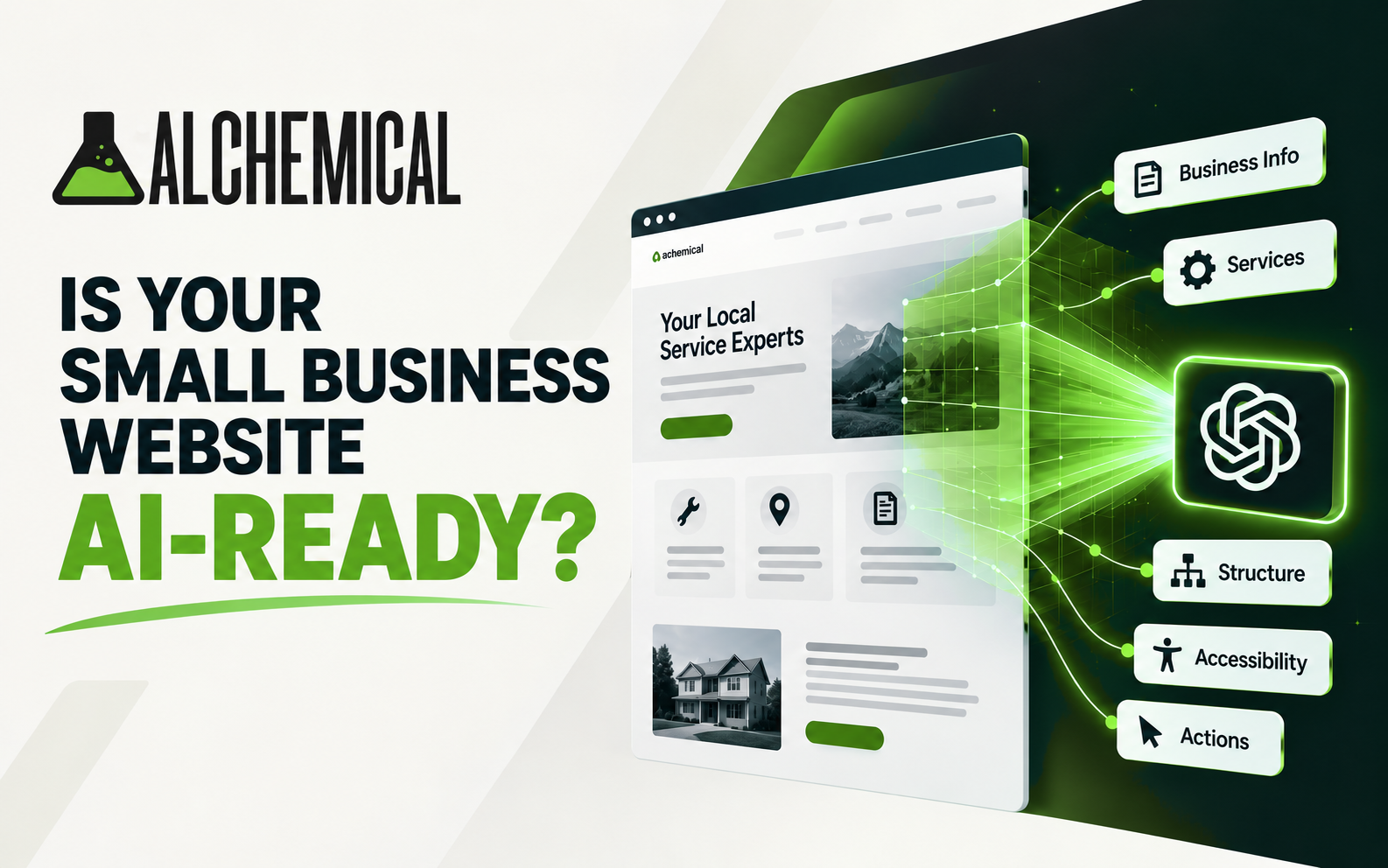
AI search systems can pull information from your website to answer questions. AI agents can go a step further and try to use the site for someone. This is the future of the internet!
That does not mean you need a second website for machines, it means that you need a compatible website for machines.
An AI ready website is one that AI systems can find, understand & when appropriate… interact with without making the experience worse for people.
If your website basics are still shaky, start with our guide to building a small business website that actually works. If you’re looking for a full small-business marketing strategy, Check out our website here: Alchemical Marketing.
TABLE OF CONTENTS
What Is an AI-Ready Website?
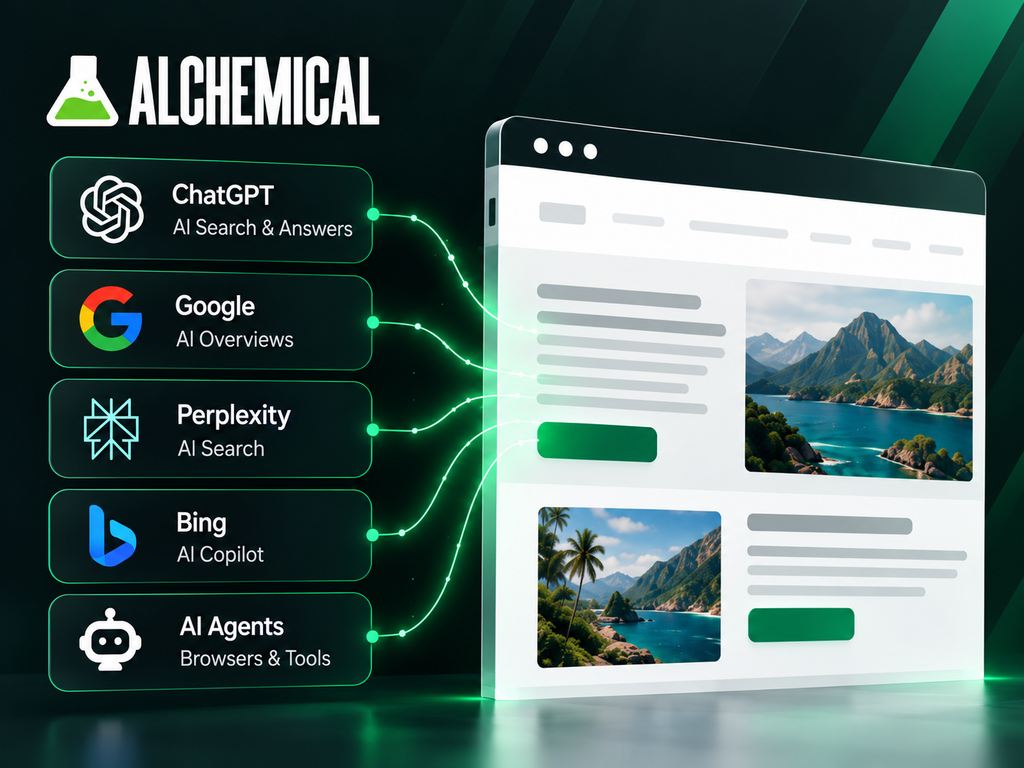
An AI-ready website handles two jobs:
- AI discovery: search & answer systems reach the site, understand the content & connect it to relevant questions that people are actually asking.
- AI agent use: browser agents can understand the page structure, identify controls & complete useful tasks.
Google says its generative search features still rely on core SEO fundamentals meaning SEO IS NOT DEAD. Pages that rank are typically what gets cited as long as your information is true and answer the questions being asked.
Pages should be crawlable, contain useful info & technically clear. Google also says you do not need special AI schema, a special Markdown version, or an llms.txt file to appear in its generative search features (but it doesn’t hurt).
For agents, Google’s guidance adds another layer. Agents may interpret a page through screenshots, HTML & the accessibility tree. Clear structure, labels, roles & predictable interactions matter.
In practice, AI readiness comes down to access, clarity, structure, usability & measurement!
How Do You Check If a Website Is AI-Agent Ready?
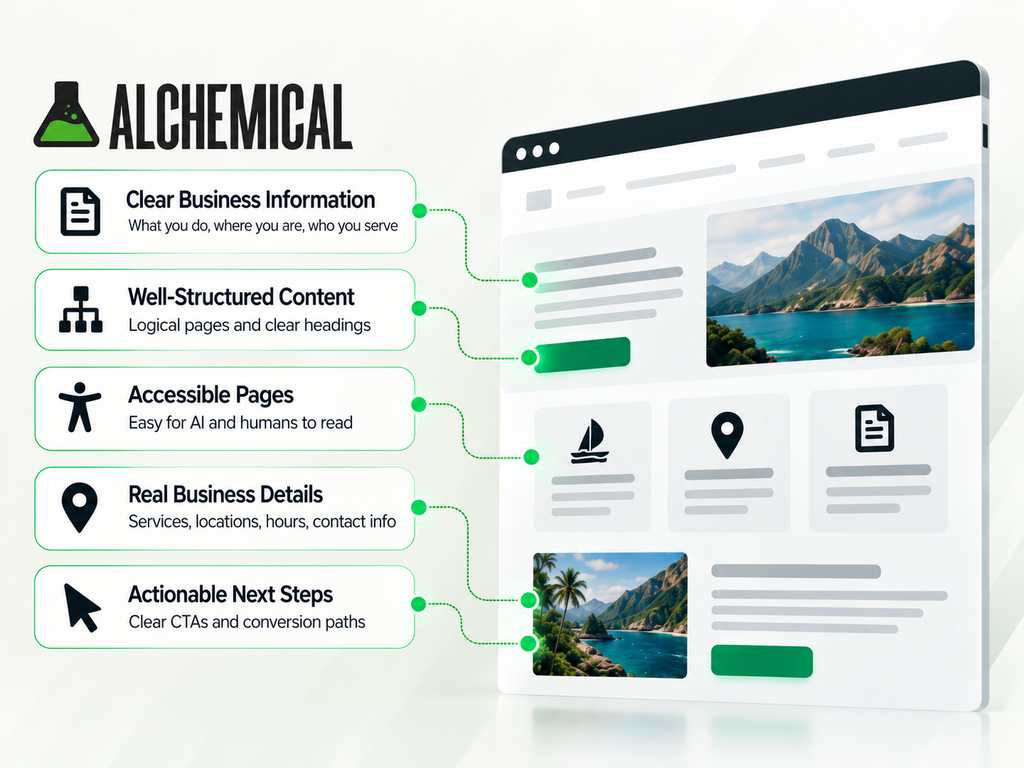
Design a website that an AI system can reach important information, understand it & move through the same basic journey you expect from a customer.
- Access: Can the search crawlers and fetchers you want to reach the important pages?
- Clarity: Is it obvious who the business is, what it offers, who it helps, and where it operates?
- Structure: Are headings, links, forms, buttons, labels, and page relationships clear in the underlying HTML?
- Actionability: Can an agent move through an important task without confusing or hidden controls?
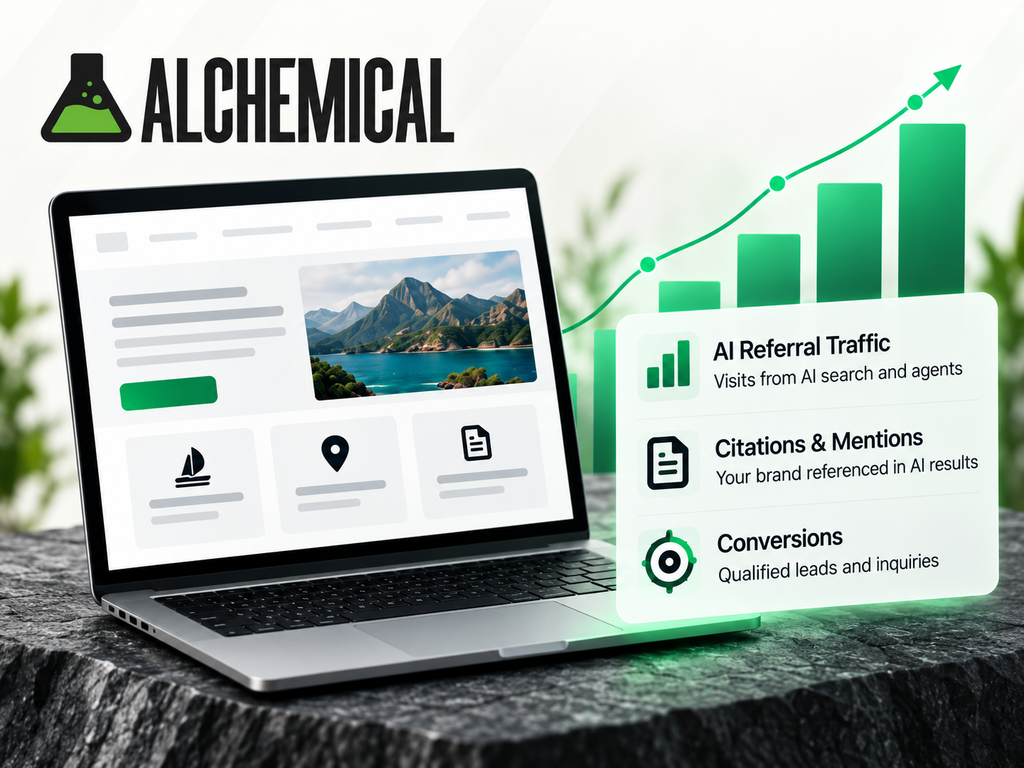
- Measurement: Can you see whether AI-powered discovery is producing visibility, citations, traffic, or conversions?
The first thing to do is fix the biggest blockers. A blocked crawler or unlabeled form matters more than the newest AI optimization tactic.
Can AI Systems Clearly Understand Your Business?
Make sure the AI systems don’t have to guess the basics:
- Business name
- Products or services
- Who those services are for
- Locations or service areas
- What makes each offer different
- Proof behind important claims
- How a customer takes the next step
Clear copy & clear site architecture work together. Thin service pages, conflicting business information or several pages trying to explain the same thing make the site harder to interpret.
Structured data can add machine-readable context. Google describes it as a standardized way to give explicit clues about page meaning. It should match what users can actually see on the page. Make it clear!
Do not treat schema as an AI citation shortcut. Google says special schema is not required for its generative AI features, and Semrush notes that OpenAI and Perplexity have not confirmed that structured data determines citations.
BUT that doesn’t mean you shouldn’t care about the Schema, look at everything holistically!
Can AI Search Engines Find and Interpret Your Content?
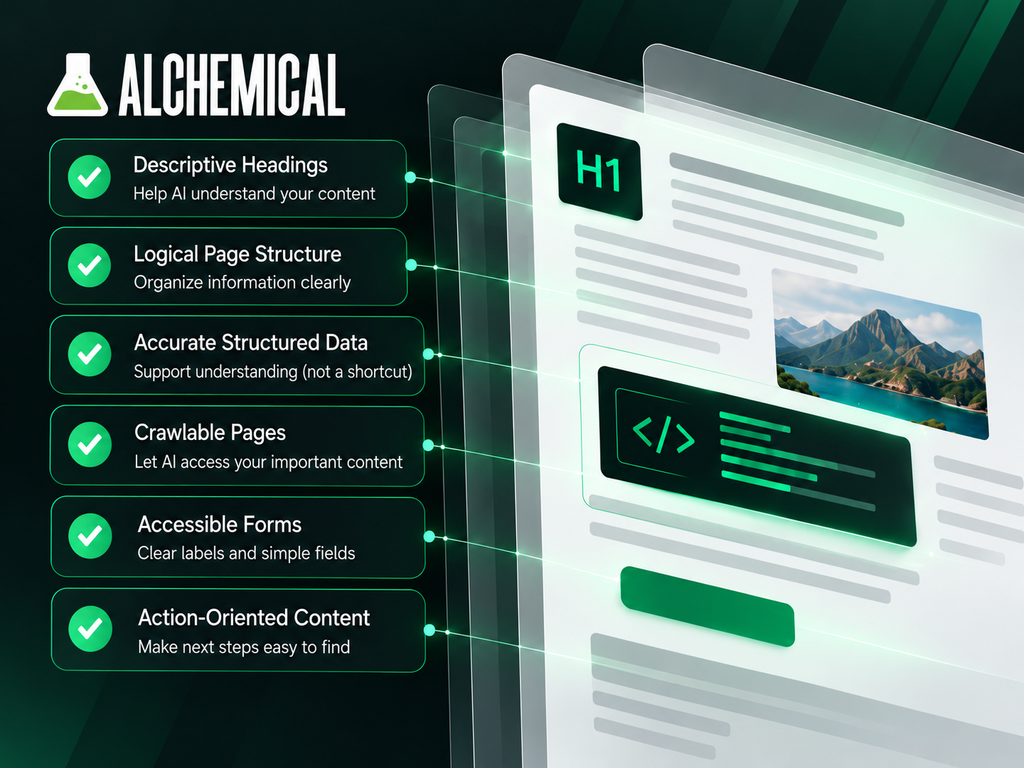
If an AI search system cannot reach a page, nothing else matters.
- Google: important pages should meet Search technical requirements, be crawlable, and be eligible to appear in Search.
- ChatGPT: OpenAI recommends allowing OAI-SearchBot if you want pages eligible for ChatGPT search.
- Perplexity: its documentation recommends allowing PerplexityBot if you want pages surfaced and linked in Perplexity search.
Check out your robots.txt, firewall rules, CDN settings, bot protection & server responses. A crawler can be allowed in robots.txt and still be blocked somewhere else. This can get pretty technical so if you need help make sure to give us a shout at ALCHEMICAL!
Keep the main meaning of important pages available in clear, accessible HTML where practical. Crawler rendering behavior is not identical across platforms.
Content quality still matters the most! Google’s guidance favors useful, people-first content. Do not create a thin page for every possible AI prompt. One strong page should own one real intent family. Think in terms of a cluster of information!
For the broader strategy of getting found in Google and AI search, see our small business SEO guide.
Can AI Agents Actually Use Your Website?
Agent readiness looks a lot like good interface design.
Google’s agent-friendly guidance says browser agents may use screenshots, the DOM, and the accessibility tree. That makes the following basics especially important:
- Use real buttons for actions and real links for navigation.
- Connect form labels to the correct fields.
- Use descriptive link and button text.
- Use semantic headings and page regions.
- Make states clear, including expanded menus, selected options, errors & disabled controls.
- Do not make important actions depend only on hover behavior.
- Keep layouts stable and predictable.
WAI-ARIA provides standard roles, states, and properties that accessibility tools use to understand interfaces. Those same signals can also help browser agents interpret controls.
A simple test: try the site’s main tasks. Submit a form. Book an appointment. Request a quote. Find a location. Complete a purchase. If the path is confusing with keyboard navigation or assistive technology, an agent may struggle too.
This means put yourself in the eyes of the customer by going through the process yourself and maybe have friends and family do the same and give feedback!
How Do You Know Whether Your Website Is Showing Up in AI?
AI visibility measurement is still evolving, so there is no single universal ranking report.
Useful signals include:
- Google Search Console data for Google’s generative search experiences
- ChatGPT referral traffic, including utm_source=chatgpt.com when present
- Landing pages receiving AI referral traffic
- Whether important brand & service questions return accurate answers
- Citations or mentions for topics that matter to the business
- Calls, forms, bookings, sales, or other conversions from that traffic
Third-party AI visibility tools can help, but treat their scores as diagnostics (they’re not always right unfortunately). Google says third-party tools do not have access to its internal ranking or AI systems.
Ahrefs has found correlations between authoritative branded web mentions and AI visibility. That is useful evidence, but correlation is not proof of causation.
HubSpot’s AEO audit framework is also useful because it separates different problems: content coverage, answerability, schema, and off-site citation sources. Different problems need different fixes.
What Should a Small Business Fix First?
1. Make sure important pages can be reached
Check indexing, robots.txt, firewall rules, CDN settings, and bot protection. Fix accidental blocks first.
2. Make the business easier to understand
Clarify services, locations, page purpose, proof, contact information, and the next step.
3. Clean up the underlying structure
Use semantic HTML where practical. Keep important content in the page itself. Use accurate structured data where it belongs. Connect related pages with clear internal links.
4. Make important actions accessible and predictable
Label forms, use proper controls, test keyboard access, and make errors easy to understand.
5. Measure before adding more tactics
Set a baseline for search visibility, AI referrals, citations where measurable, and website conversions.
Lower priority: chasing llms.txt, publishing pages for every prompt variation, or installing a plugin that promises instant ‘AI optimization.’ None replaces access, clarity, structure, usability, and useful content.
AI-Ready Website Checklist for Small Businesses
- Can the search and AI crawlers you want reach the important pages?
- Are those pages indexable where search visibility matters?
- Does every major page have one clear purpose?
- Is it obvious what the business offers, who it helps, and where it operates?
- Are services, locations, contact details, and company information consistent?
- Is important content available in clear HTML?
- Do headings, links, and buttons clearly describe the page and next action?
- Are form fields properly labeled and key tasks keyboard-friendly?
- Does structured data accurately match visible content where it is used?
- Do important pages connect through useful internal links?
- Can you track AI referral traffic and conversions where data is available?
- Have you checked how major AI search experiences describe your business?
- Are you publishing useful original content instead of thin prompt-targeted pages?
If several answers are no, start with the fixes that help both people and machines: clearer content, better navigation, accessible forms, clean internal links, and reliable measurement.
The Goal Is Not to Build a Website for Robots
Do not build one website for customers and another for AI.
Build one clear, useful website with sound technical structure, accessible controls, easy next steps, and content the search systems you care about can reach.
AI readiness should be an extension of a website that already works, not a collection of new tricks.
If you are planning a new site or reviewing an existing one, explore our web design and development approach. Ready to talk through what the site needs to do? Schedule a meeting.
Frequently Asked Questions About AI-Ready Websites
What is an AI-ready website?
A website AI systems can access, understand, and, when appropriate, use. That usually means strong SEO basics, clear content, sound technical structure, accessible controls, and measurable user paths.
Is an AI-ready website the same as a website built with AI?
No. AI-ready describes how well AI systems can discover, interpret, and use the site, not which tool built it.
Do I need an llms.txt file to make my website AI-ready?
Not for Google Search. Google says llms.txt is not a special signal for Search or its generative AI features. Other platforms may handle it differently.
Does schema markup help my website appear in ChatGPT or Perplexity?
Structured data can clarify page meaning, but there is no public confirmation that schema alone makes ChatGPT or Perplexity cite a page.
How can I make my website eligible for ChatGPT search?
OpenAI recommends allowing OAI-SearchBot and making sure your host, CDN, or security layer does not block its published searchbot traffic. Eligibility does not guarantee placement.
How can I make my website easier for AI agents to use?
Use semantic HTML, clear links and buttons, proper form labels, accessible roles and states, stable layouts, and predictable task flows.
What is the difference between an AI-ready website and AI search optimization?
AI readiness is about whether the website can be accessed, understood, and used by AI systems. AI search optimization is the broader work of improving visibility and authority in AI-powered discovery.
Sources
- Google Search Central — Optimizing your website for generative AI features on Google Search — https://developers.google.com/search/docs/fundamentals/ai-optimization-guide
- web.dev — Build agent-friendly websites — https://web.dev/articles/ai-agent-site-ux
- OpenAI Help Center — Publishers and Developers FAQ — https://help.openai.com/en/articles/12627856-publishers-and-developers-faq
- OpenAI Help Center — Searching the web with ChatGPT — https://help.openai.com/en/articles/9237897/searching-the-web-with-chatgpt
- Perplexity — Perplexity Crawlers — https://docs.perplexity.ai/docs/resources/perplexity-crawlers
- Google Search Central — Introduction to structured data markup in Google Search — https://developers.google.com/search/docs/appearance/structured-data/intro-structured-data
- Google Search Central — Google Search technical requirements — https://developers.google.com/search/docs/essentials/technical
- W3C Web Accessibility Initiative — WAI-ARIA Overview — https://www.w3.org/WAI/standards-guidelines/aria/
- Semrush — How to prepare your site for AI agents — https://www.semrush.com/blog/how-to-prepare-your-site-for-ai-agents/
- Semrush — Google’s AI search optimization guide: what to do next — https://www.semrush.com/blog/google-ai-search-optimization-guide/
- Ahrefs — What We Actually Know About Optimizing for LLM Search — https://ahrefs.com/blog/llm-search/
- Ahrefs — How to Rank on ChatGPT: What Actually Works — https://ahrefs.com/blog/how-to-rank-on-chatgpt/
- HubSpot — How to optimize your website for AI search — https://blog.hubspot.com/marketing/optimize-website-ai-search
- HubSpot — Diagnosing AEO gaps: A content audit guide — https://blog.hubspot.com/marketing/fix-aeo-gaps
- HubSpot — AI search behavior: What it means for your marketing strategy in 2026 — https://blog.hubspot.com/marketing/ai-search-behavior