

TABLE OF CONTENTS
When a family searches for “home care near me,” they are often dealing with an immediate need—not casually researching a service they may use next year.
Your agency’s visibility at that moment depends on more than adding city names to your website. Strong home care local SEO requires accurate business information, useful local content, genuine reviews, community authority, and a reliable way to measure which searches become care inquiries.
Google explains that local results are primarily determined by three factors:
- Relevance: How closely your business matches the search
- Distance: How far the business is from the person searching
- Prominence: How established and well known the business appears
No single optimization can control all three. The goal is to build a complete local presence that helps Google understand your agency while giving families enough confidence to contact you.
The direct answer: Home care agencies can improve local search visibility by completing an accurate Google Business Profile, publishing useful service and location pages, correcting inconsistent business listings, earning relevant local mentions, collecting genuine reviews, implementing accurate structured data, and tracking qualified inquiries.
Home care local SEO requires a complete system—not a single profile, page, or keyword.
Local SEO is one part of a broader home care SEO strategy that also includes site structure, service pages, educational content, technical SEO, authority, and conversion tracking.
How Does Google Evaluate Local Home Care Results?
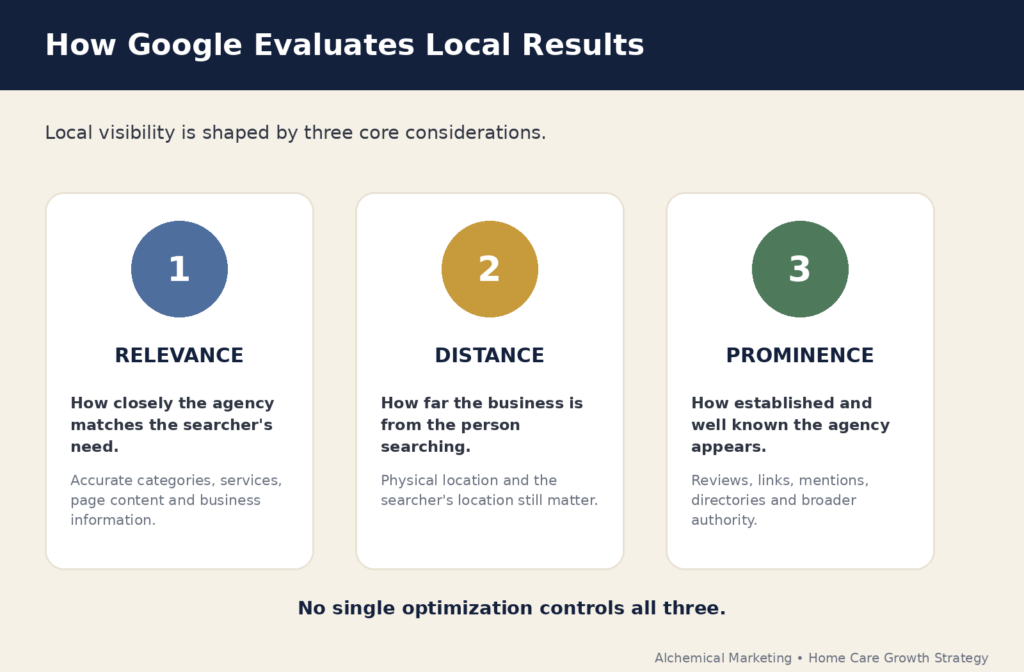
Google’s local search system attempts to find businesses that are relevant to the search, reasonably close to the person searching, and prominent enough to appear trustworthy.
Google identifies relevance, distance, and prominence as its primary local ranking considerations.
Relevance can be strengthened by accurate categories, detailed services, useful website content, and consistent business information.
Distance is influenced by the relationship between the person searching and the business location. Listing a city as a service area does not remove geography from the equation.
Prominence reflects how established the business appears across the web. Reviews, local links, directory listings, media mentions, and other authority signals can all contribute to this broader picture.
The following ten steps create the foundation for a stronger home care local search presence.
1. Claim and Verify Your Google Business Profile
For an eligible home care agency, Google Business Profile is one of the most important parts of local visibility. It controls how the agency’s information may appear across Google Search and Maps.
Start by claiming and verifying the profile. Verification confirms that you are authorized to represent the business and gives you control over its primary information.
Complete every applicable field, including:
- Established business name
- Main phone number
- Website
- Business hours
- Appointment availability
- Business description
- Opening date
- Services
- Photos
- Service areas
Make sure the information represents the business accurately. Do not add keywords, cities, or service descriptions to the business name unless they are genuinely part of the name used in the real world.
Google states that complete and accurate information makes a business more likely to appear for relevant local searches.
2. Choose Accurate Categories, Services, and Service Areas
Your primary category should be the most specific category currently available that accurately describes the agency.
Google’s category options can change, so confirm the available choices inside the profile rather than relying on an old category list. Add secondary categories only when they represent services the agency actually provides.
Do not add loosely related categories merely to appear in more searches. Categories help Google understand what the business is—not every type of customer the agency would like to attract.
Then complete the services section.
Depending on the agency’s care model, services could include:
- Companion care
- Personal care
- Respite care
- Dementia support
- Post-hospital assistance
- Meal preparation
- Transportation assistance
- Overnight care
- Live-in care
Use clear, family-friendly names and descriptions. Avoid repeating the same city and keyword in every service description.
Configure the Service Area Correctly
A home care agency that visits clients but does not receive customers at its office will usually operate as a service-area business.
An agency that both welcomes customers at a staffed location and provides care in clients’ homes may qualify as a hybrid business.
Google currently allows businesses to define service areas using supported cities, postal codes, and geographic areas. Those areas should reflect where the agency genuinely provides care.
Do not treat service-area settings as a way to manufacture rankings throughout an entire state.
A service-area business should generally have one profile covering its actual territory—not a separate profile for every city it serves. Additional profiles should represent genuine, staffed, and eligible business locations.
3. Use Posts and Photos to Improve Conversion
Google Business Profile posts and photos can make the agency look more current, credible, and useful to families comparing providers.
Useful home care posts could cover:
- A new service area
- Caregiver training initiatives
- Educational resources for families
- Changes to consultation hours
- Community involvement
- A newly published guide
- Questions families should ask when comparing agencies
Useful photos may include:
- Leadership and office staff
- The exterior of a public office
- Branded vehicles
- Community events
- Training sessions
- Educational materials
- Approved team photos
Do not claim that publishing a certain number of posts or photos will automatically improve rankings. Google does not identify posting frequency as one of its primary local ranking factors.
Use these features primarily to help families recognize, understand, and trust the agency.
The 10-Step Home Care Local SEO Roadmap
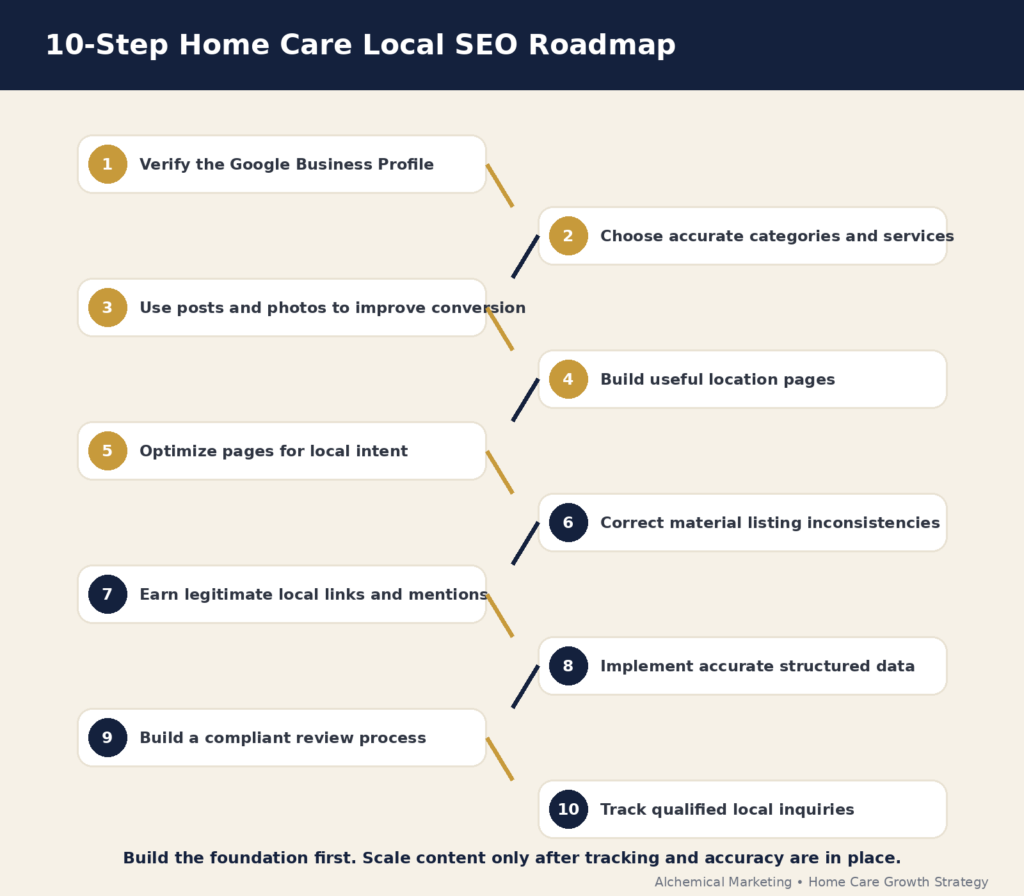
Build the foundation first. Scale local content only after business information and conversion tracking are accurate.
The sequence matters. An agency should not publish dozens of location pages while its Google Business Profile, listings, website, or tracking remain incomplete.
4. Build Useful Location Pages—Not Doorway Pages
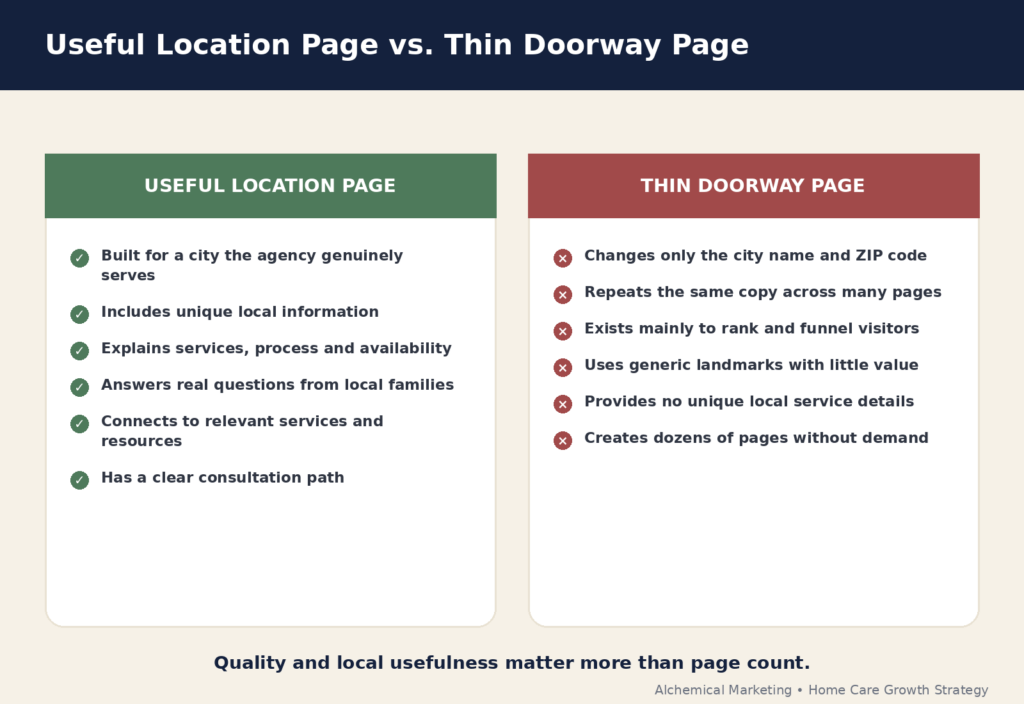
A general service page may rank for the city where the agency is established, but it may not adequately address families in every community the agency serves.
A dedicated location page can help when the agency has a legitimate reason to provide city-specific information.
The page should answer questions that matter to families in that community—not simply replace one city name with another.
A strong location page may include:
- The services available in that area
- The agency’s consultation and care-start process
- Communities or neighborhoods covered
- Relevant office or team information
- Local caregiver availability considerations
- Transportation or geographic considerations
- Local aging and caregiver resources
- Frequently asked questions from families in that area
- A clear way to request a consultation
There is no universal word count that guarantees rankings. The page should be long enough to answer the reader’s questions without padding the content.
Avoid Mass-Produced City Pages
Google’s spam policies prohibit doorway abuse, including substantially similar pages built for multiple cities that primarily funnel visitors to the same destination.
Do not publish 50 nearly identical pages that change only:
- The city name
- The ZIP code
- The title
- A few nearby landmarks
Build a location page only when the agency genuinely serves the area and can provide useful, differentiated information.
For smaller service territories, one strong service-area hub may be more useful than dozens of weak city pages.
Useful location pages provide meaningful local information. Doorway pages simply reproduce the same content for multiple cities.
5. Optimize Each Page Around Local Search Intent
Every important service and location page should have a clear purpose.
For example, a page targeting families looking for in-home care in Naperville could use:
SEO title:
Home Care Services in Naperville, IL | Agency Name
H1:
Compassionate Home Care in Naperville, Illinois
Suggested URL:
/locations/naperville-home-care/
The exact wording can vary, but the service and location should appear naturally in prominent places such as:
- The SEO title
- H1
- Opening paragraph
- URL
- Meta description
- Relevant subheadings
- Image alt text where appropriate
- Internal-link anchor text
Write for the family first. The page should sound natural when read aloud and clearly explain why the agency is relevant to that particular community.
Avoid awkward constructions such as repeating “home care in Naperville” in every paragraph.
Strengthen Internal Linking
Every location page should connect naturally to:
- The homepage
- Relevant care-service pages
- A central locations or service-area page
- Helpful educational resources
- Closely related locations when useful
- The consultation or contact page
This creates a clearer site structure and helps families move from geographic information to the specific care service they need.
Do not force the same exact-match anchor text into every page. Use natural variations such as:
- Home care services in Naperville
- Dementia care options
- Explore our service area
- Request a care consultation
- Learn about companion care
6. Correct Material Business-Listing Inconsistencies
Google gathers business information from the business itself, public web content, licensed data, users, and other sources.
That makes accurate listings important, but the goal is not to obsess over harmless formatting differences such as “Street” versus “St.”
Focus on material inconsistencies, including:
- Incorrect business name
- Old address
- Unstaffed or virtual office listed as a location
- Disconnected phone number
- Wrong website
- Incorrect business hours
- Duplicate profiles
- Former service areas
- Incorrect business category
Create a master business-information record containing the approved:
- Business name
- Address or service-area configuration
- Primary phone number
- Website
- Hours
- Description
- Categories
- Services
Compare major listings against that record.
Begin with platforms that are both relevant and eligible for the agency, which may include:
- Google Business Profile
- Apple Business Connect
- Bing Places
- Yelp
- State or local business directories
- Relevant senior-care directories
- Local chamber or business-association listings
Industry directories should be evaluated individually.
For example, Medicare Care Compare applies to eligible Medicare-certified providers and should not be treated as a general directory for every non-medical home care agency.
Accuracy and relevance matter more than submitting the agency to hundreds of low-quality directories.
7. Earn Legitimate Local Links and Mentions
Listings confirm basic business information. Local links and editorial mentions provide a different signal: evidence that the agency is known and connected within its community.
Potential local link opportunities include:
- Chamber of commerce membership
- Local senior-resource organizations
- Community sponsorships
- Caregiver education events
- Local nonprofit partnerships
- Aging-related resource guides
- Hospital or rehabilitation resource pages
- Professional associations
- Local news coverage
- Guest educational contributions
- Community event calendars
The strongest links are usually earned through a legitimate relationship, useful resource, event, or contribution.
For example, an agency could:
- Sponsor a local caregiver-support event
- Provide an educational article for a senior center
- Create a hospital-discharge resource for local families
- Participate in an aging-services coalition
- Offer a workshop for adult children caring for aging parents
- Contribute expert commentary to a local news story
Avoid buying large packages of generic backlinks or submitting the agency to unrelated websites.
Those links rarely help families and may create unnecessary SEO risk.
8. Implement Accurate Structured Data
Structured data gives search engines explicit information about the entities and content on a website.
It can help Google understand the page and may make certain pages eligible for enhanced search features, but it does not guarantee higher rankings or a rich result.
For most home care websites, the structured-data foundation should include:
- Organization for the agency
- LocalBusiness for each genuine business location
- BreadcrumbList for site navigation
- Article or BlogPosting for educational articles
A healthcare-related MedicalBusiness subtype may be appropriate for some licensed medical providers, but it should not be applied automatically to every non-medical home care agency.
Do Not Create a LocalBusiness Entity for Every Service City
A city the agency serves is not automatically a separate business location.
A location entity may contain accurate properties such as:
- Name
- Address
- Phone
- URL
- Opening hours
- Geographic coordinates
- Service area
- Image
- Parent organization
Do not add a fake address or create a separate schema entity merely to target another city.
Avoid Self-Serving Review Markup
A home care agency may display genuine testimonials on its website, but it should not expect review stars to appear because it added LocalBusiness or Organization review markup to its own pages.
Google considers reviews about a business placed on that business’s own website to be self-serving and ineligible for LocalBusiness or Organization review stars.
Validate structured data using:
- Google’s Rich Results Test
- Schema Markup Validator
- Google Search Console
Yoast may already generate Article, Organization, WebPage, and Breadcrumb schema. Review the plugin’s output before manually adding another schema block.
9. Build a Compliant and Policy-Safe Review Process
Reviews help families evaluate trust, communication, responsiveness, and professionalism.
The goal is to build a consistent process for requesting genuine feedback—not to manipulate the agency’s rating.
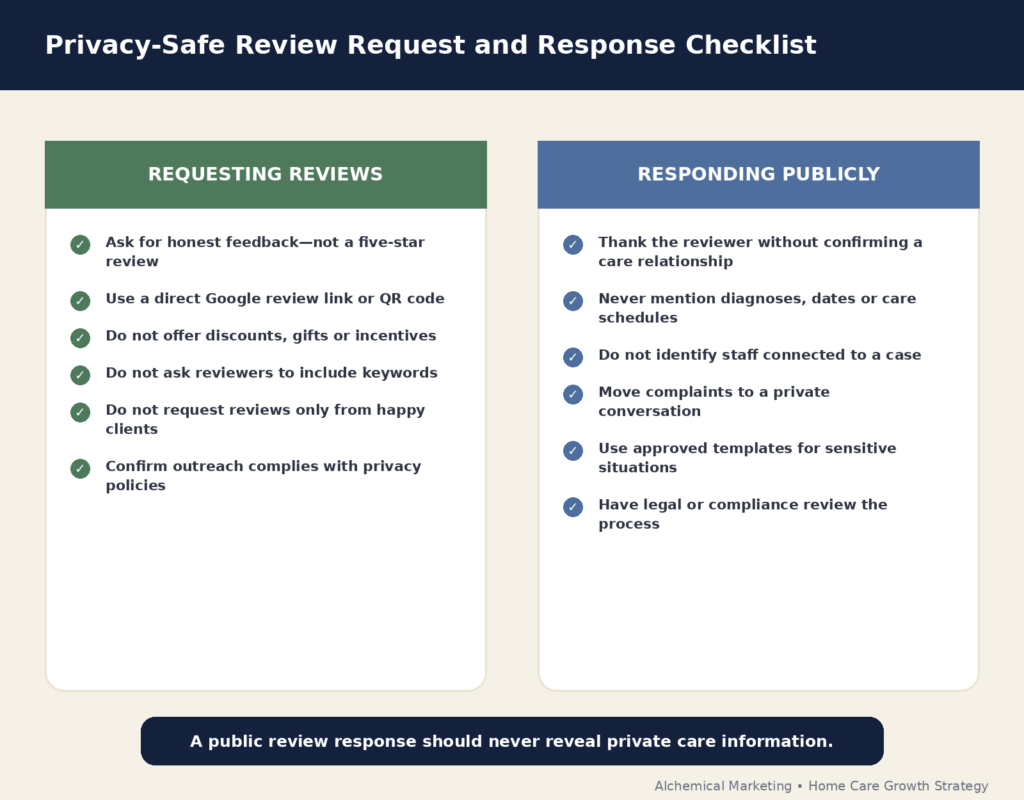
Google allows businesses to share a direct review link or QR code. However, its policies prohibit:
- Paying for reviews
- Offering discounts or gifts for reviews
- Requesting only positive reviews
- Discouraging negative reviews
- Pressuring customers to leave a certain rating
- Asking reviewers to include specific keywords or employee names
- Asking someone to revise or remove a negative review in exchange for a benefit
Reviews should reflect genuine experiences and remain unbiased.
Review requests should remain neutral, while public responses should never reveal private care information.
Account for Healthcare Privacy
HIPAA does not automatically apply to every home care organization. The agency should determine whether it is acting as a covered entity, business associate, or organization governed by another federal or state privacy framework.
Organizations subject to HIPAA must be especially careful when responding to reviews. Healthcare providers have faced enforcement action after disclosing protected health information while responding to negative online reviews.
A reviewer’s decision to discuss their own experience publicly does not give the business permission to disclose additional information.
A safer public response is:
Thank you for sharing your feedback. We take privacy seriously and cannot discuss individual circumstances in a public forum. Please contact our office directly so the appropriate team member can speak with you.
Avoid publicly mentioning:
- Whether the person received care
- A family member’s identity
- Diagnoses
- Care schedules
- Staff assigned to a case
- Insurance or payment details
- Dates of service
- Complaints documented internally
Have the agency’s compliance or legal advisor review the request and response process before implementation.
10. Track Qualified Local Inquiries
Local visibility matters only when it produces meaningful business outcomes.
Define the actions that matter before evaluating performance:
- Calls from qualified prospective clients
- Consultation-request forms
- Scheduled care assessments
- Completed assessments
- New client admissions
- Weekly care hours generated
- Revenue or lifetime value by source
Google Business Profile performance reporting can show applicable metrics such as:
- Searches
- Profile views
- Call-button clicks
- Website clicks
- Direction requests
- Messages
- Bookings
A reported call generally represents a click on the profile’s call button—not necessarily a completed conversation or qualified inquiry.
Combine profile data with:
- Google Analytics 4
- Google Search Console
- Form tracking
- Call tracking
- CRM lead-source fields
- Intake disposition data
- Consultation and admission outcomes
Add campaign parameters to the website link used on the Google Business Profile so visits can be distinguished from other organic traffic.
Then evaluate performance by page and market:
- Which cities produce qualified inquiries?
- Which service pages assist conversions?
- Which search queries produce impressions but few clicks?
- Which pages generate traffic but no consultations?
- Which inquiries become assessments?
- Which assessments become clients?
- Which clients generate sustainable weekly care hours?
Do not describe organic inquiries as free.
Local SEO requires strategy, writing, development, outreach, technology, and ongoing maintenance. Measure the cost of the program against the qualified inquiries and admissions it produces.
What Should a Home Care Agency Prioritize First?
An agency starting from a weak local foundation should normally work in this order:
- Verify and accurately complete the Google Business Profile.
- Correct the primary category, services, hours, and service areas.
- Confirm the website clearly describes services and locations.
- Fix major business-information errors and duplicate listings.
- Establish conversion tracking.
- Improve or build the most commercially important location pages.
- Create a compliant review-request process.
- Earn relevant local links and mentions.
- Implement and validate structured data.
- Review lead quality and update the strategy from actual results.
This sequence prevents the agency from publishing dozens of location pages while its profile, listings, website, or tracking remain incomplete.
Frequently Asked Questions About Home Care Local SEO
How Long Does Home Care Local SEO Take?
There is no reliable universal timeline.
Results depend on the agency’s starting position, market size, competition, physical location, website quality, review profile, local authority, and implementation pace.
Basic corrections may be processed relatively quickly, while competitive organic and map visibility may require sustained work.
Avoid agencies promising a guaranteed ranking by a specific date.
Do Google Business Profile Service Areas Improve Rankings?
Service areas help communicate where the agency provides services, but selecting a city does not guarantee visibility or rankings in that city.
Distance remains one of Google’s primary local ranking considerations. Service-area settings cannot eliminate the geographic relationship between the agency and the person searching.
Does a Home Care Agency Need a Page for Every City It Serves?
No.
Create a city page when the agency genuinely serves the location and can provide useful, differentiated information.
A smaller number of high-quality pages is safer and more useful than dozens of nearly identical pages.
Do Google Business Profile Posts Improve Local Rankings?
Google presents posts as a way to share updates and help customers make decisions.
Google does not list posting frequency as one of its three primary local ranking factors.
Use posts to support trust, engagement, and conversion rather than treating them as a guaranteed ranking tactic.
Does Schema Markup Improve Rankings?
Structured data helps search engines understand entities and page content. It may also make qualifying content eligible for enhanced search appearances.
It does not guarantee a ranking increase or rich result.
Can a Home Care Agency Ask Clients for Reviews?
Google permits businesses to request genuine reviews through a direct link or QR code, provided the business does not offer incentives, selectively request positive reviews, or dictate what the reviewer should write.
Healthcare and home care organizations should also evaluate HIPAA applicability, state privacy laws, consent requirements, and internal policies before contacting clients or families.
Should Home Care Agencies Respond to Every Review?
Agencies should monitor every review, but every response must be handled carefully.
A response should never reveal private information or confirm details about a person’s care.
Positive responses should remain warm and general. Negative or complex issues should be moved to a private channel.
Build a Local Search System, Not a Checklist
Home care local SEO is not a one-time project.
Business information changes. New competitors enter the market. Reviews accumulate. Service territories expand. Website pages become outdated. Google changes how profiles and search results appear.
The agencies that build sustainable visibility are the ones that maintain an accurate profile, publish useful local information, earn genuine community authority, protect client privacy, and connect marketing data to actual admissions.
Alchemical Marketing helps home care agencies identify the gaps preventing qualified families from finding and contacting them.
The Home Care Growth Audit evaluates your Google Business Profile, website structure, local pages, business listings, review process, tracking, and competitive search visibility.
The result is a prioritized action plan based on your agency’s market—not a generic SEO checklist.
Start with a free Home Care Growth Audit to determine which local search improvements should come first.