
TABLE OF CONTENTS
Best Home Care Advertising Platforms in 2026
The best advertising platform for a home care agency depends on the type of prospective client you are trying to reach.
Google Search Ads should normally receive the first advertising dollar because they reach families actively looking for care. Facebook and Instagram are better for education, awareness and retargeting. Microsoft Ads can extend high-intent search coverage, while Nextdoor is best treated as a selective hyper-local test.
The platform itself is only one part of the decision. The agency’s care services, service area, monthly budget, intake capacity and ideal client all affect which channel is likely to produce qualified care inquiries.
Advertising works best when it fits into a broader home care marketing strategy that connects paid search, SEO, local visibility, website conversion, and intake.
A family searching “24-hour home care near me” after a hospital discharge is not the same buyer as an adult daughter scrolling Facebook while beginning to wonder whether her mother needs help.
One is actively trying to hire a provider. The other may still be weeks or months away from making a decision.
Treating those two people identically is one of the fastest ways to waste a home care advertising budget.
Which Advertising Platforms Work Best for Home Care Agencies?
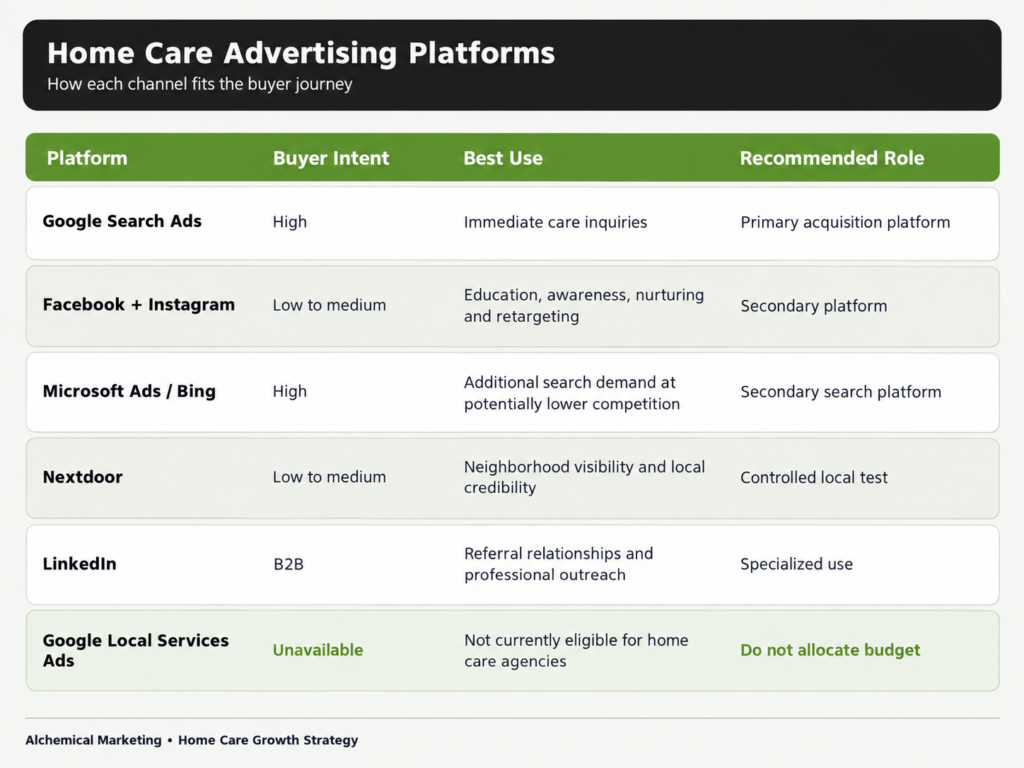
Google Search is generally the strongest place to begin because it captures existing demand. Meta helps an agency reach families before they search. Microsoft Ads can capture additional search traffic, and Nextdoor may increase visibility in specific neighborhoods.
The appropriate mix changes from one agency to another. A private-pay agency seeking dementia and 24-hour care cases may rely heavily on search. An established agency with strong intake and a recognizable local brand may be able to invest more aggressively in awareness and retargeting.
Why Buyer Intent Changes Everything in Home Care Advertising
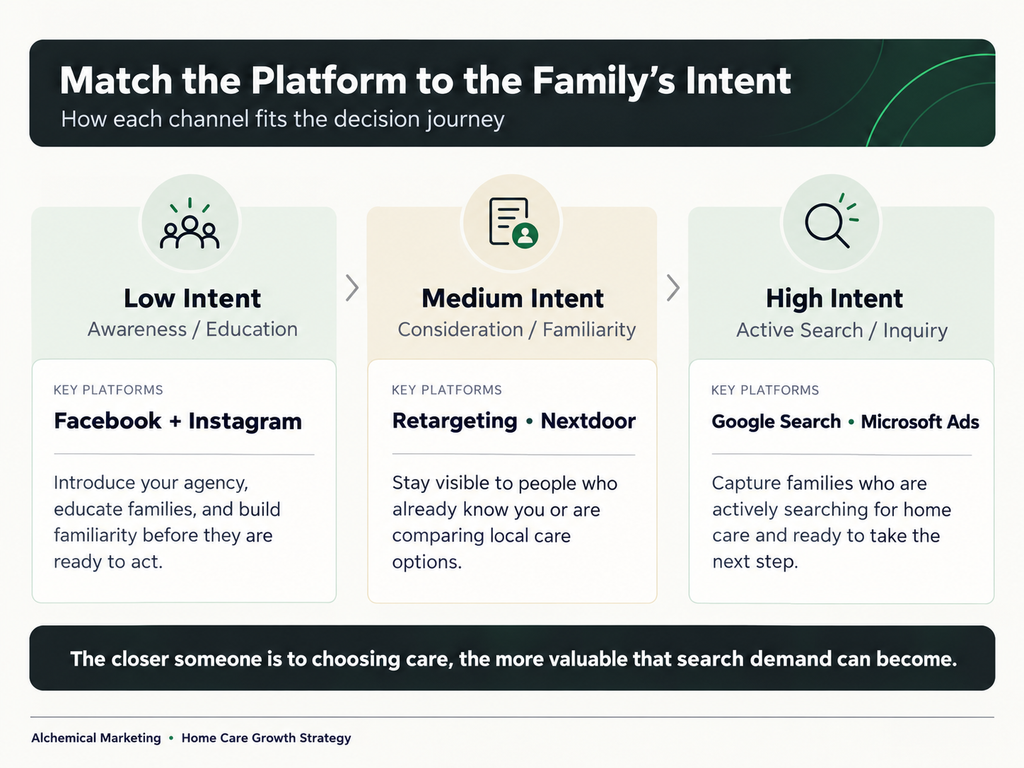
Most prospective home care clients fall into one of three broad buyer-intent stages.
High-intent families
High-intent families are actively trying to solve a care problem now.
A hospital discharge may be approaching. A parent may have fallen. Dementia symptoms may have worsened. An informal caregiver may no longer be able to manage the situation safely.
These families are searching.
They may contact several agencies on the same day and need relatively few interactions before scheduling a care consultation. Their questions tend to be immediate:
- Can someone start this week?
- Do you serve our area?
- Can you provide dementia care?
- Do you offer overnight or 24-hour care?
- How much does care cost?
- Can I speak with someone now?
Google Search and Microsoft Ads are best positioned to reach this audience because the family is actively expressing a need and looking for a provider.
Medium-intent families
Medium-intent families already understand that home care may be necessary, but they are still comparing options, researching providers or waiting for the right time to move forward.
They may have visited your website before, read reviews, spoken with siblings or started comparing agencies in their area.
Their questions are more evaluative:
- Which home care agency should we choose?
- What makes one provider different from another?
- What level of care does my parent actually need?
- Can we trust this agency with our family member?
- What should we expect during the first consultation?
- How quickly can care begin if we decide to move forward?
Retargeting and local visibility channels such as Nextdoor can be useful at this stage because the goal is often to stay familiar and credible while the family moves closer to a decision.
Low-intent families
Low-intent families recognize that something may be changing, but they are not yet actively looking for a home care agency.
A parent may be forgetting medications, struggling to prepare meals, becoming more isolated or having difficulty moving safely around the home.
The family is concerned, but there may not be enough urgency yet to trigger a provider search.
Their questions are more exploratory:
- How do I know when my parent needs home care?
- What is the difference between companion and personal care?
- Can a caregiver help someone with dementia?
- How much help does my parent need?
- How do families pay for home care?
Facebook and Instagram are better positioned to reach families at this stage because the advertising can introduce the agency, educate the family and build familiarity before a formal search begins.
None of these stages should be treated exactly the same.
A high-intent family does not need a vague awareness message when they are trying to find care today.
A low-intent family is unlikely to respond to an aggressive “Schedule care now” ad before enough trust and urgency exist.
And a medium-intent family may not need more education at all. They may simply need another reason to remember, trust and choose your agency.
The closer someone gets to choosing care, the more the advertising strategy should shift from education and familiarity toward capture and conversion.
1. Do Google Ads Work for Home Care Agencies?
Google Search Ads are the closest thing home care agencies have to a direct line to families actively looking for help.
When someone searches for:
- “Dementia caregiver in [city]”
- “24-hour home care near me”
- “Help for elderly parent at home”
- “Post-hospital home care”
- “Overnight caregiver near me”
- “Live-in care for elderly parent”
the person has often moved beyond general awareness. The family is comparing providers, evaluating trust and deciding whom to call.
That makes Google Search the strongest initial advertising platform for many home care agencies.
For the campaign setup side, our Google Ads for home care agencies guide covers targeting, keywords, campaign structure, conversion tracking, and landing pages in more detail.
What does a home care Google Ads lead cost?
Published planning estimates for home care Google Ads commonly place cost per lead between approximately $74 and $150, with cost per click near $6.30.
Those numbers should be treated as directional planning ranges, not universal performance guarantees.
Actual costs can change significantly based on:
- Market competition
- Population density
- Service-area size
- Keyword selection
- Care type
- Private-pay demand
- Minimum shift requirements
- Landing-page quality
- Call-answering performance
- Existing brand recognition
Broader search-advertising data provides useful context, although home care does not fit perfectly into any general benchmark category.
WordStream’s 2025 benchmark data places the average Google Search conversion rate across all measured industries at 7.52%. Its adjacent Home & Home Improvement category produced a 7.33% conversion rate, a $7.85 average CPC and a $90.92 average cost per lead. These are not home care-specific figures, but they demonstrate how quickly local, high-value search campaigns can become expensive.
The agency should therefore evaluate Google Ads based on the cost of acquiring an actual client—not whether an individual click or lead looks expensive.
Agencies already running paid search should also look for the common targeting, search-term, tracking, and landing-page problems that can waste Google Ads budget.
How should a home care Google Ads campaign be structured?
A home care campaign should separate searches by the type and urgency of care being requested.
Someone seeking a few hours of weekly companionship should not necessarily see the same advertisement or landing page as someone searching for immediate 24-hour dementia care.
Campaigns may need separate keyword groups, advertisements or landing pages for:
- Companion care
- Personal care
- Dementia and Alzheimer’s care
- Respite care
- Post-hospital care
- Overnight care
- 24-hour care
- Live-in care
This separation allows the advertisement to reflect the family’s actual situation.
An effective dementia-care advertisement might emphasize caregiver experience, safety and rapid consultation availability. A companion-care advertisement may focus more on independence, social support and help with daily routines.
The service area also matters. Home care is inherently local, and a campaign that works in one county may perform completely differently two counties away because of population density, income, competition and available search volume.
Use the advertisement to improve lead quality
The purpose of an advertisement is not only to generate clicks. It should also help the wrong prospects recognize that the agency may not be a match.
Depending on the agency, the ad or landing page may need to clarify:
- Service area
- Care types offered
- Minimum shift requirements
- Private-pay positioning
- Availability
- Whether skilled medical care is provided
- Whether the agency accepts Medicaid or insurance
- How quickly care can begin
This can reduce irrelevant calls and help the intake team spend more time with qualified families.
Mobile performance and call response matter
One frequently cited estimate suggests that approximately 68.5% of home care service searches occur on mobile devices.
The exact percentage will vary by market and source, but the operational lesson is sound: the campaign must be designed for a stressed person using a phone.
That means the agency needs:
- Click-to-call functionality
- A fast mobile landing page
- A prominent telephone number
- Short, simple forms
- Clear service-area information
- Immediate form confirmation
- Reliable call answering
A family dealing with an urgent care situation may call several agencies within a short period. When the first agency sends the call to voicemail, the family often moves directly to the next result.
A technically strong Google Ads campaign cannot compensate for an intake team that does not answer, returns calls slowly or fails to guide the family toward an assessment.
When should a home care agency avoid Google Ads?
Google Ads may not be the right first investment when:
- Local search volume is extremely limited.
- The agency cannot consistently answer calls.
- The agency does not have capacity for additional cases.
- The website is difficult to use on a phone.
- The landing page does not clearly explain the service.
- The agency cannot follow up quickly.
- The monthly budget is too low to collect meaningful data.
- The agency cannot track inquiries through assessments and admissions.
In those situations, the conversion and intake system should be repaired before more traffic is purchased. See if Google Ads is a good fit for your agency.
Can Home Care Agencies Use Google Local Services Ads?
Home care and home health agencies are not currently listed as eligible U.S. Local Services Ads categories.
Google lists qualifying businesses across home, professional, healthcare, care, wellness and other service categories. Its eligible care categories include services such as child care, funeral homes, pet boarding and veterinary care. Eligible health categories include providers such as dentists, chiropractors, physical therapists and primary-care practices.
Non-medical home care and home health agencies do not appear on Google’s current eligibility list.
This matters because home-services benchmarks for Google Local Services Ads are sometimes cited in home care advertising articles.
Those benchmarks may include figures such as:
- Approximately $53 per lead
- Approximately 40%–44% of answered calls becoming bookings
- Pay-per-lead rather than pay-per-click pricing
- A Google screening badge
Those figures apply to eligible LSA categories. They should not be used to build a home care media plan when the agency cannot enroll in the product.
For home care agencies, the relevant Google paid-search channel is traditional Google Search Ads.
If Google adds home care as an eligible LSA category in the future, the opportunity can be evaluated at that time. It should not receive any current budget allocation.
2. Are Facebook and Instagram Ads Effective for Home Care?
Facebook and Instagram are better at reaching families before they begin actively searching for an agency.
The adult children researching care for aging parents are often balancing work, children, household responsibilities and informal caregiving. They may recognize that a parent needs more help but have not yet reached the point of searching for a provider.
The role of Meta advertising is therefore different from the role of Google Search.
Google captures existing demand. Meta can create familiarity before the need becomes urgent.
A person may see an educational video about early dementia warning signs, a caregiver testimonial or a guide explaining when an older adult may need in-home assistance.
The person may not contact the agency immediately. However, the agency becomes more recognizable when the family eventually begins comparing providers.
Which Meta advertisements work best for home care?
Meta advertisements should generally lead with education, relevance and trust rather than an immediate hard sell.
Potential creative themes include:
- Signs a parent may need help at home
- What to expect during a home care assessment
- How post-hospital home care works
- Questions to ask before hiring a caregiver
- The difference between companion care and personal care
- How respite care supports family caregivers
- Caregiver introductions
- Client or family testimonials, with proper permission
- Common misconceptions about private-pay home care
Video can work particularly well because home care is an emotional, trust-sensitive service. Real caregivers, agency leadership and authentic family stories can communicate credibility more effectively than generic stock imagery.
Native lead forms may also reduce friction because the user can request information without leaving Facebook or Instagram.
The tradeoff is that an easier form may create more low-intent submissions. The form should include enough qualifying questions to help the intake team distinguish a serious care inquiry from casual interest.
What do Meta leads cost?
Planning estimates from senior care and adjacent home-services campaigns often place Meta lead costs between approximately $50 and $150.
This is an intentionally broad range. Performance depends heavily on:
- Geography
- Audience size
- Creative quality
- Offer
- Form length
- Care type
- Brand recognition
- Follow-up speed
- Lead qualification
- Campaign objective
A $50 Meta lead is not automatically better than a $130 Google lead.
The Google prospect may be ready to schedule an assessment immediately. The Meta prospect may need several calls, emails and advertising touchpoints before seriously discussing care.
Meta requires a follow-up system
An agency using Facebook and Instagram should be prepared to follow up through more than one channel.
That may include:
- Immediate telephone outreach
- Text-message confirmation
- Email education
- Retargeting advertisements
- Downloadable guides
- Consultation reminders
- Ongoing testimonial content
Making one telephone call and marking the lead as unresponsive is not an adequate Meta follow-up strategy.
Meta is generally best used as an awareness, education and retargeting platform. It should not normally become the primary acquisition channel for an agency with a lean budget and an immediate need for admissions.
When should a home care agency avoid Meta Ads?
Meta may be a weak first investment when:
- The agency needs admissions immediately.
- The intake team makes only one follow-up attempt.
- No email or text nurturing process exists.
- The agency cannot produce credible creative.
- The offer is vague.
- The agency has no retargeting strategy.
- Performance is measured only through last-click leads.
- Every form submission is treated as a sales-ready prospect.
When the budget is limited, Google Search usually deserves priority because it reaches families who are already expressing a need.
3. Should Home Care Agencies Advertise on Microsoft Ads?
Microsoft Ads, commonly associated with Bing search traffic, deserves more attention than many home care agencies give it.
The platform reaches a smaller search audience than Google, but it still captures people actively looking for services. Its strategic role is therefore closer to Google Search than to Meta.
Bing’s user base is often described as older and more affluent. Those demographic characteristics may align with private-pay home care decision-makers, but an agency should validate that assumption through actual campaign and lead-quality data.
Historical WordStream industry benchmarks and other paid-search analyses frequently place Microsoft Ads CPCs approximately 30%–40% below Google Ads in many industries.
For an agency paying approximately $6–$8 per click on Google, lower Microsoft Ads competition could create meaningful budget efficiency.
Lower CPCs do not automatically mean better performance, however.
Microsoft Ads should be judged according to:
- Qualified inquiry volume
- Telephone-call quality
- Consultation rate
- Assessment rate
- Admission rate
- Cost per admission
- Client lifetime value
- Revenue generated
Microsoft Ads is usually a logical secondary platform after the agency has built a functioning Google Search campaign.
A successful Google campaign can often provide the initial keyword, advertisement and landing-page structure. The Microsoft campaign can then be optimized according to its own search terms, conversion rates and lead quality.
When is Microsoft Ads worth testing?
The platform becomes especially attractive when:
- Google campaigns are already producing qualified inquiries.
- The agency wants more search volume without significantly raising Google bids.
- The target market has sufficient Bing search activity.
- The agency serves private-pay clients.
- Search campaigns can be tracked through admissions.
- The budget is large enough to support a secondary platform.
An agency should not divide a very small search budget between Google and Microsoft before either platform has enough data to optimize effectively.
4. Is Nextdoor Worth Testing for Home Care Advertising?
Nextdoor operates at the neighborhood level, which aligns with the local nature of home care.
Families choosing an agency to enter a parent’s home often place significant value on familiarity, neighborhood reputation, reviews and recommendations.
Nextdoor may allow an agency to reinforce its name through both paid visibility and community participation.
A family might encounter an agency through a sponsored placement, see it recommended by a neighbor and later recognize the name when searching on Google.
Planning estimates for home care campaigns on Nextdoor sometimes place cost per lead between approximately $26 and $75.
This range should be treated as a testing assumption, not a reliable national benchmark. Volume, targeting availability and lead quality may vary considerably from one neighborhood to another.
Nextdoor may be useful for agencies seeking:
- Visibility in selected ZIP codes
- Awareness in higher-income neighborhoods
- Promotion of local educational events
- Community credibility
- Brand reinforcement
- Additional reach outside the Google auction
The platform’s limitations are equally important.
Nextdoor typically has less volume than Google or Meta, and users are not necessarily searching for home care when the advertisement appears. It should generally be tested with a controlled budget rather than treated as the main source of new admissions.
5. Should Home Care Agencies Use LinkedIn Ads?
LinkedIn is not typically the strongest platform for reaching families seeking immediate home care.
Its more relevant use is B2B referral development.
A home care agency may use LinkedIn to build familiarity with:
- Hospital discharge planners
- Social workers
- Geriatric care managers
- Elder-law attorneys
- Senior living professionals
- Rehabilitation providers
- Hospice professionals
- Physicians and practice administrators
- Long-term-care insurance professionals
The objective is not necessarily to generate an immediate family inquiry. It is to create professional awareness and support referral relationships.
LinkedIn advertising can be expensive, and the available audience in a local service area may be small. Direct outreach, professional content and relationship-building may outperform paid advertising for many agencies.
LinkedIn should therefore be treated as a specialized referral-development channel rather than a core family-acquisition platform.
How Should a Home Care Agency Divide Its Advertising Budget?
For an agency spending between $3,000 and $10,000 per month, the following can serve as a starting planning framework:
- Google Search Ads: 55%–70% for high-intent acquisition
- Facebook and Instagram prospecting: 10%–20% for awareness and education
- Retargeting: 10%–15% across Google and Meta
- Microsoft Ads: 5%–15% for additional search coverage
- Nextdoor or other local tests: 0%–10% based on market fit
These percentages are not fixed rules. They are starting assumptions that should be adjusted according to actual inquiry quality and admission data.
Google Local Services Ads should receive 0% because home care agencies are not currently listed as an eligible category.
Example allocation for a $5,000 monthly budget
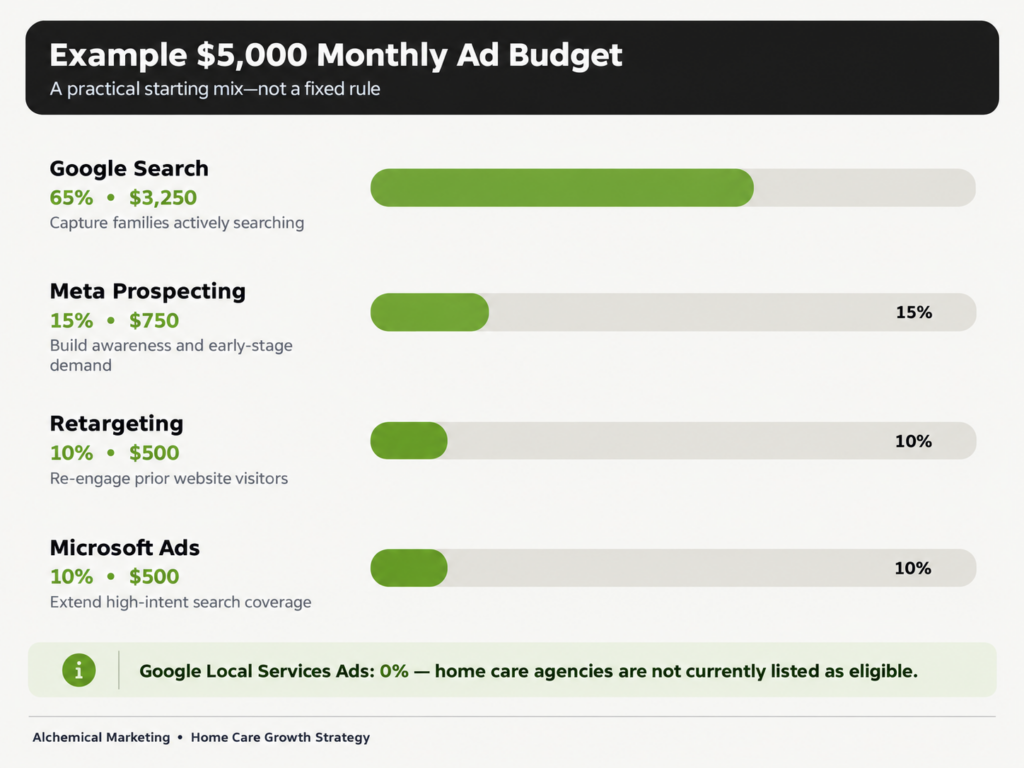
A newer agency with little brand recognition may allocate slightly more to awareness. An established agency with a strong reputation, proven intake process and demand for additional admissions may place a larger percentage into Google Search.
Private-pay agencies targeting dementia care, overnight care or 24-hour cases should generally lean toward search because families looking for those services are more likely to act with urgency.
Do Not Judge Advertising Platforms Only by Cost per Lead
Cost per lead is useful, but it does not tell the agency whether a campaign is generating clients.
Consider two hypothetical platforms:
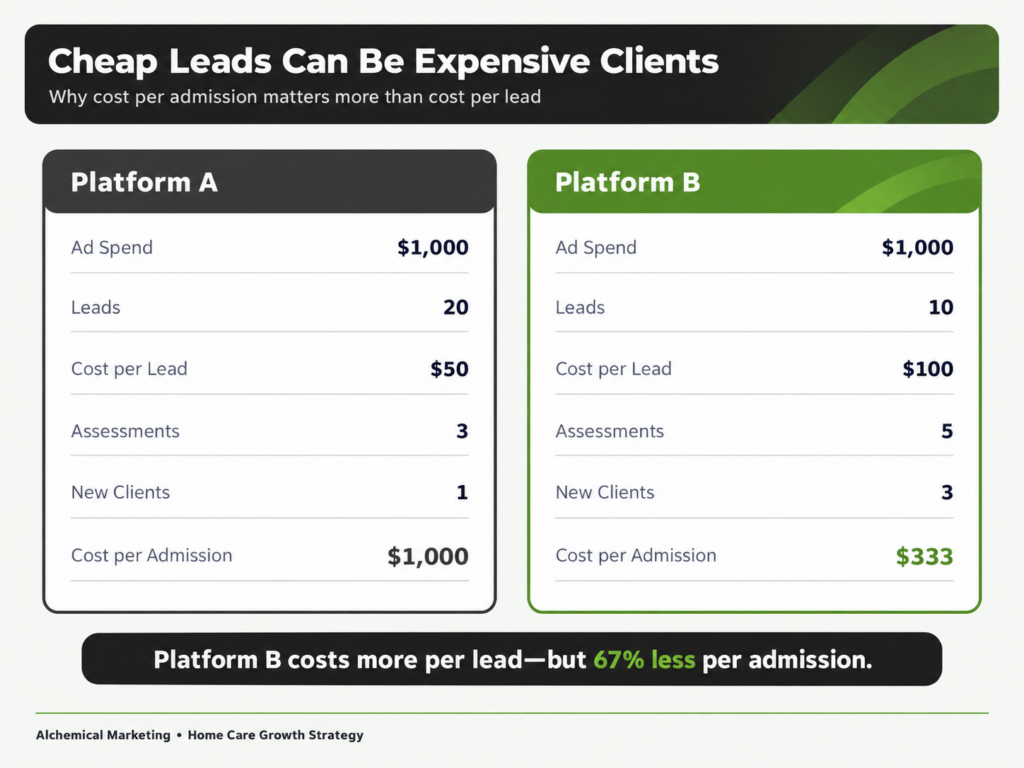
Platform A appears more efficient when measured by cost per lead.
Platform B is substantially more efficient when measured by cost per admission.
Home care agencies should track advertising through the entire acquisition process:
- Lead received
- Lead contacted
- Lead qualified
- Consultation scheduled
- Assessment completed
- Client admitted
- Weekly hours started
- Revenue generated
- Client lifetime value
The cheapest lead source may become the most expensive source of actual clients.
Intake Performance Can Matter More Than Platform Choice
Advertising performance does not end when a form is submitted or a call is placed.
The intake process determines whether the inquiry becomes an assessment and whether the assessment becomes an admission.
Important intake metrics include:
- Call-answer rate
- Average response time
- Contact rate
- Qualified-lead rate
- Consultation-booking rate
- Assessment-completion rate
- Admission rate
- Lost-lead reasons
- Time from inquiry to start of care
A $150 Google lead that goes to voicemail has no more value than a $40 Facebook lead that never responds.
The entire system must work together:
Platform → advertisement → landing page → inquiry → intake → assessment → admission
Optimizing only the advertising account ignores most of the actual client-acquisition process.
Why Home Care Advertising Requires a Home Care-Specific Strategy
A general campaign framework may miss the differences that make home care advertising difficult.
The buyer is often a stressed adult child making a high-stakes and emotional decision under time pressure. The searches are local. The service cannot be delivered outside the agency’s coverage area. The message may need to filter for financial fit, care type, schedule requirements and urgency.
The economics can also vary dramatically from one territory to another.
A campaign producing an $80 CPL in one county may perform very differently in another county because of:
- Franchise competition
- Population density
- Household income
- Search volume
- Caregiver availability
- Local brand recognition
- Hospital and referral relationships
- Service-area boundaries
That is why platform selection should be based on the agency’s market rather than a generic industry checklist.
Alchemical Marketing builds platform selection and budget allocation around each agency’s care offerings, service territory and buyer profile.
The process starts with a structured Home Care Growth Audit that evaluates market demand, competition, targeting gaps and the agency’s current client-acquisition system before the advertising budget is allocated.
That specificity affects:
- Keyword selection
- Negative keywords
- Geographic targeting
- Private-pay qualification
- Advertisement messaging
- Landing-page structure
- Call tracking
- Intake measurement
- Budget pacing
- Cost-per-admission reporting
Clients also retain ownership of their advertising accounts and campaign data, which becomes important when expanding into new territories or evaluating another provider.
Frequently Asked Questions About Home Care Advertising Platforms
What is the best advertising platform for a home care agency?
Google Search Ads are generally the strongest initial platform because they reach families actively searching for home care. Meta is better for awareness and retargeting, while Microsoft Ads can provide additional search coverage.
Can home care agencies use Google Local Services Ads?
Home care and home health agencies are not currently included in Google’s published U.S. list of eligible Local Services Ads categories. Agencies should use traditional Google Search Ads instead.
How much should a home care agency spend on advertising?
An agency needs enough budget to generate a meaningful number of clicks and inquiries in its market. For many agencies, a paid-media budget between $3,000 and $10,000 per month provides a reasonable testing and optimization range, although smaller or larger markets may require a different investment.
Are Facebook Ads effective for home care agencies?
Facebook Ads can be effective for education, awareness, lead nurturing and retargeting. They are usually less reliable as the sole source of immediate admissions because users are not actively searching for care when the advertisement appears.
Is Bing advertising worth it for home care?
Microsoft Ads can be valuable after a Google Search campaign is working. It may provide additional high-intent traffic with less auction competition, although the agency should evaluate it based on cost per admission rather than CPC alone.
Should a home care agency advertise on Nextdoor?
Nextdoor may be worth testing when neighborhood credibility and specific ZIP-code visibility are important. It should generally receive a controlled test budget rather than becoming the primary acquisition channel.
Which advertising metric matters most?
Cost per admission is more meaningful than cost per click or cost per lead. The agency should also track assessment rate, weekly care hours, revenue, client lifetime value and return on advertising spend.
Choosing the Right Home Care Advertising Mix
Google Search should usually serve as the primary acquisition platform for home care agencies because it reaches families at the moment they are actively looking for help.
Facebook and Instagram can support the earlier stages of the decision process by educating families, building trust and retargeting people who have already visited the agency’s website.
Microsoft Ads can extend high-intent search visibility, while Nextdoor can provide selective neighborhood-level exposure.
Local Services Ads should not be included in the current plan because home care agencies are not listed as an eligible category.
The right platform mix is only half of the equation. Keyword targeting, ad messaging, landing pages, call response, lead qualification and intake performance determine whether the advertising produces booked consultations or wasted clicks.
Paid media can capture demand quickly, while Home Care Local SEO can help build longer-term visibility when families search for providers in the agency’s market.
Agencies that want a platform strategy built around their care services, market and growth goals can begin with a free Home Care Growth Audit from Alchemical Marketing.
The audit evaluates local search demand, competition and targeting gaps and includes a $500 Google Ads credit when an eligible agency books a consultation.
The objective is not simply to generate more leads. It is to build a measurable system that produces qualified assessments, sustainable admissions and profitable growth.