

TABLE OF CONTENTS
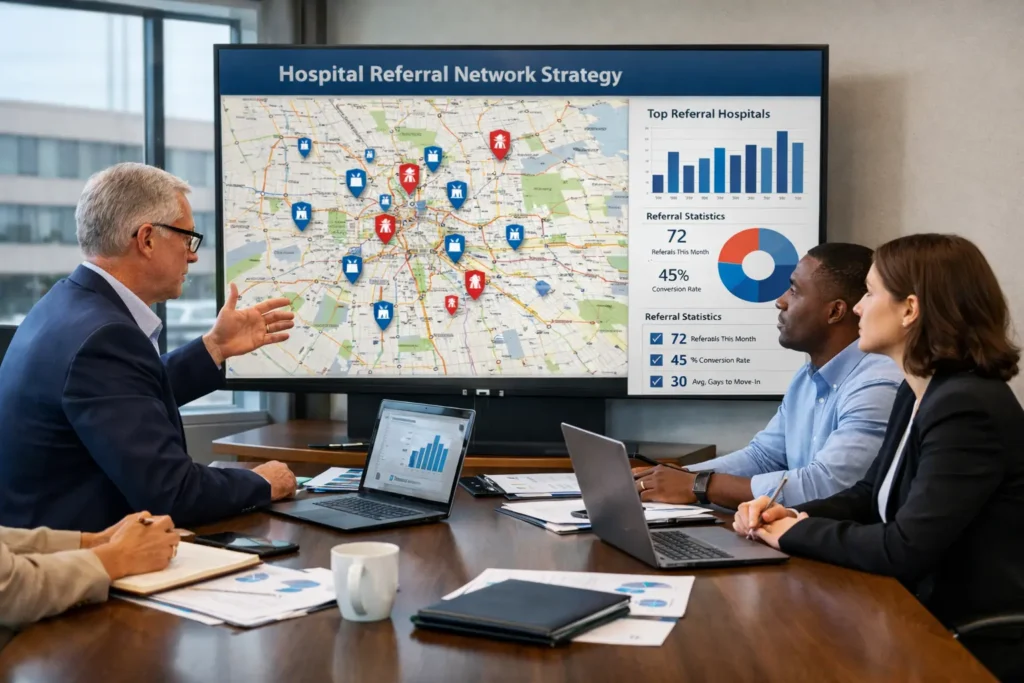
Hospital referral networks remain the highest-ROI lead source in senior living. I consulted for a 10-community operator in 2025 whose occupancy averaged 77% despite decent digital spend. Referrals from hospitals were inconsistent – some sites got 2–3 per month, others got zero. We audited relationships, created a standardized referral playbook, hosted quarterly clinical education sessions, built easy digital referral portals, and tracked referral velocity weekly. Nine months later, referrals accounted for 58% of move-ins, portfolio occupancy stabilized at 89%, and annualized revenue increased by approximately $6.1 million. The Regional Director later said the biggest shift was realizing hospitals weren’t “sending” patients randomly – they were sending to operators they trusted and could work with easily.
Senior living demand continues to outpace new supply in most primary markets. NIC MAP Vision Q4 2025 preliminary data shows overall occupancy stable at 88–89%, with assisted living and memory care communities adding occupied units steadily despite annual inventory growth below 1% in most metros. In this environment, operators who build strong hospital referral networks and discharge planner partnerships consistently outperform those relying solely on digital or consumer channels.
This guide is written specifically for Executive Directors, Owners/Operators, Regional Directors, and Sales Directors who want a repeatable senior living referral strategy that drives census growth through hospital and discharge planner relationships.
If referrals are inconsistent or underperforming in your portfolio, schedule a free referral network audit call – we’ll review your current relationships and show you the fastest path to more consistent, high-conversion move-ins.
Why Hospital Referrals Remain the Highest-ROI Source in 2026
Hospital discharge planners and case managers control a huge share of senior living placements – especially for higher-acuity assisted living and nearly all memory care admissions. Typical benchmarks:
- Conversion rate from hospital referral → move-in: 35–55% (vs 10–20% from consumer leads)
- Cost per move-in from referrals: $1,800–$3,500 (vs $4,000–$7,000 from paid digital)
- Average time from referral to move-in: 45–90 days (faster than broad consumer funnels)
In 2026, with occupancy already high and competition for quality referrals fierce, operators who actively build and nurture hospital referral networks capture disproportionate move-ins.
Step 1: Map & Audit Your Current Referral Landscape
Start with visibility.
Key audit questions operators should answer monthly:
- How many active hospital/discharge planner relationships do we have per community?
- What % of move-ins came from referrals last quarter?
- Which hospitals send the highest-acuity / highest-revenue residents?
- What is our referral-to-tour and tour-to-move-in conversion by source?
- Are we tracking referral sources in CRM consistently?
Most operators I advise discover they have only 3–5 active relationships per site – far below the 10–15 needed for a stable census.
Step 2: Build a Standardized Referral Playbook
Consistency wins referrals.
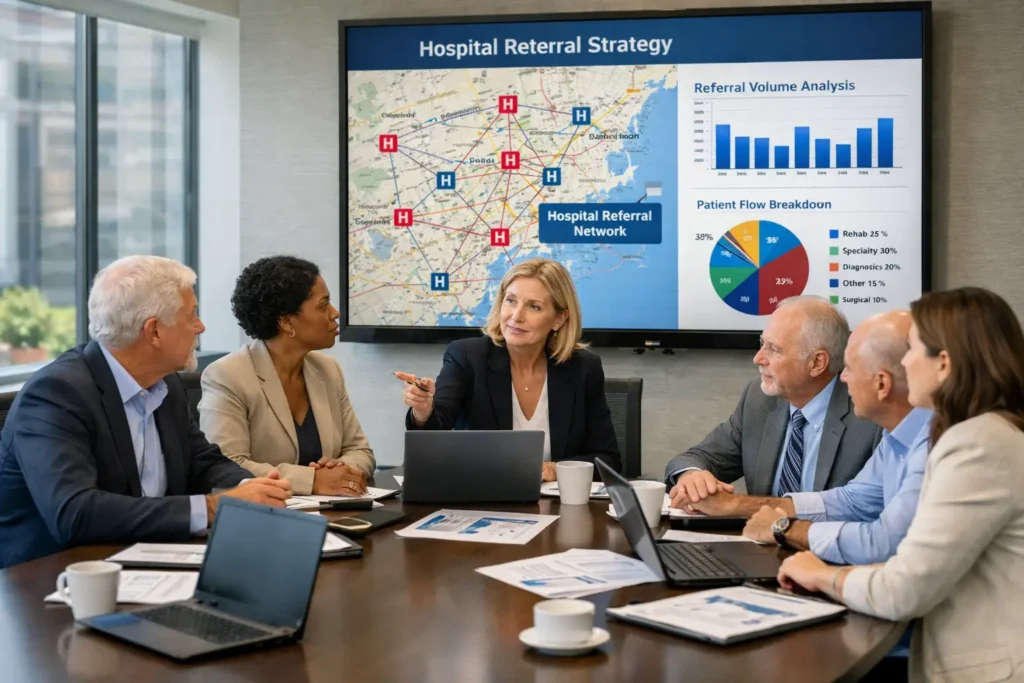
Core elements of a high-performing playbook:
- Clinical Lunch & Learns – Quarterly 45-min sessions on dementia care, fall prevention, or occupancy solutions
- Easy Referral Portal – Secure online form with direct clinical handoff
- Co-Branded Materials – Quick-reference guides that hospitals can give families
- Outcome Reporting – Monthly thank-you notes + anonymized success metrics
- Referral Incentives – Gift cards, CEU credits, or priority placement for urgent cases
Standardize this playbook chain-wide – local teams execute, corporate tracks.
Step 3: Prioritize & Segment Hospital Targets
Not all hospitals are equal.
Segmentation operators use:
- Tier 1 – Large systems with high senior volume (top 3–5 per market)
- Tier 2 – Mid-size hospitals with consistent discharges
- Tier 3 – Smaller facilities or specialty centers (stroke, ortho)
Focus 70% effort on Tier 1 – they send the most qualified, highest-revenue residents.
For multi-site referral scaling, see marketing assisted living across multiple communities and scaling memory care marketing across multiple communities.
Step 4: Automate Referral Follow-Up & Relationship Nurturing
Manual follow-up doesn’t scale.
Recommended automation layers:
- Instant Referral Acknowledgment – Auto-SMS/email to referrer within 5 minutes
- Clinical Handoff Notification – Alert to nursing/clinical director
- 30-Day Outcome Report – Automated anonymized update to referrer
- Quarterly Nurture Sequence – Clinical content drops + invitation to next lunch & learn
This increases referrer satisfaction and repeat referrals by 40–60%.
For automation examples, see how automation improves memory care census and assisted living marketing automation drives move-ins.
Step 5: Track Referral Pipeline & ROI Weekly
Referral marketing must be measured like any other channel.
Essential weekly KPIs:
- Referrals received per community
- Referral-to-tour conversion
- Tour-to-move-in rate by referrer
- Cost per move-in from referrals (usually the lowest channel)
- Top 5 referrers by move-in volume
- Referral pipeline coverage (qualified referrals vs needed move-ins)
These metrics prove referral ROI and guide relationship investment.
For reporting fundamentals, see forecasting memory care census and better planning.
Step 6: Handle Common Referral Objections & Build Trust
Hospitals send to operators they trust. Common objections and responses:
- “We already have partners.” → Offer faster response time or priority placement
- “Your rates are high.” → Show clinical outcomes and average length of stay data
- “We need urgent placement” → Guarantee 24-hour tour availability
- “We’re worried about readmissions.” → Share low readmission rates and clinical protocols
Consistent clinical excellence + fast response turns objections into repeat referrals.
Integrating Referral Marketing Into the Full Census Growth System
Referral marketing is not standalone – it feeds every part:
- Lead Generation – Highest-quality source → see memory care lead generation qualified move-ins
- Automation – Consistent referrer nurturing → explore how automation improves memory care census
- Pipeline – Clear stages → read building a predictable assisted living sales pipeline
- Tour & Move-In – Clinical focus → check improving memory care tour-to-move-in conversion
- Forecasting – Accurate projections → learn from forecasting memory care census, better planning
At Alchemical Marketing, we build these integrated systems with strong referral engines. One 18-community operator increased its portfolio average occupancy from 80% to 89% in 12 months, with referrals driving 62% of move-ins and adding over $10 million in revenue.
Discover how we approach referral marketing and explore our full range of services.
Ready to build a hospital referral network that scales your census? Secure your free referral strategy session.
Your Next Step for Stronger Referral-Driven Census Growth
With senior living occupancy stable around 88–89% in early 2026 and demand still outpacing supply, operators who build active hospital referral networks will capture the largest share of high-quality move-ins.
If referrals are inconsistent or underperforming in your portfolio, schedule a complimentary referral network review today – we’ll assess your current relationships and deliver clear, prioritized next steps.
Here’s to more qualified move-ins, higher occupancy, and stronger revenue in 2026.
Frequently Asked Questions
How many active hospital referral relationships should a memory care community have?
8–12 strong, active relationships per site is typical for a stable census. Focus on 3–5 Tier 1 hospitals/systems.
What’s the fastest way to start building a hospital referral network?
Host a quarterly clinical lunch & learn – invite discharge planners and case managers. Follow up with easy referral portal access and outcome reports.
How do you measure ROI on referral marketing?
Track referrals received, referral-to-tour conversion, tour-to-move-in rate, and cost per move-in by referrer. Referrals usually have the lowest cost per move-in.
Can one referral strategy work for both assisted living and memory care?
Yes – but tailor messaging (lifestyle support vs clinical/dementia expertise). Use separate referral portals if the acuity mix differs significantly.
How long does it take to see the census lift from building hospital referral networks?
Initial referrals often start within 60–90 days. A significant occupancy lift (10–20%) typically takes 6–12 months of consistent relationship-building.