
TABLE OF CONTENTS

Running marketing for 5–25 memory care communities is nothing like managing a single site. I learned this the hard way in 2025 when I took over marketing oversight for an 11-community memory care portfolio in the Midwest. Occupancy ranged wildly – from 66% at one struggling site to 92% at the flagship. Each Executive Director had their own “unique market” excuse, but the real issue was no centralized system. We created a unified regional memory care marketing framework with standardized clinical messaging, shared referral development, portfolio dashboards, and automated long-cycle nurturing. Ten months later the portfolio average reached 89%, the lowest site climbed to 84%, and annualized revenue increased by roughly $7.2 million. The corporate team finally had visibility and control without suffocating local execution.
Memory care fundamentals are exceptionally favorable. NIC MAP Vision Q4 2025 preliminary indicators show senior housing occupancy stable at 88–89%, with memory care communities continuing to gain occupied units despite very limited new supply growth (<1% annually in most primary markets). For regional operators managing multiple memory care sites, this environment offers massive upside – but only if marketing is scalable, consistent, and tied directly to portfolio census growth.
This guide is written specifically for Owners/Operators, Regional Directors, corporate marketing leads and Executive Directors responsible for scalability MC across multiple memory care communities. We’ll cover how to build systems that deliver consistent move-ins and occupancy without micromanaging every site.
If your memory care portfolio has uneven occupancy or marketing efforts feel disconnected by location, schedule a free multi-site strategy call – we’ll review your current setup and identify the biggest levers for portfolio-wide gains.
Why Single-Site Memory Care Tactics Fail at Scale
What works brilliantly at one 35-unit community usually collapses when replicated across 8–20 sites. The most common scaling failures I see:

- Decentralized control – inconsistent branding and clinical messaging
- Location-specific ads competing for the same referral sources
- No centralized dashboard – no visibility into which tactics actually move occupancy
- Over-customization – every site doing its own thing, diluting chain equity
- Slow replication – best practices from top sites take 6–12 months to spread
In 2026, with occupancy benchmarks continuing to rise and labor/staffing costs still elevated, regional memory care marketing must prioritize scalability MC – repeatable systems that lift portfolio census growth without chaos.
Core Framework for Multi-Community Memory Care Marketing
A strong multi-location framework has four pillars that work together:
- Centralized Clinical Brand & Messaging Define chain-wide value propositions, clinical authority statements, and core offers (e.g., “Secure dementia care with individualized behavior support”). Local sites adapt tone and imagery – never core clinical promise.
- Regional Referral & Demand Systems Build referral relationships at a regional level (hospital systems, neurology groups). Create shared referral portals and education events replicated across similar markets.
- Standardized High-Conversion Sales Workflows Document and enforce best practices for inquiry response (<30 min), clinical nurture sequences, tour scripts, and post-tour follow-up. Train once, replicate everywhere.
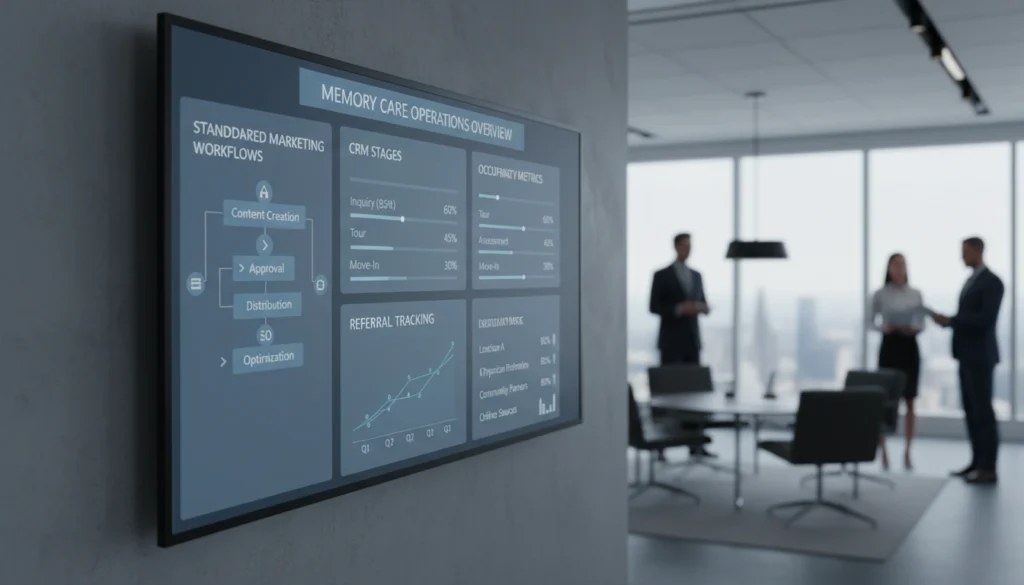
- Portfolio-Wide Reporting & Visibility One dashboard showing occupancy trends, move-in velocity, cost per move-in, and top/bottom performers. Weekly regional review meetings keep everyone aligned.
This structure enables regional ops efficiency while preserving enough local flexibility to win in different markets.
For multi-site fundamentals that apply directly to memory care, see marketing assisted living across multiple communities – the principles translate almost identically.
Lead Generation & Demand Creation at Portfolio Level
Effective memory care multi-location marketing starts with smarter, centralized demand creation:
- Centralized B2B Search & Content – Run chain-level campaigns targeting professionals (“memory care referral network,” “dementia placement support”) + geo-targeted ads for each market
- Regional Referral Development – Build relationships with hospital systems and neurology groups at scale; replicate top referrer lists across similar markets
- Clinical Education Syndication – Create high-value assets once (e.g., “2026 Dementia Care Referral Guide”) and distribute to all sites with local landing pages
- Cross-Portfolio Support – Use high-occupancy sites to support lower performers via shared referral incentives and overflow placement
Top multi-site operators I’ve advised see 55–75% of qualified leads come from centralized + referral sources when executed this way.
For lead quality tactics that scale across locations, see improving assisted living lead quality not just volume – the B2B principles apply directly.

Standardizing the Memory Care Sales & Admissions Engine
Consistency in sales workflows drives the largest portfolio census growth gains.
Standardized elements that work:
- Unified CRM & Pipeline – One system with memory care-specific stages → see crm systems built for memory care sales teams
- Automated Long-Cycle Nurturing – Chain-wide clinical sequences → explore how automation improves memory care census
- Clinical Tour & Close Playbooks – Documented best practices replicated across sites → check improving memory care tour-to-move-in conversion
- Move-In Process Standardization – Digital paperwork, dedicated coordinators → read optimizing memory care move-in process higher conversions
When these are standardized, top-performing sites become templates that accelerate turnaround at underperformers.
Portfolio Reporting & Systems That Prevent Silos
Multi-site memory care marketing requires one source of truth.
Essential weekly portfolio dashboard KPIs:
- Portfolio average occupancy
- Move-ins per community (current vs target)
- Cost per move-in by source
- Lead-to-tour conversion by site
- Top/bottom performing communities
- Referral source contribution %
This visibility allows rapid replication of winning tactics and correction of underperformers.
For reporting and forecasting fundamentals, see forecasting memory care census better planning.

Implementation Roadmap for Regional Memory Care Operators
- Month 1–2 – Audit current state, centralize clinical brand & core messaging, deploy unified CRM
- Month 3–4 – Roll out automated nurture sequences & standardized tour/close playbooks
- Month 5–6 – Launch portfolio dashboard, shift budget to high-ROI referral & B2B channels
- Month 7–9 – Train local teams, replicate best practices from top sites, monitor portfolio lift
- Ongoing – Weekly regional reviews, monthly best-practice sharing, quarterly rebalancing
At Alchemical Marketing we help regional operators build and execute exactly this kind of scalable framework. In one recent engagement a 14-community memory care chain went from portfolio average 78% to 89% in 11 months – adding ~$8.4M in annualized revenue. The corporate team gained control without micromanaging.
See how we approach multi-location memory care on the Alchemical Marketing homepage or explore our full range of services.
Ready to scale your memory care marketing and stabilize portfolio census growth? Secure your free multi-site strategy session.
Common Scaling Mistakes in Memory Care Portfolios
From real multi-site operators:
- Allowing too much local variation – dilutes clinical brand
- Centralizing everything – kills local market responsiveness
- No portfolio dashboard – hides chronic underperformers
- Budget silos by community – creates internal competition
- Slow replication – best practices stay trapped in top sites
Balance is key: 70–80% standardization + 20–30% local adaptation.
Your Next Step for Portfolio-Wide Memory Care Growth
With memory care demand continuing to grow and occupancy stable around 88–89% in early 2026, regional operators who master memory care multi-location marketing will widen the gap between top and bottom performers in their portfolio.
If your memory care communities have uneven occupancy or marketing efforts feel disconnected by location, don’t wait another quarter. Schedule a complimentary portfolio review today – we’ll assess your current state and deliver clear, prioritized recommendations.
Here’s to consistent census growth, more predictable move-ins, and healthier memory care portfolios in 2026.
Frequently Asked Questions
How much local customization should each memory care community have?
20–30% local adaptation (market-specific imagery, referral messaging) is ideal. Keep 70–80% standardized (clinical messaging, nurture sequences, pipeline stages) for consistency and scalability.
What’s the biggest benefit of centralizing memory care marketing across sites?
Visibility and replication speed. A single portfolio dashboard reveals top/bottom performers instantly, and proven tactics can be rolled out chain-wide in 60–90 days instead of 6–12 months.
Can smaller memory care portfolios (5–10 communities) use the same approach?
Yes – smaller portfolios often see faster percentage gains because changes implement quicker. The key is still standardization + regional oversight.
How do you prevent internal competition between memory care communities for leads?
Centralized budget allocation + shared referral incentives + overflow placement from high-occupancy sites to lower ones. Focus on portfolio census growth, not individual site targets.
How long does it take to see portfolio occupancy lift from better multi-location memory care marketing?
Initial improvements (5–10% average lift) often appear in 4–6 months; full stabilization and 12–20% portfolio gains are common within 9–12 months when systems are fully aligned.