
TABLE OF CONTENTS
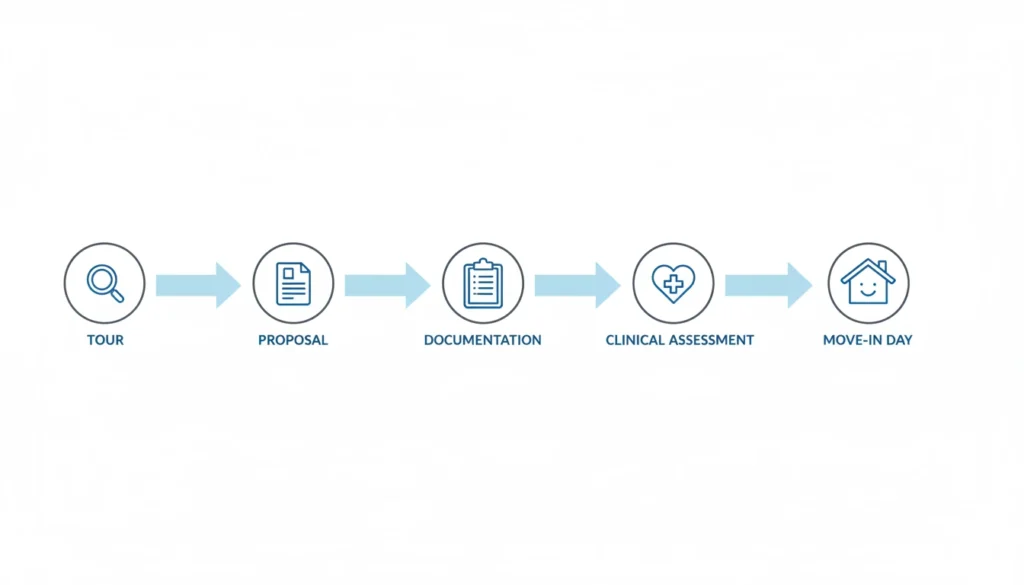
The move-in stage is where most memory care revenue is won or lost. I once consulted for a 42-unit memory care community that had excellent tour bookings but terrible close rates — only 22% of tours resulted in move-ins. Families would leave the tour excited, then disappear during paperwork and administrative delays. We audited the entire admissions workflow, eliminated bottlenecks, automated routine steps, and trained staff on clinical handoffs. Six months later, their tour-to-move-in rate reached 46%, they added 12 residents, and occupancy climbed from 76% to 90%. The Operations Director said the biggest surprise was how much of the problem was administrative friction — not lack of interest.
Memory care fundamentals remain very favorable. NIC MAP Vision Q4 2025 preliminary indicators show senior housing occupancy stable at 88–89%, with memory care communities gaining steadily despite limited new supply growth (<1% annually in most primary markets). Demand continues to outpace construction, which means operators who optimize the memory care move-in process can convert more tours into revenue quickly.
This guide is written specifically for Executive Directors, Owners/Operators, Regional Directors, and Sales/Admissions Directors who want MC admissions optimization that removes move-in bottlenecks and drives conversion improvement.
If your memory care tours are strong but move-ins are inconsistent or delayed, schedule a free move-in process audit call — we’ll map your current workflow and pinpoint the biggest friction points.
Why the Move-In Stage Is the Biggest Census Leak
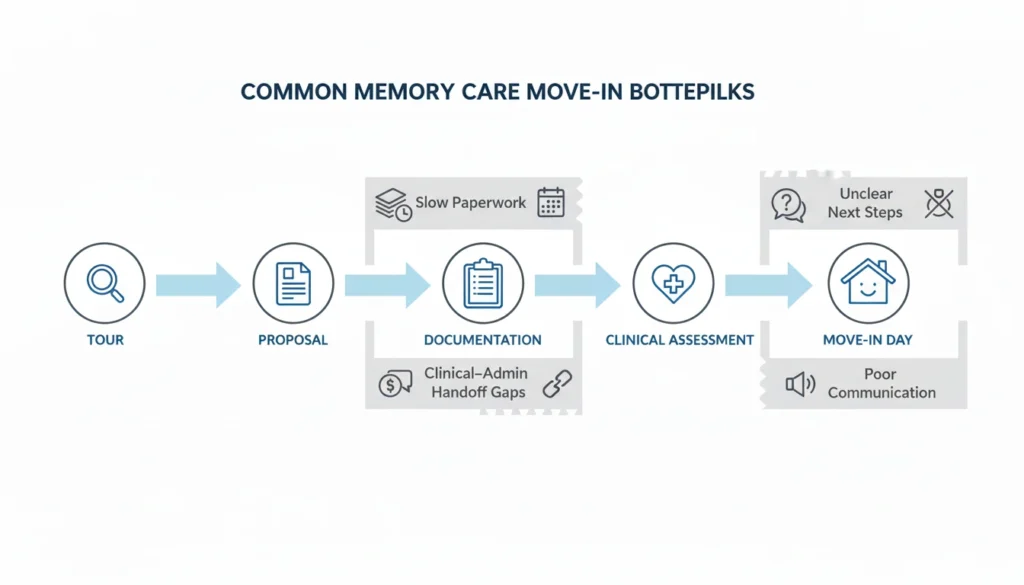
Tour-to-move-in rates in memory care typically range 20–35% — often lower than assisted living because of added complexity. Common internal bottlenecks include:
- Slow or manual paperwork — families lose momentum
- Poor clinical-to-administrative handoff — information gets lost
- Delayed financial/medical clearance stalls the process
- Lack of transparency — families feel uncertain about next steps
- No proactive communication — silence breeds doubt
Each day of delay increases ghosting risk by 10–15%. In a high-demand environment like 2026, every lost move-in is expensive.
Mapping the Ideal Memory Care Move-In Workflow
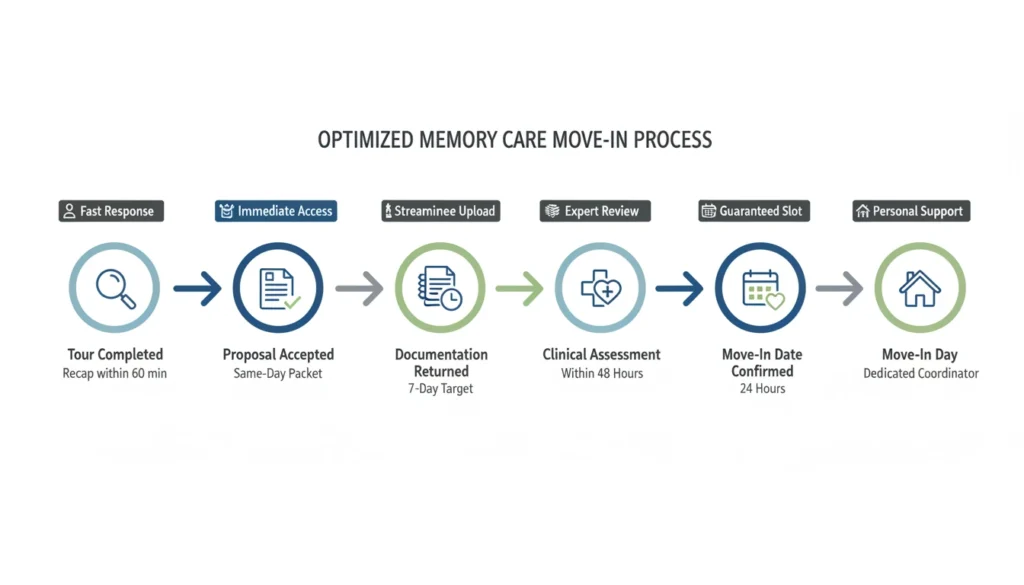
A streamlined memory care move-in process has clear, predictable stages.
Typical optimized workflow:
- Tour Completed — Immediate recap sent (within 60 min)
- Proposal Accepted — Financial & medical packet emailed/sent same day
- Documentation Returned — 7-day target with automated reminders
- Clinical Assessment — Scheduled within 48 hours of docs received
- Move-In Date Confirmed — Within 24 hours of assessment
- Move-In Day — Dedicated coordinator handles transition
Target total time from tour to move-in: 45–75 days (vs industry average 75–120+ days).
Removing the Most Common Move-In Bottlenecks
Here are the highest-impact fixes operators use to accelerate conversion improvement:
- Digital Packet & e-Signatures — Replace paper forms with secure portals (DocuSign, HelloSign)
- Dedicated Move-In Coordinator Role — One point of contact from proposal to move-in
- Automated Reminders & Escalations — 3-touch sequence if docs not returned in 7 days
- Pre-Approval Financial Screening — Run basic checks during the tour phase
- Clinical Handoff Checklist — Standardized form ensures no information is lost
These five changes alone often shave 20–45 days off the average move-in timeline.
For pipeline visibility that supports faster move-ins, see building a Predictable Assisted Living Sales Pipeline.
Streamlining Admissions Workflows with Automation
Sales ops and admissions teams are frequently overloaded. Automation removes repetitive friction.
Recommended tools & automations:
- Zapier / Make.com — Auto-create tasks when proposal is accepted
- CRM workflows — Trigger reminders at 3, 5, 7 days
- Secure resident portals — Families upload docs anytime
- Calendar integrations — Auto-schedule assessments & move-in dates
- Reporting dashboards — Track average days from tour → move-in by referral source
Operators who implement these see move-in delays drop 30–50%.
For automation examples that directly support this stage, explore how automation improves the memory care census.
Measuring Move-In Performance & Improvement
Track these KPIs weekly to drive continuous MC admissions optimization:
| KPI | Target (Strong Performer) | Red Flag | Why Track It |
| Tour-to-Move-In Rate | 40–50% | <30% | Core conversion health |
| Average Days Tour → Move-In | 45–75 days | >90 days | Speed & momentum |
| % of Move-Ins Delayed >90 Days | <15% | >25% | Identifies bottlenecks |
| % of Families Who Ghost After Proposal | <20% | >35% | Follow-up effectiveness |
| Cost per Move-In (all-in) | <$3,200 | >$4,500 | Overall efficiency |
Weekly review meetings should focus on the top 2–3 red metrics and test one fix at a time.
Integrating Move-In Optimization Into the Full Census System
The move-in process is only one part of a complete system:
- Lead Generation — Quality sources → see memory care lead generation that produces qualified move-ins
- Tour Excellence — Clinical focus → check improving memory care tour-to-move-in conversion
- Follow-Up Automation — Consistent nurturing → explore how automation improves memory care census
- CRM & Pipeline — Clear stages → read crm systems built for memory care sales teams
- Overall Strategy — Census-first → learn from memory care census growth strategies
At Alchemical Marketing, we help memory care operators build these end-to-end census systems. One 45-unit facility went from 32% tour-to-move-in to 48% after streamlining admissions — adding 13 residents in seven months (~$1.1 million annualized revenue).
See how we approach memory care on the Alchemical Marketing homepage or explore our full range of services.
Ready to remove move-in friction and accelerate census growth? Secure your free move-in optimization session.
Common Move-In Bottlenecks and Quick Fixes
From real memory care turnarounds:
- Paper-based forms → switch to e-sign portals
- Multiple handoffs → assign single move-in coordinator
- No reminders → automate 3-touch sequence
- Slow clinical clearance → pre-schedule assessments
- Poor communication → send weekly status updates
Fix one bottleneck at a time — measure weekly — repeat.
Your Next Step for Faster Memory Care Move-Ins
With memory care demand continuing to grow and occupancy stable around 88–89% in early 2026, operators who optimize the memory care move-in process can turn more tours into revenue quickly.
If delays or drop-offs after tours are hurting your census, don’t accept it as normal. Schedule a complimentary admissions process review today — we’ll map your current workflow and give you prioritized fixes.
Here’s to shorter move-in timelines, more residents, and stronger occupancy in 2026.
Frequently Asked Questions
What’s a realistic target for tour-to-move-in conversion in memory care?
Strong performers reach 40–50%. The average is 20–35%. Clinical personalization and fast follow-up drive the higher end.
How long should the memory care move-in process take?
Target 45–75 days from tour to move-in. Industry average is 75–120+ days — every week shaved adds meaningful revenue.
What’s the biggest bottleneck in MC admissions optimization?
Paperwork and handoff friction. Moving to digital forms and a single coordinator role can cut delays by 30–50%.
How much revenue can faster move-ins generate?
At an $8,500/month average rate, reducing the average move-in time by 30 days on 10 annual move-ins adds ~$255,000 annualized per community.
Should we automate the entire move-in process?
Not everything — automate repetitive tasks (reminders, document requests, scheduling). Keep clinical conversations human.