
TABLE OF CONTENTS
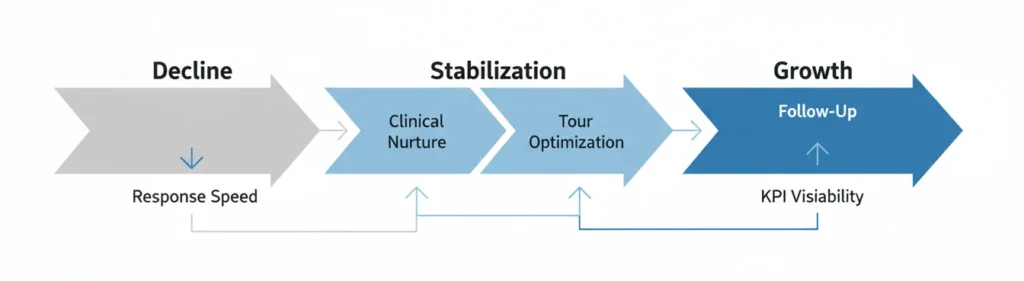
I’ve seen memory care communities drop to painfully low occupancy levels more times than I’d like. One 44-unit facility I consulted for in 2025 had fallen to 68% over 14 months. The owner was convinced the market had changed, and they were “just unlucky.” After auditing the full sales & admissions process, we found the problem was almost entirely internal: slow inquiry response, no structured clinical nurturing, inconsistent tour follow-up, and zero visibility into where leads were actually dying. We prioritized those four leaks first. No new ad spend. Seven months later, the community reached 89% occupancy and added 11 residents. The relief on the Executive Director’s face when we reviewed the new dashboard was unforgettable.
As of January 20, 2026, the senior living sector continues to benefit from strong fundamentals. NIC MAP Vision Q4 2025 preliminary indicators show overall senior housing occupancy stable at 88–89%, with memory care communities tracking slightly below but still gaining occupied units quarter over quarter. New memory care supply growth remains very limited (<1% annually in most primary markets), which means low-occupancy memory care communities have a realistic path to recovery if they fix the right internal issues first.
This guide is written specifically for Executive Directors, Owners/Operators, Regional Directors, and Sales Directors who need to execute memory care census recovery quickly and sustainably. We focus on the highest-leverage fixes first.
If your memory care occupancy has dropped and stayed down, schedule a free census recovery audit call — we’ll look at your current numbers and tell you exactly where to start.
Diagnosing the Real Cause of MC Census Decline
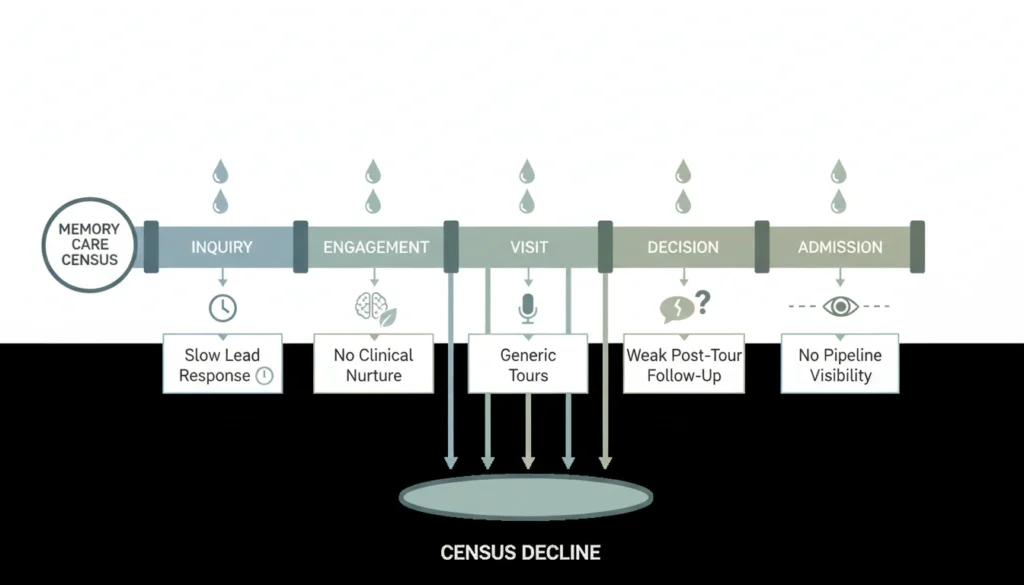
When occupancy falls and stays low, the cause is rarely “not enough leads.” More often, it’s one or more of these internal breakdowns:
- Lead response time > 60 minutes → families move on
- No structured, clinical nurture sequence → leads cool during 60–120 day decision window
- Tours that feel generic or amenity-focused → fail to build clinical trust
- Weak or inconsistent post-tour follow-up → momentum dies
- No weekly pipeline visibility → leaks compound unnoticed
In memory care, each of these issues is amplified because families are under emotional stress and require repeated reassurance.
Priority #1 – Slash Lead Response Time
The single fastest lever for memory care turnaround strategy is response speed.
Industry data consistently shows:
- Response <30 minutes → tour booking probability 300–400% higher than 1–2 hours
- Response >4 hours → recovery rate usually <15%
Immediate action steps:
- Implement instant SMS + email auto-confirmation
- Route clinical inquiries directly to the nursing/clinical director
- Use dynamic templates with the referral source name and basic need acknowledgment
Many operators see 30–50% more tours within 60 days after fixing this one issue.
Priority #2 – Build Clinical Nurturing That Lasts 90+ Days
Memory care families need education and reassurance over months, not days.
Recommended long-cycle nurture framework:
- Minute 0–30 — Instant SMS + email from Clinical Director
- Hour 1 — Value email: “Understanding the 7 Stages of Dementia & Care Needs.”
- Day 1 — Personalized video message (2–3 minutes max)
- Day 3 — Downloadable guide: “Safety & Security in Memory Care Environments.”
- Day 7 — SMS + calendar link for consultation
- Day 14 — Testimonial from a similar referral source
- Day 30–90 — Monthly clinical updates + gentle check-ins
This sequence reduces early-stage drop-off by 40–60% in most memory care communities I’ve advised.
For automation basics that apply directly to memory care, see how automation improves the memory care census.

Priority #3 – Transform Tours Into Clinical Consultations
Tours must feel like medical consultations, not property tours.
High-conversion memory care tour elements:
- Clinical staff present from minute one
- Start with family concerns and medical history
- Demonstrate dementia-specific safety features first
- Show real individualized care plans and daily routines
- End with clear next steps and immediate follow-up commitment
Operators who shift to this model often see tour-to-move-in rates rise 15–25 points.
For proven tour frameworks, review improving memory care tour-to-move-in conversion.
Priority #4 – Immediate & Structured Post-Tour Follow-Up
Post-tour momentum is critical in memory care.
Standard protocol that works:
- Recap + customized care plan proposal sent within 60 minutes
- 24–48 hour structured follow-up call
- Automated 7–10 day nurture touches with clinical answers
- Monthly check-in cadence for warm leads
This single change frequently adds 5–10 points to conversion rates.
Priority #5 – Weekly KPIs & Reporting That Prevent Future Declines
You cannot fix what you cannot see.
Essential weekly memory care dashboard KPIs:
| KPI | Target (Strong Performer) | Red Flag | Why It Matters |
| Lead Response Time | <30 minutes | >60 minutes | Drives tour volume |
| Lead-to-Tour Conversion | 30–45% | <20% | Pipeline health |
| Tour-to-Move-In Rate | 35–50% | <25% | Revenue impact |
| Move-Ins per Month (per site) | 2–4 (30–40 unit community) | <1 | Occupancy velocity |
| Active Referral Sources | 8–12 high-quality | <5 | Lead quality |
| Cost per Move-In | <$3,500 | >$5,000 | Marketing ROI |
Review these weekly. Act immediately when any KPI turns red.
For pipeline visibility fundamentals, see Building a Predictable Assisted Living Sales Pipeline.
Integrating Recovery Tactics Into a Full Census System
The fastest and most sustainable memory care census recovery comes from an integrated framework:
- Lead Generation — High-quality B2B sources → see memory care lead generation that produces qualified move-ins
- Follow-Up Automation — Long-cycle clinical sequences → explore how automation improves memory care census
- CRM & Pipeline — Memory care-specific stages → read crm systems built for memory care sales teams
- Tour & Close — Clinical-first approach → check improving memory care tour-to-move-in conversion
- Overall Strategy — Census-first mindset → learn from memory care census growth strategies
At Alchemical Marketing, we help memory care operators build exactly these integrated census systems. In one recent engagement, a 48-unit facility went from 66% to 91% occupancy in nine months — adding 14 residents and ~$1.3 million in annualized revenue. The team finally had both visibility and control.
Discover how we approach memory care recovery on the Alchemical Marketing homepage or explore our full range of services.
Ready to start your memory care census recovery? Secure your free recovery strategy session.
Common Pitfalls During Memory Care Census Recovery
From real operator turnarounds:
- Trying to fix everything at once creates paralysis
- Adding more lead volume before fixing leaks — amplifies waste
- Ignoring clinical messaging — families stay unconvinced
- No weekly KPI discipline — small problems become big ones
- Giving up too early — most meaningful lifts take 4–9 months
Prioritize ruthlessly: response time → nurture → tours → visibility.
Your Next Move After Occupancy Drops
With senior living occupancy stable around 88–89% into 2026 and memory care demand continuing to outpace new supply, operators who execute focused memory care census recovery can close the gap quickly.
If your memory care community is below benchmark, don’t accept it as the new normal. Schedule a complimentary census recovery call today — we’ll review your current state and give you clear, prioritized first steps.
Here’s to turning the corner and rebuilding strong occupancy in 2026.
Frequently Asked Questions
How quickly can memory care census realistically recover?
Initial gains (5–10% lift) often appear in 60–120 days after fixing response time and nurturing. Full stabilization (15–25%+) typically takes 6–9 months of consistent execution.
What is the single biggest lever for reversing the MC census decline?
Lead response time under 30 minutes. It can increase tour bookings 300%+ and sets the foundation for everything else.
Should we keep spending on marketing during recovery?
Not aggressively. First plug the internal leaks (response, nurture, follow-up). Once conversion improves, then scale quality leads sources.
How much revenue can memory care census recovery generate?
At average monthly rates of $8,000–$10,000 per resident, recovering from 70% to 90% occupancy in a 40-unit community can add 8–10 residents—$768,000–$1.2M+ annually.
What’s the most common mistake during memory care turnaround?
Trying to fix everything simultaneously instead of prioritizing ruthlessly. Start with response time and nurture — measure weekly — then expand.