
PPC Management for Small Businesses: How to Get More From Your Ad Budget
PPC is one of the best ways to put a small business in front of someone who is searching for what they actually sell. But getting the click is only the beginning.
Strong PPC management should connect paid traffic to business results. It means choosing the right keywords for the right searches, controlling where budget goes, tracking the right conversions, improving ads and landing pages, and deciding what deserves more or less spend. That broader performance mindset is central to Alchemical Marketing.
Still deciding whether paid search makes sense for your business? Start with our full Google Ads guide, Google Ads for Small Business: How They Work, What They Cost, and When They’re Worth It.
If you already know you want help managing campaigns, see our feel free to schedule a call with our team for a FREE Google Ads strategy session.
The goal of PPC management is not to produce the most clicks. It is to produce more of the right business outcomes at an acquisition cost the business can support.
What Is PPC Management?
TABLE OF CONTENTS
PPC management is the ongoing process of having an agency plan, run, measure & improving pay-per-click campaigns. This is typically done for Google or Microsoft Ads
That includes much more than launching ads. A well-managed account may involve:
- keyword research
- search-term reviews
- negative keyword strategies
- campaign & ad group structure
- bidding & budget decisions
- ad testing
- audience & location targeting
- conversion tracking
- landing page review
- lead quality analysis
- performance reporting
Semrush describes PPC management as the work of overseeing campaign strategy, targeting, bidding, ads, landing pages, tracking & optimization.
Google Ads documentation reinforces the same idea from the perspective of the platform: performance depends on ongoing decisions around targeting, search terms, conversions, bidding, budgets & campaign quality.
What Is PPC Campaign Management?
Campaign management is the hands on part of that process. It focuses on the individual campaigns running inside an ad platform built and structured based on your goals.
A campaign manager is not just checking whether ads are live. They are asking questions such as:
- Which searches are actually triggering the ads?
- Which terms are producing qualified leads?
- Which locations are wasting budget?
- Which ads are converting?
- Are conversions being tracked correctly?
- Is the landing page helping or hurting performance?
- Should budget move from one campaign to another?
The difference between setting up PPC & managing PPC is the difference between launching a campaign & systematically improving it.
What Does a PPC Manager Do?
A PPC manager is responsible for keeping campaign decisions connected to business goals.
That can include building campaigns, reviewing search terms, adjusting bids & budgets, monitoring conversion data, testing ads, checking landing pages, reviewing lead quality & reporting what is changing and why.
The best PPC managers do not stop at platform metrics. A click can be cheap & still not attain your goals. A lead can be inexpensive & still be a bad quality. A campaign can show a strong conversion rate but generate leads that never become customers.
That is why good PPC management keeps moving closer to business outcomes.
A PPC manager is not paid to keep campaigns running. They are paid to analyze & decide what should keep running, what deserves more budget & what should stop costing you money.
How Do You Manage PPC Campaigns Effectively?
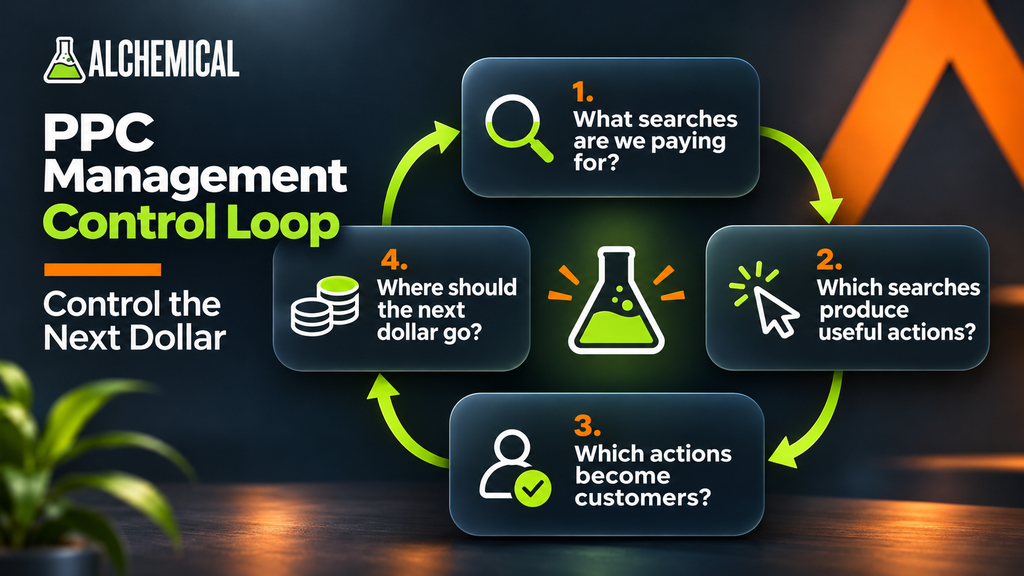
Effective PPC management starts with control. The account should be able to answer four basic questions:
- What searches are we paying for?
- Which of those searches produce useful actions?
- Which actions become qualified opportunities or customers?
- Where should the next dollar go?
If those answers are unclear, increasing spend is usually a bad move.
How Do You Do Keyword Research for PPC?
PPC keyword research should identify searches that are highly relevant to your business, high purchase or informational intent & have a reasonable cost per click.
Start with the way potential customers describe the problem or service, then evaluate the intent behind those searches. Someone searching “how much does roof repair cost” may be researching. Someone searching “roof repair company near me” is much closer to hiring.
Both searches may be relevant, but they should not automatically be valued the same way. Depending on your budget, you might be wasting money on terms with the wrong intent.
Google Keyword Planner is a free wat that can help advertisers estimate search demand and costs. Ahrefs recommends evaluating PPC keywords by factors such as intent, CPC, traffic potential & how closely the search connects to a business outcome.
The keyword list is only the starting point. Once campaigns are live, the search terms report becomes one of the most important management tools in the account. What is a search term you ask?
Search Terms and Negative Keywords
A keyword is what you choose to target. A search term is what the person actually typed into the search. Those are not always the same thing. Google, Microsoft and LLM AI matches your keyword to searches they feel are relevant.
For example, a business targeting a phrase around “home care” may trigger a search from someone looking for “home care jobs near me.” The words overlap. The intent obviously does not.
Google’s search terms report shows the actual searches that triggered ads. Those searches can reveal new opportunities, but they also reveal waste. Negative keywords help prevent ads from appearing for searches that are not a fit.
The goal is not to block every imperfect query. It is to stop repeatedly paying for intent the business cannot convert.
Track Conversions Before You Optimize
Optimization depends on the conversion signals you give the ad platform.
If a campaign treats a button click, a completed form & a qualified booked consultation equally then you can see how that might not produce the best results. The optimization system does not understand the difference unless you build that distinction into tracking.
Google Ads allows advertisers to separate primary conversion actions used for optimization from secondary actions used for observation. It also allows you to set campaign specific goals.
For a lead-generation business, better conversion signals may include:
- completed forms
- meaningful phone calls
- booked consultations
- qualified leads
- closed customers
The closer the measurement gets to real business outcomes, the more useful campaign decisions become.
The same logic applies after the click. If the campaign is attracting the right people but the page is losing them, that is a website or landing-page problem, not a reason to keep buying more traffic. Our guide to building a small business website explains how the conversion path should support the traffic you are paying for.
How Do You Optimize PPC Campaigns?
PPC optimization is the ongoing process of improving campaign performance based on data. That usually means finding what is working, finding what is wasting money, and changing the account accordingly.
Common optimization areas include:
- search terms
- negative keywords
- match types
- bidding
- budgets
- ads
- locations
- devices
- schedules
- landing pages
- conversion tracking
- lead quality
Google recommends evaluating campaigns around the conversion goals that matter to the business rather than judging success only by clicks.
How Do You Improve PPC Performance?
Improving PPC performance does not always mean increasing the budget. Sometimes the biggest gains come from reducing waste.
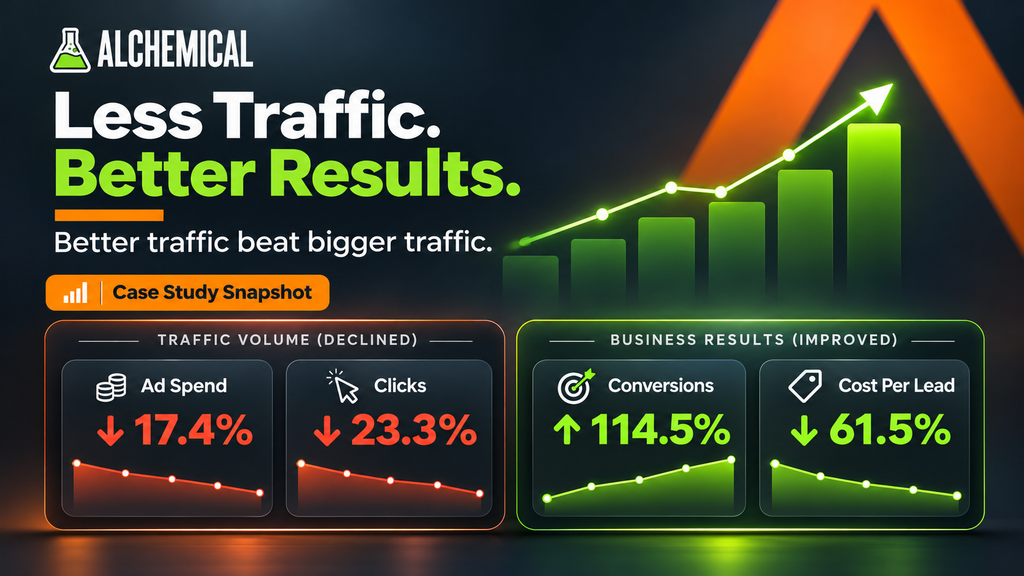
Our Unisson Groupe case study is a good example. Ad spend fell 17.4% and clicks fell 23.3%, while conversions increased 114.5% and cost per lead dropped 61.5%. Better PPC performance came from making the traffic more productive, not simply buying more of it.
Campaign A produces 20 leads at $40 each, for $800 in lead cost. Campaign B produces 10 leads at $65 each, for $650 in lead cost. If Campaign A closes two customers and Campaign B closes four, Campaign B has the more expensive lead but the better business result.
That is why cost per lead should not be treated as the finish line.
Useful PPC performance metrics can include:
- cost per qualified lead
- conversion rate
- customer acquisition cost
- lead-to-customer close rate
- revenue from paid search
- return on ad spend where appropriate
CTR, CPC, impressions, and raw conversion volume still matter as diagnostic metrics. They simply should not be confused with the final business outcome.
How Should Small Businesses Set a PPC Budget?
A useful PPC budget starts with business economics, not with a random monthly number.
Google recommends setting budgets according to campaign goals and what the advertiser is comfortable spending. That is the platform-level starting point. The business-level calculation should go deeper.
A practical way to work backward is:
customer value → acceptable customer acquisition cost → lead-to-customer close rate → allowable cost per lead → landing-page conversion rate → estimated cost per click → required budget
Suppose a customer is worth $2,000 in gross profit and the business is comfortable spending $400 to acquire one. If one out of every four qualified leads becomes a customer, the business can theoretically support up to $100 per qualified lead before other costs are considered.
That does not mean the campaign should aim to spend the maximum. It gives the business a financial boundary for decision-making.
How Do You Calculate a PPC Budget?
Estimate how much traffic is required to generate the number of leads or sales you need.
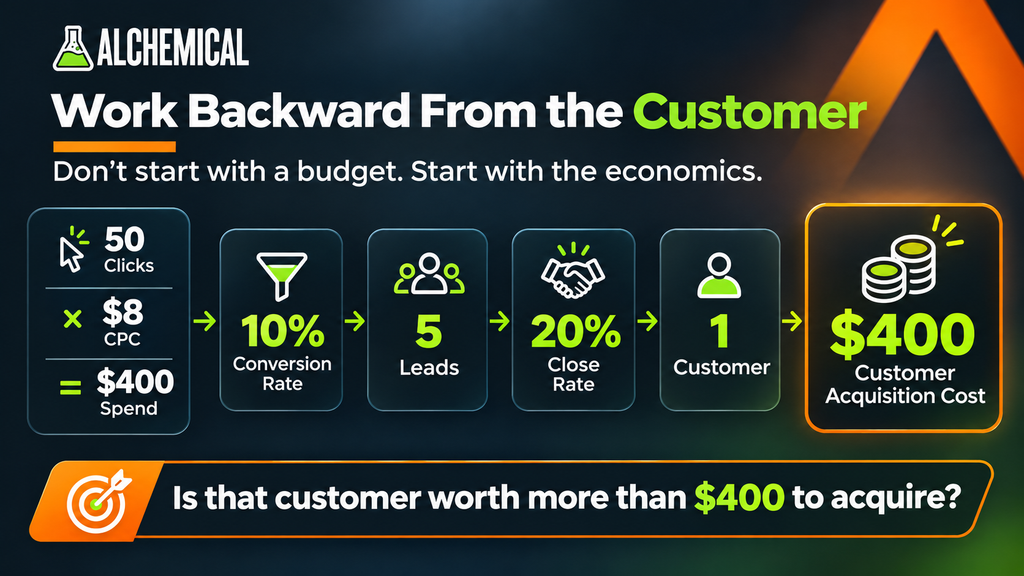
For example, 50 paid clicks at a 10% landing-page conversion rate produces five leads. If each click costs $8, that traffic costs $400. If one of those five leads becomes a customer, the acquisition cost is $400.
The real question is whether that $400 customer acquisition cost works for the business. Small-business PPC budgeting should therefore connect traffic assumptions with conversion rates, close rates, and customer value.
How Can Small Businesses Maximize a Limited PPC Budget?
When budget is limited, focus matters more.
Small businesses can usually stretch PPC budgets further by:
- prioritizing searches with stronger commercial intent
- reviewing search terms frequently
- using negative keywords to reduce obvious waste
- limiting geography to the markets that matter
- sending traffic to relevant landing pages
- tracking meaningful conversions
- moving budget toward campaigns producing better qualified outcomes
- avoiding unnecessary fragmentation across too many campaigns or platforms
A small business does not need to win every auction. It needs to win enough of the right auctions.
Earth Love Cleaning shows what that can look like in practice. After tightening campaign structure, search intent, and conversion focus, clicks fell 45.2% and ad spend fell 21.8%, while conversions increased 96.8% and cost per lead dropped 60.3%.
Can Small Businesses Manage PPC Themselves?
Yes. Some small businesses can successfully manage their own PPC campaigns.
DIY management can make sense when the account is simple, ad spend is limited, the owner or team understands the platform, conversion tracking is reliable, and someone has time to review the account consistently.
The question is not whether PPC can technically be run in-house. The question is whether doing so is the best use of the team’s time and whether the person managing it can make reliable decisions.
Semrush notes the tradeoff clearly: in-house management can avoid agency fees, while outsourced PPC management can add specialized expertise and reduce the internal time required to manage campaigns.
For some businesses, DIY is completely reasonable. For others, the cost of poor tracking, irrelevant traffic, weak landing pages, or slow optimization can exceed the cost of professional management.
What Should You Expect From a PPC Management Agency?
A PPC management agency should be able to explain what it is doing, why it is doing it, and how those decisions connect to the business.
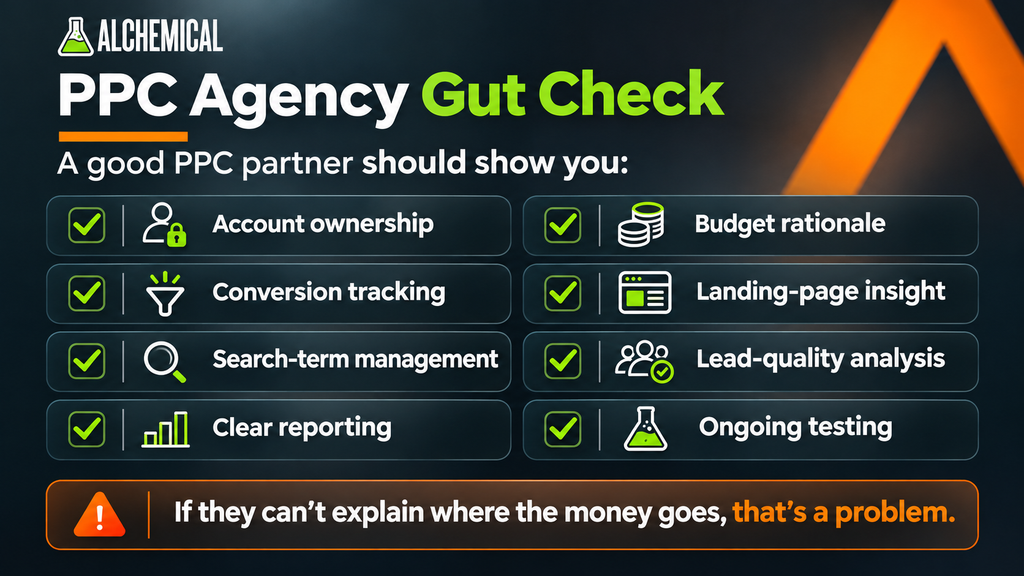
At minimum, expect visibility into:
- campaign strategy
- keyword and search-term management
- negative keywords
- bidding and budgets
- ad testing
- conversion tracking
- landing-page recommendations
- lead quality
- performance reporting
- ongoing optimization
You should also be able to understand where the budget is going. A useful report should not simply say impressions increased or CTR improved.
It should help answer:
- How many meaningful conversions did we generate?
- What did they cost?
- Which campaigns produced them?
- Which searches are wasting money?
- What did we change this month?
- What are we testing next?
- Are leads becoming real customers?
Transparency is part of the service.
If a report makes the account look busy but cannot tell you what produced a qualified lead, it is not doing much for the business.
What Questions Should You Ask a PPC Management Company?
Before hiring a PPC management company, ask questions that reveal how it actually manages performance.
- How will you measure qualified leads and sales, not just clicks?
- How often do you review search terms and negative keywords?
- How do you decide which campaigns or keywords receive more budget?
- Who owns the Google Ads account?
- How do you evaluate landing-page performance?
- How will you connect ad performance with lead quality?
- What happens when performance declines?
- What will your reports actually show?
- How often do you make optimization decisions?
- What access will I have to my campaigns and data?
A strong agency should be able to answer these clearly without hiding behind technical jargon.
How Much Does PPC Management Cost?
PPC management pricing varies because account complexity, ad spend, number of campaigns, channels, tracking requirements, and service scope all vary.
Common pricing models include:
- flat monthly management fee
- percentage of ad spend
- tiered retainer
- hybrid pricing
- performance-based structures in some cases
The management fee and the advertising budget are separate costs. If a business spends $3,000 with Google and pays an agency $1,000 to manage the campaigns, the total monthly investment is $4,000.
Clutch pricing data shows that PPC agencies use a wide range of hourly, monthly, and project-based pricing structures. Semrush similarly identifies flat-fee, percentage-of-spend, and performance-based management models.
Price should be evaluated against scope. A lower management fee may be appropriate for a simple account. A more complex account that includes landing-page work, CRM tracking, call tracking, conversion setup, multiple markets, or several ad platforms may require more management.
The important question is not simply “What does PPC management cost?” It is “What work is included, and can I measure whether that work improves the economics of customer acquisition?”
How Do You Choose the Right PPC Agency?
A good PPC agency should make the account easier to understand, not harder.
Search Engine Land recommends evaluating agencies around their experience, methodology, transparency, reporting, pricing, onboarding process, and ability to explain how they will approach the account.
For a small business, useful evaluation criteria include:
- clear ownership of the ad account
- transparent reporting
- reliable conversion tracking
- a defined optimization process
- experience with lead quality, not just lead volume
- landing-page awareness
- clear communication
- realistic expectations
- evidence from actual campaign results
Be cautious when an agency promises guaranteed results, refuses account access, reports only on vanity metrics, or cannot explain how it will connect advertising to business outcomes.
When Should a Small Business Hire a PPC Management Agency?
A small business should consider professional PPC management when paid search has become important enough that poor decisions are expensive.
Common signs include:
- ad spend is growing
- lead quality is inconsistent
- conversion tracking is unclear
- cost per lead is rising
- search terms are not being reviewed
- campaigns are becoming more complex
- no one internally has time to manage the account
- the business cannot tell which campaigns produce customers
- the website and landing pages need to be evaluated alongside the ads
The strongest reason to hire an agency is not that PPC is complicated. It is that the business has enough opportunity at stake to justify specialized management.
PPC Management Should Make the Business More Efficient
Good PPC management does not try to make every number inside Google Ads look impressive. It tries to make paid acquisition more useful to the business.
That means buying the right traffic, eliminating unnecessary waste, improving conversion paths, measuring lead quality, and moving budget toward the campaigns most likely to produce profitable customers.
If you want help reviewing your current paid-search setup, budget, tracking, landing pages, and biggest areas of waste, schedule a meeting with Alchemical Marketing.
Frequently Asked Questions
Does PPC Work for Small Businesses?
Yes. PPC can work for small businesses when there is enough relevant search demand, customer value can support the acquisition cost, the conversion path works, and campaigns are actively managed. A smaller budget increases the importance of focusing spend on the searches and audiences most likely to produce qualified customers.
Is PPC or SEO Better for a Small Business?
Neither is automatically better. PPC can capture existing search demand quickly but requires ongoing ad spend. SEO can build compounding organic visibility over time but usually takes longer. Many businesses use PPC for immediate demand capture and SEO for longer-term visibility.
If you are weighing the two, our small business SEO guide explains what SEO is designed to do and where it fits alongside paid search.
What Are the Benefits of PPC Advertising for Small Businesses?
PPC can provide fast visibility, precise targeting, measurable results, and control over where budget is allocated. It can be especially useful when potential customers already search for the product or service and the business can track whether those clicks become qualified leads or sales.
What Is the Best PPC Bidding Strategy for Small Businesses?
There is no single best bidding strategy for every small business. The right approach depends on campaign goals, conversion volume, tracking quality, available data, and budget. Automated conversion-based bidding can work well when reliable conversion data exists, while newer or lower-volume campaigns may need tighter control as they build useful data.
Sources
- Google Ads Help: Search terms report
- Google Ads Help: About conversion goals
- Google Ads Help: Average daily budgets
- Google Ads Help: Improve campaign performance
- Semrush: PPC Management
- Ahrefs: PPC Keyword Research
- Search Engine Land: How to find the right PPC agency
- Search Engine Land: PPC management checklist
- Clutch: PPC Agency Pricing