
TABLE OF CONTENTS

A senior living sales system is the operational backbone that turns qualified inquiries into predictable move-ins and stable occupancy. I once helped a 12-community operator in 2025 who had strong lead flow but wildly inconsistent results – some sites hit 90% occupancy while others languished at 72%. The problem was no unified sales systems for senior living – each location used different CRMs, follow-up cadences, and tour scripts. We built a single integrated system with standardized CRM workflows, automated admissions handoffs, clinical tour playbooks, and portfolio reporting. Eleven months later, portfolio average occupancy reached 89%, the lowest site climbed to 85%, and annualized revenue increased by roughly $7.8 million. The corporate team finally had repeatability instead of constant guesswork.
Senior living fundamentals are very favorable. NIC MAP Vision Q4 2025 preliminary indicators show overall occupancy stable at 88–89%, with both assisted living and memory care communities continuing to add occupied units despite limited new supply (<1% annual growth in most primary markets). Operators who build scalable sales systems – not just more leads – capture the biggest share of this demand.
This guide is written specifically for Executive Directors, Owners/Operators, Regional Directors, and Sales Directors who want senior living sales systems that deliver consistent move-ins and occupancy growth – not random spikes.
If your sales process feels inconsistent or occupancy results are unpredictable, schedule a free sales system review call – we’ll map your current workflow and show you the highest-impact fixes.
The Six Core Elements of a Scalable Sales System
Every high-performing sales systems senior living has these six interlocking elements:
- Lead Qualification & Scoring Filter early to focus on high-intent prospects (referral source, acuity fit, decision-maker role).
- Multi-Channel Automation Workflows Instant response + long-cycle nurturing (60–180 days) that feels personal while being perfectly consistent.
- CRM Workflows & Pipeline Stages Clear, segment-specific stages with automated task creation and velocity tracking.
- Clinical Tour & Admissions Systems Standardized playbooks and digital handoffs that reduce friction and build trust.
- Reporting & KPIs Weekly dashboards showing pipeline health, cost per move-in, and occupancy projections.
- Continuous Optimization: Monthly best-practice sharing, quarterly audits, and rapid testing.
These elements create a repeatable engine that scales across one or many communities.
Lead Qualification: The Gatekeeper of Sales Efficiency
Poor lead quality kills even the best sales system. Start with strict qualifications.
Common scoring criteria operators use:
- Referred by neurologist/geriatrician/hospital (+40 points)
- Specific clinical need mentioned (wandering, sundowning) (+25 points)
- Decision-maker is adult child + medical POA (+20 points)
- Responds to first nurture touch within 48 hours (+15 points)
Score >70 = fast-track to clinical call. Score <40 = long nurture drip only.
This simple step cuts wasted time by 50–70%.
For lead quality tactics, see improving assisted living lead quality, not just volume, and memory care lead generation, qualified move-ins.
Multi-Channel Automation Workflows
Automation keeps long-cycle leads alive without burning out staff.
Recommended 90–180 day sequence structure:
- Minute 0–30 – Instant SMS + email confirmation
- Hour 1 – Value email: clinical guide or safety overview
- Day 1 – Personalized video message from Clinical Director
- Day 3 – Downloadable resource (dementia stages, behavior support)
- Day 7 – SMS + calendar link for consultation
- Day 14 – Testimonial from a similar referral source
- Day 30–90 – Bi-weekly clinical content drops
- Day 90–180 – Monthly check-in + success story
This automation reduces early drop-off by 40–60% and increases tour bookings significantly.
For practical examples, see how automation improves memory care census and assisted living marketing automation drives move-ins.
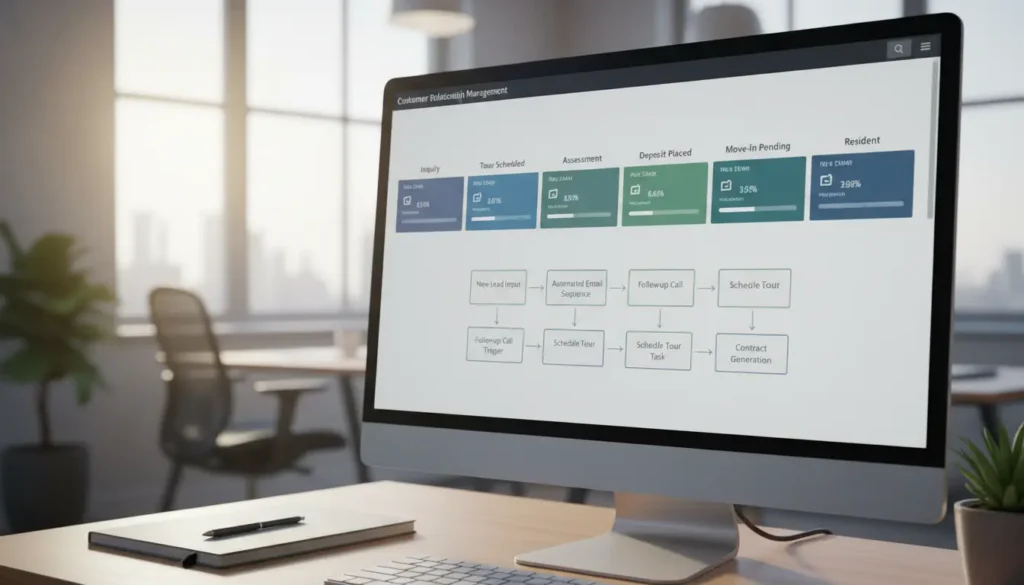
CRM Workflows & Admissions Systems
A strong CRM is the nervous system of the sales system.
Must-have features:
- Custom stages (Inquiry → Clinical Qualification → Tour → Proposal → Move-In)
- Automated task creation (follow-ups, reminders)
- Lead scoring & tagging
- Digital admissions portals (e-signatures, document upload)
- Seamless handoff from sales to clinical/ops
Operators with this setup see move-in delays drop 30–50%.
For memory care-specific CRM setup, see crm systems built for memory care sales teams.
Tour & Move-In Optimization
Tours and admissions are where revenue is won or lost.
High-conversion elements:
- Clinical staff present from the start
- Focus on safety, behavior management, care plans first
- Immediate post-tour recap + customized proposal (within 60 minutes)
- Dedicated move-in coordinator for paperwork & transition
- Automated reminders for documentation & assessments
This reduces ghosting and speeds move-ins.
For tour strategies, see improving memory care tour-to-move-in conversion and optimizing the memory care move-in process for higher conversions.
Reporting & KPIs That Drive Continuous Improvement
You cannot improve what you cannot measure.
Essential weekly KPIs:
- Lead-to-tour conversion
- Tour-to-move-in rate
- Cost per move-in by source
- Move-ins per community vs target
- Pipeline coverage ratio
- Acuity-adjusted occupancy projection (90 days)
Monthly portfolio review meetings focus on these metrics and test one improvement at a time.
For forecasting and reporting fundamentals, see forecasting memory care census, better planning.

Portfolio & Multi-Site Scaling Systems
For operators with multiple communities, add these layers:
- Centralized clinical brand & messaging
- Regional referral development
- Portfolio dashboard with segment filters
- Monthly best-practice sharing across sites
- Quarterly portfolio rebalancing
This creates scalability without chaos.
For multi-site principles, see marketing assisted living across multiple communities and scaling memory care marketing across multiple communities.
How Alchemical Marketing Builds These Sales Systems
We specialize in designing and implementing senior living sales systems that scale occupancy for assisted living and memory care operators. Our frameworks integrate all six components above – with special attention to memory care’s longer cycles and clinical needs.
In one recent engagement, a 15-community operator went from a portfolio average 80% to 89% occupancy in 12 months – adding over $9.5 million in annualized revenue. The corporate team gained full visibility while local sites retained enough flexibility to win in their markets.
Learn more about our tailored approach on the Alchemical Marketing homepage or explore our full range of services.
Ready to build or upgrade your senior living sales system? Secure your free system design consultation.
Common Implementation Mistakes to Avoid
From real operator rollouts:
- Trying to do everything at once creates paralysis
- Skipping standardization leads to inconsistent results
- Ignoring weekly KPI discipline – problems compound
- Over-customizing locally – dilutes chain equity
- No scenario planning – blindsided by downside
Start with response time + nurture – measure weekly – expand.
Your Next Step Toward Predictable Occupancy
With senior living occupancy stable around 88–89% in early 2026 and demand still outpacing supply, operators who implement true senior living sales systems will achieve the most sustainable occupancy gains.
If your current sales process feels reactive or move-ins are unpredictable, schedule a complimentary sales system review today – we’ll map your current state and give you clear, prioritized next steps.
Here’s to more predictable move-ins, stronger occupancy, and healthier operations in 2026.
Frequently Asked Questions
What’s the single biggest component of a senior living sales system?
Automation – specifically fast, multi-channel follow-up. It’s the engine that keeps long-cycle leads alive and prevents early drop-off.
How long does it take to build and see results from a full sales system?
Initial gains (5–10% occupancy lift) often appear in 4–6 months. Full stabilization and 15–25% portfolio gains are common within 9–15 months.
Can one sales system work for both assisted living and memory care?
Yes – with separate nurture cadences, clinical messaging, and pipeline stages. One dashboard with segment filters works best.
How much revenue can a well-implemented sales system add?
For a 50-unit portfolio at a $7,500/month average rate, moving from 80% to 90% occupancy adds 5 residents per site – ~$4.5 million annualized.
What’s the most common mistake when building a sales system?
Trying to fix everything simultaneously instead of prioritizing ruthlessly. Start with response time and nurture – measure weekly – then expand.