
TABLE OF CONTENTS

Senior living marketing works best when it’s built for operators – not for families. I learned this early when I helped a 9-community chain in 2025 that was spending heavily on consumer ads (“assisted living near me”). They got lots of inquiries, but move-ins stayed flat at 6–8 per quarter. Families were shopping early and dropping off. We flipped the strategy to B2B senior living marketing: targeted professional referrals, clinical authority content, operator-focused SEO, and automated nurture sequences. Within eight months, qualified leads dropped 40% in volume, but move-ins rose 65%, portfolio occupancy climbed from 78% to 89%, and annualized revenue increased by ~$4.9 million. The corporate team finally stopped chasing volume and started winning the right move-ins.
Senior living demand remains strong. NIC MAP Vision Q4 2025 preliminary indicators show overall occupancy stable at 88–89%, with both assisted living and memory care communities adding occupied units despite very limited new supply growth (<1% annually in most primary markets). In this environment, operator-focused marketing that prioritizes lead quality, clinical trust, and sales efficiency delivers far better ROI than broad consumer campaigns.
This guide is written specifically for Executive Directors, Owners/Operators, Regional Directors, and Sales Directors who want a true senior living operator marketing approach – one that fills beds predictably and profitably.
If your current marketing feels scattered or produces too many unqualified inquiries, schedule a free operator marketing audit call – we’ll review your sources, messaging, and ROI and show you the fastest path to better results.
The Operator-First Mindset for Senior Living Marketing
Traditional senior living marketing targets families searching for care. That produces volume – but low intent and high drop-off. An operator marketing mindset flips the priority:
- Target decision-makers who control move-ins (referral sources, discharge planners, physicians)
- Focus on clinical authority and trust – not lifestyle amenities
- Measure success by move-ins and occupancy lift – not clicks or leads
- Build long-cycle systems (90–180 days) – not quick closes
- Prioritize ROI – cost per move-in, not cost per lead
In 2026, with occupancy already high, operators who adopt this approach achieve the strongest census gains.
Core Elements of a High-ROI Operator Marketing Strategy
A strong B2B senior living marketing strategy has five interlocking elements:
- Professional Referral Networks Primary source of high-conversion leads (35–55% close rate).
- Operator-Focused SEO & Content Rank for professional terms (“memory care referral network,” “assisted living occupancy solutions”).
- Clinical Messaging & Authority: Every touchpoint reinforces safety, dementia expertise, and staff training.
- Automation & Long-Cycle Nurturing Multi-channel sequences that keep leads warm over 90–180 days.
- Pipeline & ROI Tracking Weekly KPIs: qualified lead rate, cost per move-in, occupancy velocity.
These elements create a system that scales occupancy without wasting budget.
For multi-site scaling principles, see marketing assisted living across multiple communities and scaling memory care marketing across multiple communities.
Building Professional Referral Networks
Professional referrals remain the highest-converting source in senior living.
High-impact tactics operators use:
- Quarterly clinical education lunches for discharge planners
- Easy referral portals with direct clinical handoff
- Co-branded materials for neurologists and geriatricians
- Referral incentives tied to successful move-ins
- Regular follow-up with top referrers (thank-you notes, outcome reports)
Operators who actively manage 8–12 strong referral relationships often get 50–70% of move-ins from them.

Operator-Focused SEO & Content Strategy
Operator-focused SEO targets professionals – not families.
High-ranking keywords in 2026:
- “memory care referral network”
- “assisted living operator marketing”
- “dementia care placement support”
- “senior living occupancy solutions”
- “regional memory care partnerships”
Content assets that work:
- “2026 Guide to Dementia Care Referral Best Practices”
- “How to Evaluate Memory Care Communities for Clinical Fit”
- “Occupancy Growth Playbook for Senior Living Operators”
These assets build authority and generate inbound leads from decision-makers.
For lead quality tactics, see improving assisted living lead quality not just volume.
Clinical Messaging & Authority Building
Every piece of communication must answer: “Can this community safely care for my patient/resident?”
Core messaging pillars operators use:
- “100% staff trained in Teepa Snow Positive Approach®”
- “Secure environments with 24/7 wander management”
- “Individualized behavior support plans updated weekly”
- “Dedicated clinical liaison for families & referrers”
- “Average length of stay 32 months – 18 months above industry average”
Use these consistently across the website, collateral, referral materials, and nurture sequences.
For clinical-first tour strategies, see improving memory care tour-to-move-in conversion.
Automation & Long-Cycle Nurturing
Automation keeps leads warm over 90–180 days without manual overload.
Recommended sequence structure:
- Minute 0–30 – Instant SMS + email confirmation
- Hour 1 – Value email: clinical guide
- Day 1 – Personalized video from Clinical Director
- Day 3 – Downloadable safety resource
- Day 7 – SMS + calendar link
- Day 14 – Testimonial from referral source
- Day 30–90 – Bi-weekly clinical content
- Day 90–180 – Monthly check-in
This lifts response rates 2–3× and increases conversion.
For automation examples, see how automation improves memory care census and assisted living marketing automation drives move-ins.
Pipeline, CRM & ROI Tracking
A strong pipeline + CRM turns leads into measurable move-ins.
Must-have elements:
- Custom stages (Inquiry → Clinical Qualification → Tour → Proposal → Move-In)
- Lead scoring based on referral source and engagement
- Automated task creation and reminders
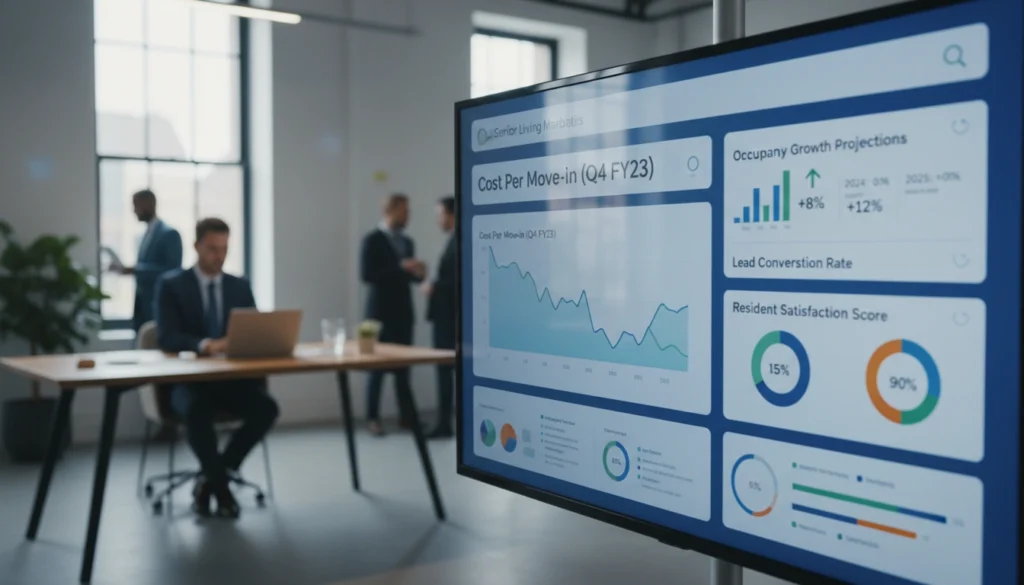
- Weekly dashboard: qualified lead rate, cost per move-in, occupancy velocity
These metrics prove ROI and guide continuous improvement.
For CRM setup, see crm systems built for memory care sales teams.
Common Mistakes in Operator-Focused Senior Living Marketing
From real operator engagements:
- Chasing consumer volume – low intent, high drop-off
- Generic messaging – misses clinical trust needs
- No lead scoring – wastes time on unqualified prospects
- Short nurture cycles – families need 90–180 days
- Focusing on clicks – ignores move-in ROI
Fix one mistake at a time – measure weekly – repeat.
Integrating Everything Into a Full Census Growth System
Operator marketing feeds the broader system:
- Lead Generation – Quality sources → see memory care lead generation qualified move-ins
- Automation – Consistent nurturing → explore how automation improves memory care census
- Pipeline – Clear stages → read building a predictable assisted living sales pipeline
- Tour & Move-In – Clinical focus → check improving memory care tour-to-move-in conversion
- Forecasting – Accurate projections → learn from forecasting memory care census better planning
At Alchemical Marketing, we build these integrated systems for senior living operators. One 16-community operator went from a portfolio average 80% to 89% occupancy in 12 months, adding over $9.5 million in revenue.
Discover how we approach operator marketing on the Alchemical Marketing homepage or explore our full range of services.
Ready to shift to operator-focused marketing that actually fills beds? Secure your free strategy session.
Your Next Step Toward Better Operator Marketing
With senior living occupancy stable around 88–89% in early 2026 and demand still outpacing supply, operators who master senior living operator marketing will capture the largest share of qualified move-ins.
If your current marketing produces too many low-intent inquiries or inconsistent results, schedule a complimentary operator marketing review today – we’ll assess your current approach and give you clear, prioritized next steps.
Here’s to more qualified leads, higher conversions, and stronger occupancy in 2026.
Frequently Asked Questions
What makes operator-focused senior living marketing different from consumer marketing?
Operator marketing targets referral sources and decision-makers (physicians, discharge planners) with clinical authority content – not families with lifestyle ads. It prioritizes quality and long-cycle nurturing over volume.
What’s the most important channel for operator marketing in senior living?
Professional referrals (neurologists, hospitals) – typically 50–70% of the highest-converting move-ins when relationships are actively managed.
How do you measure ROI on operator-focused marketing?
Track cost per qualified lead, cost per move-in, lead-to-tour conversion, and occupancy lift – not clicks or impressions. True success shows in census and revenue.
How long does it take to see results from shifting to operator marketing?
Initial improvements (better lead quality, higher conversion) often appear in 60–90 days. Significant occupancy lift (10–20%) typically takes 6–12 months.
Can one marketing system work for both assisted living and memory care?
Yes – with separate messaging (lifestyle vs clinical), nurture cadences, and lead sources. One dashboard with segment filters works best.